I drove to our mountain cabin a day early without telling a soul. The moment I walked in, I found a real estate agent inside, measuring the rooms like the place was already halfway sold. But what stopped me cold was seeing my own son-in-law giving her the tour, smiling as he showed off every corner of our home and planning to sell it behind my back. I didn’t raise my voice. I didn’t ask questions. I walked straight in, looked them both in the eye, and shut down their entire scheme on the spot.….
I drove to our mountain cabin a day early without telling a soul. The moment I walked in, I found a real estate agent inside, measuring the rooms like the place was already halfway sold. But what stopped me cold was seeing my own son-in-law giving her the tour, smiling as he showed off every corner of our home and planning to sell it behind my back. I didn’t raise my voice. I didn’t ask questions. I walked straight in, looked them both in the eye, and shut down their entire scheme on the spot.….
My name is Margaret Ellis, and until that morning, I believed betrayal was something that happened in other families, the kind of story people whispered about over coffee and shook their heads at before going back to their own lives. I was sixty-four years old, a retired high school counselor from Asheville, North Carolina, and I had spent nearly thirty years building a life with my husband, Robert. Our mountain cabin outside Boone was never just property to us. It was where our grandchildren learned to skip stones, where my daughter Caroline got engaged under a string of yellow porch lights, where Robert and I came whenever life in town felt too loud. Every beam, every floorboard, every creak in the stairs carried some piece of us.
We were not wealthy people. The cabin was the one thing we owned that felt like a legacy. After Robert’s heart surgery the year before, we had talked about putting the place into a trust so it would stay in the family. Caroline loved it as much as we did, or so I thought. Her husband, Jason, always acted a little too interested whenever property values came up, but I told myself that was just his way. He worked in commercial insurance, always calculating, always talking about “smart moves” and “equity.”
That Friday, I drove up to the cabin a day earlier than planned because Robert had come down with a bad cough and decided to stay home. I wanted to air out the place, stock the fridge, and enjoy one quiet evening alone before the rest of the family arrived for Easter weekend. It had rained the night before, and the gravel road was slick in places. The mountains were still wrapped in morning fog when I pulled into the driveway. At first, nothing seemed wrong, except for a silver SUV I didn’t recognize parked beside the porch.
I remember thinking maybe a neighbor had come by. Then I noticed the front door standing open.
I stepped out of the car and heard voices inside, low and casual, like people discussing furniture in a showroom. A woman laughed. A man answered. Jason.
I stood frozen for one sharp second, my overnight bag still in my hand. Then I walked to the porch and into my own cabin.
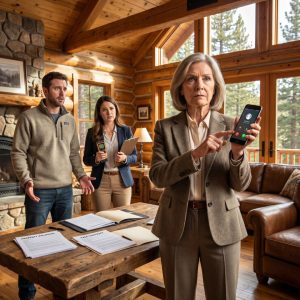
A blonde woman in a navy blazer stood in the living room with a laser measurer pointed toward the fireplace. Jason was beside her, smiling like a host. He had one hand tucked in his pocket and the other sweeping across the room.
“Original pine walls,” he was saying. “And the view out back is even better in winter.”
The woman turned first. Her smile vanished. Jason spun around so fast he nearly knocked into the coffee table.
For a heartbeat, nobody spoke.
I looked from the measuring device in her hand to the folder tucked under Jason’s arm. Then I saw papers spread across my dining table. A comparative market analysis. Recent sales. Estimated listing range. My chest tightened, not from confusion but from the terrible clarity of it. This was not curiosity. This was preparation.
Jason recovered first. “Margaret,” he said, forcing a laugh. “You weren’t supposed to come up until tomorrow.”
It was such a strange thing to say that I felt something inside me go perfectly still.
The agent cleared her throat. “Ma’am, I’m Denise Carter with Blue Ridge Premier Realty. There seems to be some misunderstanding.”
“No,” I said. “There isn’t.”
I set down my bag, walked straight to the table, and put my hand over the papers before Jason could reach them.
“Who gave you permission to be in my house?”
Jason’s jaw hardened. “Caroline said eventually this place would be hers anyway. We were just exploring options.”
“Exploring options?” I repeated.
He glanced at Denise, then back at me, and made the biggest mistake of his life.
“You and Robert can barely keep up with the property taxes now,” he said. “I’m trying to do what’s practical before this becomes a burden.”
I looked him in the eye, then pulled my phone from my purse and held it up.
“You have exactly ten seconds,” I said, “to explain why you’re trying to sell my cabin behind my back before I call the sheriff and report both of you for trespassing, fraud, and conspiracy.”
Part 2:
The silence that followed was so heavy I could hear the refrigerator humming in the kitchen.
Denise Carter was the first to move. She lowered the measuring device, stepped back from Jason, and raised both hands slightly, the way people do when they suddenly realize they’ve walked into something much worse than they were told. “Mrs. Ellis,” she said carefully, “I was informed by Mr. Whitaker that he was representing the family’s interests and had authority to discuss a future listing.”
“Future listing?” I said. “This property is deeded in my husband’s and my names. Jason’s name is nowhere near it. Neither is my daughter’s.”
Jason’s face changed then. The smooth confidence was gone. What remained was irritation, as though I had ruined a deal he thought he already owned. “Margaret, calm down,” he said. “Nobody sold anything. Nobody signed anything. We were trying to get ahead of the situation.”
“Get ahead of what situation?”
He exhaled through his nose. “Robert’s health. Your finances. The fact that Caroline will inherit this eventually. Someone has to think clearly.”
I stared at him. “You mean someone has to help themselves before the people actually alive have a say.”
His mouth tightened. “That’s not fair.”
“No,” I said, “what’s unfair is standing in my living room with a real estate agent while my husband is home sick and has no idea his son-in-law is measuring the walls.”
Denise took another step back and reached for her folder. “I think I should leave.”
“You should,” I said. “But first, I want your business card, your brokerage name, and every document you brought into this house.”
She handed them over immediately. To her credit, she did not argue. She gathered her papers from the table, except for the market report I kept under my hand. Jason moved toward me, but I held up my phone again.
“Do not come one step closer.”
He stopped.
I called the Watauga County Sheriff’s non-emergency line right there in front of them. I gave my name, the cabin address, and said I had found two unauthorized people inside my property, one of whom was a family member attempting to facilitate an unauthorized sale. I did not dramatize. I did not tremble. Years of handling panicked parents and angry teenagers as a counselor had taught me that the calmer you sound, the more seriously people listen.
When I hung up, Jason looked stunned. “You really called the police?”
“Yes.”
“For this?”
“For this,” I said.
Denise spoke in a low voice. “Mr. Whitaker, I asked you if all owners were aware of the conversation.”
Jason snapped, “I said it was a family property.”
“That is not the same thing,” she replied.
The knock came sooner than I expected. Two deputies arrived, and suddenly Jason was not the one giving tours anymore. He was standing near the fireplace answering questions with the defensive stiffness of a teenager caught lying badly. I showed the deputies my ID, the house keys, and digital copies of the deed from my phone. Denise gave them her card and explained that she had been contacted for a valuation walkthrough, not a signed listing appointment. One deputy asked Jason whether he had been given permission to enter. Jason said Caroline had let him borrow the spare key months earlier. That detail landed like a punch to my ribs.
Caroline had given him the key.
I had never handed it to him myself. I had trusted my daughter with access for emergencies, storms, frozen pipes. Instead, she had used that trust to let her husband bring a realtor into my home.
The deputies were professional but firm. Since no documents had been signed and no money had changed hands, they treated it as a trespass warning and documented the incident. Jason was instructed to leave immediately and not return without explicit permission from one of the deed holders. Denise all but fled to her SUV, apologizing twice before she backed down the drive.
Jason lingered on the porch. “You’re blowing this out of proportion,” he said under his breath. “Caroline was going to talk to you.”
“Then she can do it without you,” I said.
He gave me one last look, something between resentment and calculation, then walked away.
The moment his car disappeared, I locked the door, then locked the deadbolt, then sat down at the kitchen table where those papers had been spread. My hands finally began to shake. I called Robert first.
He went silent while I told him everything. Truly silent. Not disbelief. Not interruption. Just the kind of silence that comes when a person is rearranging the world in their head.
Then he said, very quietly, “Call Caroline.”
She answered on the fourth ring, cheerful at first. “Mom? You made it up there okay?”
I closed my eyes. “How long have you known Jason was trying to sell the cabin?”
There was a pause. A real one.
“Mom,” she said, and her voice changed, “it’s not like that.”
“Then tell me exactly what it is like.”
She started crying almost immediately, which would once have softened me. That day it did not. Between tears and excuses, the truth came out in pieces. Jason had been under financial pressure for months. Failed investments. Credit card debt. A business loan he had personally guaranteed for a friend who defaulted. Caroline said he had convinced her that if they could persuade us to sell now, while the market was strong, everyone would benefit. He told her we would end up thanking them for forcing a difficult decision.
“Persuade us?” I said. “He brought an agent into my house with a key you gave him.”
“I didn’t think he’d do it that fast,” she whispered.
I stood up so hard the chair scraped the floor. “You didn’t think? Caroline, he was shopping our home like we were already dead.”
She sobbed openly then, but I had nothing left to offer her.
By the time I hung up, my grief had turned into something colder and sharper than anger.
I went straight to the small fireproof box in the hall closet, took out every property document we had, and spread them across the bed.
That was when I noticed something missing.
The original folder containing our signed trust draft and a notarized copy of Robert’s power of attorney was gone.
Part 3:
For one long second, I simply stared at the empty space in the fireproof box, unable to breathe.
The missing folder had been there the last time I checked, sometime after Christmas. I remembered because Robert and I had reviewed the trust draft and decided to meet with our attorney in April to finalize a few terms. The power of attorney copy was there too, tucked behind the deed paperwork. Neither document would have allowed anyone to sell the cabin outright, but in the wrong hands, they could be used to create confusion, pressure, or the appearance of authority. And Jason was exactly the kind of man who believed confusion was a useful tool.
I called Robert back immediately. He confirmed he had not taken the folder. Then I called our attorney, Daniel Mercer, in Asheville. It was a Friday afternoon, and I half expected voicemail, but he answered. I explained everything in a clipped, steady voice. He did not waste words.
“Margaret, listen carefully,” he said. “Take photos of what is in the box and what appears to be missing. Change every lock. Document every call. I’m sending you the number of a local locksmith and I’ll draft a formal notice to your daughter and son-in-law instructing them not to represent themselves as having any authority over your property, finances, or estate planning. On Monday, we’ll revoke and reissue any sensitive documents if needed.”
“Can they do anything with those papers?”
“Not lawfully,” he said. “But people attempting something improper rarely start with lawful behavior.”
That was enough for me.
I photographed everything, then called the locksmith. While I waited, I searched the cabin room by room, opening drawers, checking cabinets, looking for anything else disturbed. In the upstairs guest room, I found the answer I had been dreading. Jason had not just come for a quick walkthrough. He had been planning. In the nightstand drawer was a yellow legal pad with handwritten notes: estimated sale price, projected proceeds, repair ideas to “increase appeal,” and a line that made my stomach turn: convince M + R this is best before medical bills hit.
M and R. Me and Robert.
He had reduced our lives to initials in a sales strategy.
I took photos of every page.
The locksmith arrived before dark and replaced every exterior lock on the cabin. I told him to rekey the storage shed too. After he left, I finally sat on the porch as the mountain air turned cold and blue around me. I should have felt safe then, but safety was no longer the issue. The cabin had not just been entered. Trust had been entered. And trust, once broken inside a family, never fits back together cleanly.
The next morning, Robert insisted on driving up despite his cough. When he walked through the front door and saw my face, he knew the worst part of the story was still ahead. I showed him the missing folder, Jason’s notes, the photographs, and the incident report number from the sheriff’s office. Robert, gentle Robert, who had spent decades calming me down, said only one sentence.
“They are not touching this house.”
At noon, Caroline arrived alone.
I almost didn’t open the door. But I did, because some reckonings should happen face-to-face. She looked exhausted, mascara smeared, shoulders collapsed inward. For a moment I saw the little girl who used to run through this cabin in socks, sliding across the hardwood floors. Then I remembered the spare key.
She started crying before she sat down. She said Jason had lied to her about how far things had gone. She said she knew he wanted us to sell eventually, but she had not known he had taken documents from the cabin. She said their finances were worse than I imagined and that he had become desperate, secretive, reckless. She admitted she had let him convince her that the cabin would only become a burden to us, that selling it early could “simplify the future.” Even as she repeated his language, she seemed ashamed of how hollow it sounded.
Robert listened without expression. Then he asked the question I could not bring myself to ask.
“Did you ever think of asking us?”
Caroline broke then. Not polite tears. Not defensive tears. The kind that come when a person hears their own failure spoken out loud. “No,” she whispered. “Because I knew you’d say no.”
There it was. Not misunderstanding. Not concern. Not love expressed badly. They had gone behind our backs because they knew exactly where we stood.
I told her Jason was no longer welcome on the property. Robert told her we were changing our estate plans. The cabin would be placed in a trust with strict protections, and if we chose to leave it to future generations, it would not pass through anyone who saw it as a payday. Caroline begged us not to cut her out. Robert, with more mercy than I felt, told her that inheritance was no longer the subject. Character was.
Two days later, Daniel confirmed what we suspected. Jason had taken the document folder, likely believing it would help pressure or manipulate us. After receiving the attorney’s notice and a separate warning from the sheriff tied to the trespass report, he returned it through his own lawyer, claiming it had been “accidentally removed with miscellaneous paperwork.” No one believed that, least of all Caroline, who moved into a short-term rental within the month and filed for separation by summer.
People ask me now whether I regret calling the sheriff on family. I do not.
Because that day was not about property values or paperwork or even a cabin in the mountains. It was the day I learned that staying calm can be more powerful than shouting, that clear boundaries can expose lies faster than emotion, and that sometimes the only way to save a home is to defend it from the people smiling inside it.
The cabin is still ours. The porch lights still glow at dusk. The deed is locked away, the trust is finalized, and the spare keys are gone.
And every time I unlock that front door, I remember the look on Jason’s face when he realized the woman he thought he could outmaneuver had arrived a day early and ended everything with one sentence:
“This house is not for sale.”