I WAS STANDING IN THE MIDDLE OF MY BROTHER’S ENGAGEMENT PARTY, WATCHING HIS FIANCÉE SMILE LIKE SHE OWNED EVERYTHING IN THE ROOM—INCLUDING MY FUTURE—WHEN I REALIZED THAT THE STORY THEY’D BEEN TELLING ABOUT ME MY ENTIRE LIFE WAS ABOUT TO COLLAPSE, AND NONE OF THEM EVEN KNEW IT YET…
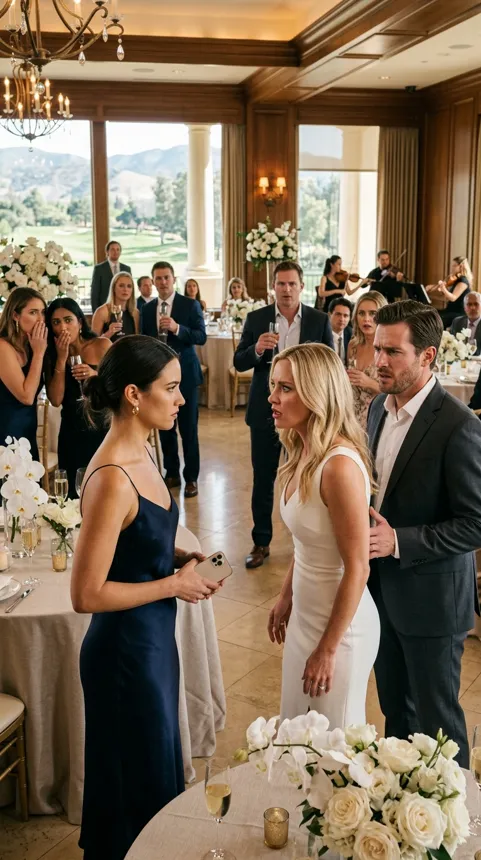
I was halfway through a $200-a-plate dinner when my brother’s fiancée raised her wine glass and laughed, “Who wants to be an accountant?”
The restaurant smelled like truffle butter and money.
It was the kind of place where the host wore a suit that fit better than most marriages, where the candles were real and the smiles were rented, where the waiters moved like quiet shadows and the menus didn’t include prices because the prices were the point. A soft jazz trio played somewhere behind a wall of potted palms, the notes drifting like perfume over linen and crystal.
My family loved places like this. They didn’t just eat here—they performed here.
Ryan sat at the center of the table the way he always did, as if the chair had been built for him. My brother’s smile was bright and easy, the kind that invited people to believe he was successful simply because he seemed like someone who should be. Jessica sat close to him, her hand resting on his forearm like a claim. Her engagement ring caught the candlelight and scattered it in tiny sharp flashes.
Across from them, my parents—Richard and Karen—leaned into the evening as if it were a spotlight. My father wore his country club laugh and his country club watch. My mother’s lipstick was the precise shade of “polished,” her hair the precise shade of “effortless,” her entire presence arranged to be admired from across a room.
And then there was me.
Sandra. Twenty-seven. The one with the sensible heels and the calm voice. The one who knew how to read a financial statement the way other people read moods. The one who always arrived on time and left quietly. Reliable. Predictable. Forgettable.
I’d learned early that there were families where everyone got to be a person, and there were families where everyone got a role. My family was the second kind, and my role had been assigned before I knew how to spell it.
Jessica lifted her wine glass, turning the stem between her fingers like she was twirling a thought into something sharp.
“I mean,” she said, her voice carrying just enough for the people at the next table to overhear, “who wants to be an accountant? It’s just so… dull.”
The laughter came fast.
Ryan laughed first, loud and pleased, because he was always pleased when the attention moved away from his own insecurities. My father chuckled with the indulgent sound he used when someone made a joke at the club. My mother laughed with her eyes, not her mouth, the way she laughed when she wanted to seem lighthearted without smudging her image.
Jessica smiled like she’d just made a point in court.
“She’s not wrong,” my father said, looking at me with the fondness reserved for pets and furniture. “Our Sandra has always been the cautious one.”
My mother reached for her water, the diamonds on her wrist catching the candlelight. “We just hope you meet a nice man someday,” she said, as if my life were an unfinished sentence. “Your job is stable. That’s… good.”
Stable. Good. Like a savings bond. Like a beige couch.
Jessica leaned forward, lowering her voice in that intimate way people use when they want to sound kind while they cut. “It’s actually kind of cute,” she said, “that you think your little spreadsheet macro is a real company.”
Her smile was polished. Practiced. She looked at me like she was waiting for the familiar outcome—for me to laugh and shrink and make room for her.
My fork hovered above my plate. The steak in front of me was perfectly cooked and tasted like nothing. The air felt thick, heavy with expectation.
I didn’t cry.
I didn’t react.
I set my fork down.
The sound was soft—metal against porcelain—but it landed like a blade. The table fell silent in a way that made the jazz trio suddenly too loud, as if every note was clearing its throat.
They were all waiting.
Waiting for me to do what I always did.
To smile. To apologize. To make myself small again.
Instead, I looked straight at Jessica.
Her face was flawless in the candlelight, her makeup blended into perfection, her confidence arranged like her hair—smooth, deliberate, unmoving.
“You’re talking about Auditly,” I said.
My voice didn’t tremble. It didn’t rise. It came out flat, calm, and that calmness did something to the room. It wasn’t drama. It wasn’t pleading. It was fact.
Jessica’s smile flickered—just a fraction, a glitch in the software of her expression.
She hadn’t expected me to know the name.
“Yes,” she said smoothly, recovering fast. “That charming little AI startup. Our fund is reviewing it. We’re planning to acquire it cheaply.”
She said cheaply the way someone might say gently. Like she was doing the world a favor.
“Really?” I asked.
Ryan shifted, already annoyed. He hated tension unless he was the one creating it.
Jessica gave a small laugh. “The founders don’t even understand what they—”
“You can’t buy it,” I said, cutting her off.
It was the first time in my life I’d cut anyone off at a family dinner.
Ryan’s jaw tightened. “Sandra, don’t do this. Don’t make things awkward.”
I didn’t look at him. My eyes stayed on Jessica.
“You can’t buy it,” I repeated, slower this time, as if the words needed to be placed carefully into the air so they would stick. “Because I own it.”
Silence swelled, heavy and round, pressing against the edges of the table.
Jessica blinked. My mother’s lips parted. My father’s hand froze around his glass. Ryan stared at me like I’d begun speaking another language.
“Auditly is mine,” I said. “I built it.”
It was strange to say it out loud, like opening a door I’d kept locked for years. Strange to see it reflected in their faces—not pride, not curiosity, but shock that I’d stepped out of character.
For a moment, no one moved. Then my father cleared his throat, the sound of a man trying to regain control of a room that was no longer listening.
“That’s… very nice, Sandra,” he said, as if I’d told him I’d taken up knitting.
Jessica’s eyes narrowed, the shine in them turning cold. “You’re joking,” she said, but her voice wasn’t as certain as her face tried to be.
I smiled, not kindly. “No.”
Ryan let out a laugh that didn’t fit, like a key scraping against the wrong lock. “Okay, okay. Sandra’s doing her thing. She likes attention. Can we—”
Jessica didn’t look at him. She looked at me, and in her gaze I saw something I hadn’t expected: calculation. Not disbelief—assessment. The way someone’s mind adjusts when new information threatens their plan.
My mother’s smile returned, tight and controlled. “Sweetheart,” she said gently, which in our family meant, please stop embarrassing us, “let’s not get into business talk tonight.”
Business talk. As if my life’s work were a rude subject.
I didn’t argue. I didn’t need to. I’d already said the sentence that couldn’t be unsaid. I lifted my napkin, dabbed my mouth, and watched Jessica take a slow sip of wine as if she could drink away the moment.
When I left the restaurant later, the air outside was cold and clean, smelling faintly of rain and city lights. The valet brought my car. Ryan called my name, but it sounded distant, like a shout from another room.
I drove home without music, without a podcast, without anything to fill the space.
The night pressed against the windshield. Streetlights slid across the hood like pale hands. My reflection in the rearview mirror looked like someone else—someone who had finally spoken and was waiting to see what it would cost.
I didn’t feel triumphant.
I felt tired. Not the normal tired of long days and spreadsheets and deadlines, but a deeper exhaustion that lived in my bones. The kind of tired that came from carrying yourself carefully for years so you wouldn’t tip over someone else’s fragile ego.
At a red light, I noticed my hands on the steering wheel. Steady. Calm. The hands of someone who spent her life finding patterns in chaos.
It struck me then, like a fact so obvious I couldn’t believe I’d missed it:
I hadn’t hidden my success because I was modest.
I’d hidden it because I was safe.
Because in my family, being small was protection. Being invisible meant you didn’t become a target, didn’t become a threat, didn’t become a disruption to the story they were all committed to telling.
The light turned green. I drove on.
By the time I pulled into the parking lot of my apartment building, my phone was already buzzing.
I sat in the dark car with the engine ticking softly, the silence broken only by the faint hum of the city and the small vibrating insistence of my screen.
The first message was from my mother.
Sandra, you humiliated Jessica tonight. I don’t know where you learned such tacky behavior. You need to call her and apologize immediately.
Tacky.
I stared at the word, as if it might rearrange itself into something more human.
A second message came in, this one from Ryan.
Are you out of your mind? You just ruined a huge opportunity. Jessica was helping me. What’s wrong with you? Why are you always jealous?
Jealous.
Another message, the words growing sharper as his anger climbed.
You ruin everything.
I scrolled, hoping—ridiculously—that somewhere in the flood of criticism there would be one simple question.
Is it true?
What is Auditly?
How did you do that?
Are you okay?
But there was nothing. Not one mention of my company. Not one word about the deal I’d quietly signed the week before. Not one flicker of interest in the thing that had taken over my nights for four years.
