“Let her go, we’re not paying for the surgery,” my father told the doctor while I was in a coma.He signed the “no resuscitation” order to save money.When I woke up,I didn’t say anything.I did something… much worse, which bankrupted him in just 24 hours.
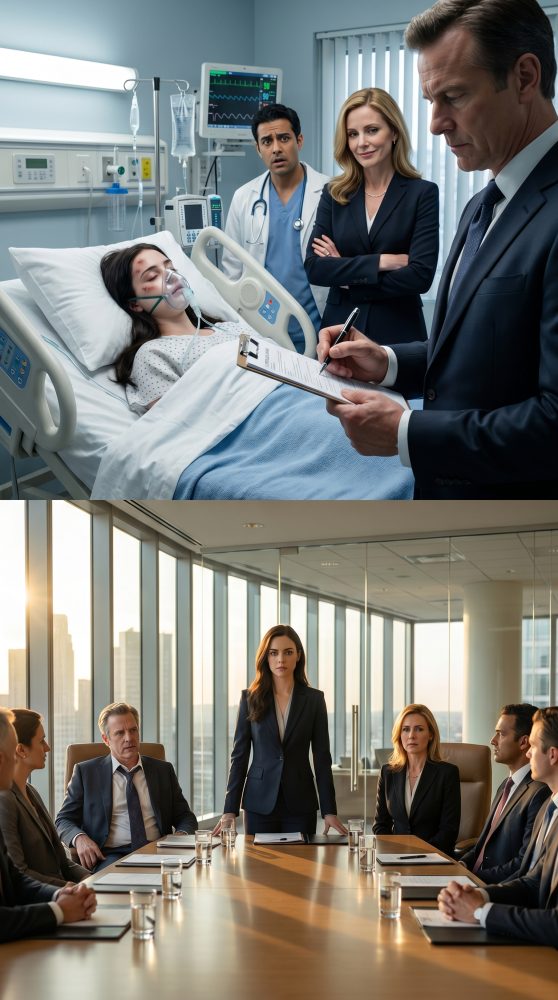
The first thing I heard was my father trying to save money with my life. The second was the doctor saying, in a low, exhausted voice, “Sir, if we stop now, she may not make it.”
I couldn’t open my eyes, couldn’t move, couldn’t even scream. But I heard him.
“Let her go,” my father said. Cold. Flat. Like he was canceling a dinner reservation. “We’re not paying for the surgery.”
A pause. Paper sliding across a clipboard.
Then the sentence that split my world in half.
“Sign the no-resuscitation order here.”
My father signed.
Even through the fog of the coma, I knew his voice. Victor Hale. Real estate developer. Local donor. Newspaper smile. Handshake like a camera flash. To the city, he was polished money. To me, he was a man who counted every human breath by the cost.
My stepmother, Celeste, was there too. Her perfume cut through antiseptic.
“She was always reckless,” she murmured. “Maybe this is fate.”
Reckless. That was what they called me after the crash. Not brilliant. Not exhausted. Not overworked. Not the woman who had quietly run half of my father’s empire while he drank bourbon and made speeches. Just reckless.
The doctor hesitated. “Your daughter is young. There’s still a strong chance—”
“She’s not my problem if she can’t survive it,” my father snapped. “I’m her next of kin. Do what the papers say.”
That was the moment I stopped being his daughter.
Hours later, a nurse named Marisol whispered near my bed, “If you can hear me, keep fighting.” Her fingers squeezed my hand. “Some people in this room don’t deserve your silence.”
I held on to that voice like a rope in black water.
When I woke up two days later, weak, stitched together, and burning with pain, my father arrived with flowers so expensive they looked offensive.
His smile was perfect. “Miracle girl.”
I stared at him.
Celeste leaned against the window, all silk and diamonds. “You gave everyone quite a scare.”
I said nothing.
My father sat by the bed and lowered his voice. “The doctors said you may be confused, so let me help. The company needs stability. I’ve already taken temporary control of your divisions. Just rest. Don’t worry your head over paperwork.”
There it was. Not relief. Not guilt. Business.
He thought the coma had erased me. He thought pain had made me harmless.
I let my eyes drift, let my voice come out hoarse and small. “Okay.”
His shoulders loosened.
That one word gave him permission to celebrate too early.
Because while Victor Hale had signed a paper to end my life, three months earlier I had signed papers of my own. Quietly. Legally. Irrevocably.
And the moment I could curl my fingers around a phone, I sent a single text to a man saved in my contacts under one word only:
Execute.
By the next morning, my father was glowing.
He swept into my hospital room in a navy suit, smelling of cologne and victory. “Good news,” he said. “The board agrees the company can’t wait for you to recover. I’ll be stepping in fully until further notice.”
“Of course,” I whispered.
Celeste smirked as she set a fruit basket on the table, untouched and theatrical. “Your father has sacrificed so much for this family.”
Family. That word almost made me laugh hard enough to split my stitches.
From my bed, I watched them perform kindness like actors hitting their marks. He asked if I needed anything. She adjusted my blanket for the nurse to see. They were careful now. Too careful. Predators who believed the prey was already dead always got sloppy around the blood.
Marisol came in after they left and checked my IV. “You want me to call the police?”
“No.”
Her brows drew together. “Then what are you going to do?”
I looked at the closed door. “Something billable.”
She blinked, then smiled despite herself.
My phone buzzed beneath the sheet. One message from Graham Reed, my attorney.
Done. Trigger confirmed. Temporary authority revoked. Protective clauses active. Are you sure you want full sequence?
I typed back with shaking fingers.
Every line.
Three months earlier, when I discovered irregular transfers in our development accounts, I hadn’t confronted my father. I had followed the money. Offshore shells. Inflated vendor contracts. Land purchases routed through Celeste’s brother. It was elegant in the way poison was elegant—clean, quiet, deniable.
They had been siphoning from Hale Urban Holdings for years.
The mistake they made was assuming I was just the dutiful daughter with spreadsheets and polite heels. They never realized I had rewritten the legal architecture of the company after Dad’s last tax investigation. He signed whatever I put in front of him then, grateful I’d kept him out of prison.
He never read the emergency governance amendment.
If any executive attempted to seize authority while the acting chief financial officer was incapacitated under suspicious circumstances, all discretionary accounts would freeze automatically, control would transfer to the independent trustee, and a forensic audit would launch across every subsidiary. I had built it for hostile investors.
I had simply never expected the hostile takeover to come from my own blood.
That afternoon, my father held a press conference outside the hospital.
“My daughter needs privacy,” he told reporters, hand over heart. “Our family asks for prayers.”
He looked noble on camera.
Seventeen minutes later, his corporate cards stopped working.
At first he thought it was a bank glitch. Then the payroll reserve locked. Then the lenders called. Then the board received notices from Reed & Vale Legal advising them that any attempt to move assets, alter signatures, or liquidate holdings would constitute obstruction in an active fraud review.
Graham called me directly. “He’s panicking.”
“Good.”
“There’s more. The hospital ethics office found the DNR form. He signed against your recorded medical directive.”
That made me sit up despite the pain. “My directive?”
“Yes. You filed one last year after the mountain rescue case. Full intervention. Explicitly no family override.”
I closed my eyes.
He hadn’t just tried to let me die.
He’d done it illegally.
By evening, my father stormed into my room without knocking, face red, tie loose, mask gone.
“What did you do?” he hissed.
I let the silence stretch.
Then I looked at him the way he had looked at that clipboard.
“Nothing,” I said softly. “Yet.”
For the first time in my life, Victor Hale looked afraid of me.
And he should have been.
Because bankruptcy was only the beginning
At 8:00 a.m. the next day, my father arrived at the trustee hearing with Celeste on his arm and fury in his throat.
At 8:07, he was still pretending this was a misunderstanding.
At 8:19, he realized it was an execution.
The hearing took place in a glass conference room downtown, high above the city he thought he owned. I shouldn’t have been there so soon after surgery, but rage can be better than anesthesia. Graham had arranged a wheelchair, a medical clearance, and a front-row seat.
When I entered, conversation died.
My father stared. “You came?”
“I wanted to hear you lie in person.”
Celeste’s expression hardened. “This is grotesque. You’re humiliating your own family.”
“No,” I said. “I’m identifying it.”
The independent trustee, Margaret Voss, opened the file. “We’ll proceed with the findings.”
She didn’t dramatize. She didn’t need to.
Wire transfers to shell companies. Forged approvals. Kickback contracts. Misuse of fiduciary authority. Attempted unlawful override of a patient’s medical directive while standing to gain immediate financial control. Every sentence landed like a hammer.
My father slammed both palms on the table. “This is her. She set me up.”
Margaret didn’t even blink. “Mr. Hale, most of these transactions predate your daughter’s accident by eighteen months.”
Celeste tried next. “She’s medicated. She’s unstable.”
Graham slid a folder across the table. “Here are the authenticated emails from your private account instructing your brother to move funds before the quarterly review.”
Celeste went white.
I watched them both with a calm so pure it felt holy.
My father turned to me, voice cracking into something uglier than anger. “You’d destroy your own father?”
I met his eyes. “You signed my death to save money.”
He opened his mouth, but Marisol stepped forward from the back wall.
I had asked her to attend.
Small. Quiet. Unshakable.
She handed Margaret a certified statement from the hospital, plus security audio from the ICU corridor. The room filled with my father’s own voice, unmistakable and cruel:
“Let her go. We’re not paying for the surgery.”
No one moved.
Then came the scratch of his pen on the DNR order.
Celeste whispered, “Victor…”
He looked around the room as if money might still save him. But power leaves a man differently when everyone watches it happen. It doesn’t explode. It drains.
At 10:42 a.m., the board voted unanimously to remove him.
At 11:15, the banks accelerated the personal guarantees tied to the frozen projects.
At 1:03 p.m., the state attorney’s office confirmed receipt of the fraud referral.
At 4:20 p.m., news outlets ran the story: Developer Ousted Amid Financial Misconduct and Daughter’s Medical Rights Scandal.
By nightfall, investors fled, creditors circled, and the empire he worshiped collapsed in on itself like a burned-out stage set. Twenty-four hours after he thought he’d inherited my silence, Victor Hale was functionally ruined.
Celeste left before the second week. She took what jewelry she could carry and filed statements blaming him for everything. Her brother was indicted by Friday. The mansion went on the market by spring.
Six months later, I stood on the rooftop terrace of our restored headquarters, the city glittering clean below me. The company survived. Leaner. Honest. Mine.
Marisol joined me with two cups of coffee. “Peaceful up here.”
“Expensive,” I said.
She laughed. “Worth it.”
I thought about my father in a rented apartment across town, fighting lawsuits he could no longer bury. About the newspapers that no longer used the word visionary. About how greed had made him sign away the only person who would have saved him.
The wind lifted my hair. The scars beneath my clothes pulled slightly when I breathed, but they no longer hurt.
I took the coffee, warm in my hands, and looked over everything he had tried to steal from me.
He had wanted me quiet.
Instead, I became the costliest decision of his life.