Three days after my mother’s funeral, her attorney told me I had inherited $47 million, three properties, and the Napa vineyard she built from nothing. I drove home through the hills thinking I finally had a future to protect — then I heard my new husband on the phone in our kitchen, saying, “She doesn’t suspect anything. Once I get access to those accounts, we’re set.”
I buried my first husband in March.
By June, I had buried my mother.
That is too much grief for one house to hold, even a house as large and beautiful as the one my mother built on the western slope above St. Helena, where the vineyard rows rolled down the hill in perfect green lines and the afternoon light made everything look forgiven.
People love to say Napa heals you.
They say it about the hills, the slow mornings, the smell of oak barrels and warm dust, the way fog lifts from the valley like a curtain being pulled from a stage.
But grief does not care where you live.
It sat beside me in the car on Highway 29.
It followed me through hospital corridors, into tasting rooms, past candlelit charity dinners, and down the gravel drive my mother had lined with olive trees twenty years before.
It was there when I opened the closet and saw David’s jackets still hanging in order.
It was there when I drove past the bend in the road where the accident happened.
It was there three days after my mother’s funeral, when her attorney told me I had inherited forty-seven million dollars, three properties, and Sullivan Vineyards.
And it was there that same evening when I stood halfway down my own back staircase and heard my new husband say into the phone, “She doesn’t suspect anything. Once I get access to those accounts, we’re set.”
For a few seconds, I honestly thought grief had finally broken my mind.
Because Garrett’s voice was calm.
Warm.
Almost amused.
The same voice that had whispered, “You don’t have to be strong with me,” while I cried into his shirt after my mother’s last treatment failed.
The same voice that had ordered soup when I forgot to eat.
The same voice that had stood at my mother’s graveside, one hand resting lightly on my back, looking like a man who belonged there.
I froze on the landing with my hand on the banister.
Below me, the kitchen was lit in soft gold. The old farmhouse sink gleamed beneath the window. My mother’s copper pots hung above the island, catching little pieces of light. Through the open French doors, I could hear water from the courtyard fountain.
Then a woman laughed outside.
Soft.
Low.
Familiar.
Too comfortable.
I knew that laugh before I let myself know it.
My sister Sienna.
I had already buried one husband that year.
David had been the kind of man who made life feel safer without ever announcing that he was doing it. He filled my gas tank if it dropped below half. He fixed loose cabinet handles before I noticed them. He called my mother every Sunday at 6:00 because he knew she pretended not to care and secretly waited all afternoon.
He was an ordinary man in all the ways that mattered most.
He had a bad habit of leaving receipts in his jeans pockets. He hated overpriced wine even though he married into a vineyard family. He could not keep basil alive in a pot to save his life. He snored when he was exhausted and denied it every time.
And he loved me in a way that made me feel easy to love.
When he died on Highway 29, something inside me did not simply break.
It emptied.
The accident happened on a gray morning after rain. David had driven into town to pick up a prescription for my mother and a part for the irrigation pump my vineyard manager had been complaining about. A delivery truck hydroplaned near the curve outside Oakville, crossed the center line, and hit him before he had time to swerve.
That was what the report said.
One sentence.
One wet road.
One delivery truck.
One life gone before lunch.
I remember standing at the side of the highway while a sheriff’s deputy asked me questions I could not understand. Vines stretched out behind him in neat winter rows, bare and brown and indifferent. Cars slowed as they passed, drivers looking just long enough to be ashamed of looking.
My mother was already sick then.
I did not tell her right away.
That was the first lie grief made me tell.
I sat beside her hospital bed that evening while she slept, my wedding ring pressed between both hands, and tried to imagine saying the words out loud.
David is gone.
Even in my head, they sounded impossible.
My mother woke before sunrise and saw my face.
She knew.
She had always known too much from too little.
“Eliza,” she whispered.
I broke then.
For the next three months, I stopped living in days and began living in tasks.
Pick up medication.
Call the funeral home.
Meet the insurance adjuster.
Drive to the hospital.
Sign the oncology discharge papers.
Email the vineyard manager.
Pay the seasonal crew.
Answer condolence texts.
Ignore the ones that said, Be strong.
At night, I drove through the Napa hills with grief sitting beside me like another passenger, heavy and silent, while my mother’s voice faded a little more each week.
Her name was Margaret Sullivan.
Most people in the valley knew her as Maggie, though no one called her that unless they had earned it. She built Sullivan Vineyards from nothing but stubbornness, borrowed money, and fifty acres nobody fashionable wanted back then because the soil was difficult and the road was bad.
She liked difficult soil.
“Easy ground makes lazy growers,” she used to say.
She started with six acres of Cabernet and a trailer office that smelled like printer ink and mouse traps. By the time I was in high school, Sullivan bottles were on restaurant lists in San Francisco, New York, Chicago, and Dallas. By the time I got married, my mother had expanded into two tasting rooms, a small production facility, and a private label people whispered about at charity auctions like it was a secret handshake.
But she never became soft.
She still walked the rows at dawn in old boots. She still knew which crew members had children in college. She still carried pruning shears in the pocket of her jacket even when she was too sick to use them.
The only thing she never managed well was Sienna.
My younger sister had my mother’s eyes and none of her discipline. She was beautiful in the fragile way that made people forgive her before she apologized. She moved through life like a storm that expected other people to call the damage weather.
When we were teenagers, Sienna was dramatic.
In her twenties, she became expensive.
In her thirties, she became frightening.
She never held a job long, but always had plans. Boutique wellness retreats. A jewelry line. A wine subscription app. A “healing brand” that sold ninety-dollar candles she forgot to ship. There were boyfriends, missed payments, tearful phone calls, and long stretches when my mother would say, “She’s trying,” as if trying were a lifetime profession.
Then came the pills.
Then the treatment centers.
Then the relapses nobody called relapses because my mother hated the word.
I loved my sister once with the blind devotion older sisters sometimes have before reality teaches them caution. I covered for her. Lent her money. Answered midnight calls. Picked her up from places I still do not talk about. I believed every “This time is different” until the sentence lost all shape.
My mother loved her too.
But unlike me, my mother eventually learned that love without boundaries can become a weapon pointed at everyone else.
That was why, three days after the funeral, Sienna’s face hardened in Harrison Whitfield’s office when he read the will.
Harrison’s office sat just off Main Street in St. Helena, upstairs from a boutique that sold linen dresses no one should wear near red wine. He had been my mother’s attorney for nearly thirty years. Thin, silver-haired, always in a navy suit even in August, he looked like a man who had been born knowing where the original document was filed.
The morning of the reading, the town outside his window looked offensively normal.
Tourists crossed the street holding coffee.
A delivery van idled near the curb.
Somewhere downstairs, a woman laughed about dinner reservations.
I sat at the conference table with Garrett on my left and Sienna across from me, her sunglasses still on though we were indoors. My mother’s chair was empty at the head of the table, and I kept looking at it like she might walk in late, annoyed at all of us for starting without her.
Garrett squeezed my hand under the table.
It should have comforted me.
Instead, even then, it felt like he was checking whether I was steady enough to sign something.
Harrison opened the folder.
He began with personal items.
My mother left her wedding band to me. Her first pair of pruning shears to our longtime vineyard manager, Tom Alvarez. Her collection of handwritten harvest journals to the winery archive. Her old yellow raincoat to Sienna, which made my sister flinch because we both knew why.
Sienna had worn that raincoat at seven years old, stomping through muddy rows behind our mother, swearing she would run the vineyard someday.
Then Harrison reached the financial portion.
His voice remained even.
The Sullivan Family Trust.
Forty-seven million dollars in liquid and investment assets.
The main vineyard estate in St. Helena.
The Carmel house overlooking the cypress trees.
A small commercial building in San Francisco my mother had bought decades earlier and never talked about.
Sullivan Vineyards itself.
The land.
The label.
The tasting room.
The contracts.
The legacy.
All of it came to me.
I did not feel rich.
That is the part people never understand about inheriting money after death. The numbers do not feel like freedom at first. They feel like weight. Every dollar sounded like my mother asking me to protect something she could no longer touch.
Across the table, Sienna slowly removed her sunglasses.
“What about me?” she asked.
Harrison turned a page.
“Sienna receives an annual distribution through a restricted wellness and housing trust. The trust provides for medical care, approved housing, treatment costs, basic living expenses, and education or employment support. Full discretionary access is suspended until completion of the recovery program outlined in the trust documents, followed by a review period of twenty-four months.”
Sienna stared at him.
“You’re joking.”
“No.”
“My mother left me an allowance?”
Garrett’s thumb moved lightly over my knuckles.
Too gently.
Too carefully.
“Sienna,” I said softly.
“Don’t.” She pointed at me. “Don’t use that voice.”
Harrison continued.
“Your mother wrote a letter explaining her reasons.”
“I don’t want her reasons.”
But she did.
I could see it.
Under the anger, under the humiliation, she wanted someone to say it was not true. That our mother had not finally drawn the line.
Harrison slid a sealed envelope toward her.
Sienna did not touch it.
Garrett leaned forward.
“Harrison, there must be some flexibility here. Margaret loved both her daughters.”
Harrison looked at him for one quiet second.
“She did.”
That was all he said.
The meeting ended badly.
Sienna shoved back her chair, grabbed the envelope, and walked out without looking at me. Garrett stood immediately.
“I’ll make sure she’s okay,” he said.
I looked up at him.
“You don’t have to.”
“She’s upset. It’s been a hard week for everyone.”
Everyone.
That word bothered me.
But grief makes you slow. It makes your instincts feel muffled, like they are speaking from another room.
So I nodded.
Garrett kissed the top of my head and followed my sister out.
I stayed behind with Harrison.
For the first time all morning, his professional expression slipped.
“Eliza,” he said quietly, “your mother was worried about people close to you.”
My chest tightened.
“What people?”
He glanced toward the closed door.
Then back at me.
“I need you to come back tomorrow morning.”
“Why?”
“Because there is something your mother instructed me to show you privately.”
“Show me now.”
“I can’t.”
“Harrison.”
“Eliza, I gave her my word. Tomorrow morning. Alone.”
I stared at him.
The office felt suddenly too warm.
“Was she worried about Sienna?”
He did not answer.
“Garrett?”
His silence was worse than any yes.
I drove home with those words turning over in my head.
Come back tomorrow morning.
Alone.
The road climbed through hills my mother had loved more than any house she ever owned. Vines ran along both sides in green, disciplined rows. The late afternoon sun softened the valley into gold. Tourists in rental cars slowed near the vineyard entrance to take photos of the sign.
Sullivan Vineyards.
My mother’s name.
My inheritance.
My responsibility.
When I turned onto the gravel drive, the house looked peaceful enough to hurt.
The old white farmhouse sat above the vines, renovated but not ruined, with wide porches, black shutters, and wisteria climbing the posts near the courtyard. The tasting room windows glowed down the hill. Olive trees moved softly in the warm breeze.
Nothing ugly should have been able to happen in a place like that.
But beautiful places are not innocent.
They only make betrayal look better lit.
I parked near the side entrance.
The house was quiet when I stepped inside.
Too quiet for a house that had held mourners for days.
My heels made soft sounds on the old oak floor. I set my bag on the bench near the mudroom and started toward the back stairs, planning to change before dinner.
Then I heard Garrett’s voice.
Low.
Relaxed.
Coming from the kitchen below.
“It’s done,” he said.
I stopped.
There was a pause.
Then he laughed softly.
“No, she doesn’t suspect anything.”
My hand closed around the banister.
“She’s exhausted. She’ll do whatever sounds like protection.”
The hallway blurred.
I stood perfectly still.
Garrett continued.
“Margaret left everything to Eliza. All of it. The vineyard, the trust, the properties. Sienna is restricted, but that may actually help us.”
Us.
Outside, near the courtyard fountain, a woman laughed.
Sienna.
I knew it in my bones.
Garrett lowered his voice further, but the kitchen carried sound in strange ways.
“Once I get access to those accounts, we’re set. She already trusts me. I can get added as financial power of attorney, maybe co-trustee if we frame it right. She’s grieving. She doesn’t want to manage all this.”
A pause.
Then:
“No. Don’t push tonight. You’ll scare her. Let me handle Eliza.”
Let me handle Eliza.
My body went cold.
I had married him six weeks earlier.
Six weeks.
A courthouse ceremony in Napa with two witnesses, one small bouquet, and me telling myself life was short. I had told myself David would not want me to stay lonely forever. I had told myself my mother would want someone standing beside me when she was gone. I had told myself love did not always arrive on a perfect schedule.
The truth was uglier.
Loneliness had made me mistake smoothness for safety.
Garrett had entered my life during the quietest, weakest season I had ever known. He appeared first at a donor reception for the hospital foundation, then at the winery, then at the funeral home after David died. He knew how to bring coffee before I asked. How to speak softly to doctors. How to put one hand at the small of my back just when the room felt too large.
He never rushed at first.
That was the genius of him.
He made himself useful before he made himself necessary.
Then my mother’s illness worsened, and he became constant.
When he asked me to marry him, he did it in the vineyard at dusk, with the hills purple behind him and tears in his eyes.
“I know the timing is not what anyone expected,” he said. “But I don’t want you facing all this alone.”
I had cried.
Not because I was in love the way I had loved David.
Because I was tired of standing upright by myself.
I said yes.
Now, halfway down my own staircase, I took my phone from my pocket, opened the recorder, and pressed the red button.
Then I stood there without breathing while my husband discussed my mother’s legacy like it was inventory.
“Sienna has to stay angry,” Garrett said. “If she looks too cooperative, Eliza may start connecting dots. Let her play wounded for a while.”
My sister said something I could not hear.
Garrett laughed.
“Because you are wounded, sweetheart. That’s why this works.”
Sweetheart.
He had called me that that morning.
I nearly dropped the phone.
Sienna’s voice floated in from outside.
“What if Harrison tells her?”
“He won’t. Attorneys are predictable. They scare people slowly. By the time he gets through all his little warnings, I’ll already be in the accounts.”
The recorder picked up everything.
Every word.
Every pause.
Every soft, familiar laugh.
I did not confront them.
That was the first smart thing I did.
The old Eliza — the one David loved, the one my mother trusted, the one who believed people became honest if you looked hurt enough — would have walked into that kitchen shaking and demanded the truth.
But the woman standing on the stairs had buried too much.
She had learned that not every wound deserved an immediate sound.
I backed up slowly.
Step by step.
Then I went upstairs, locked the bedroom door, and sat on the edge of the bed I had shared with Garrett for forty-two nights.
Forty-two nights beside a stranger.
I sent the recording to myself, then to a cloud folder David had once set up for household documents because he was the kind of man who labeled everything.
Then I called Harrison.
He answered on the first ring.
“Eliza?”
“I heard him.”
Silence.
“What did you hear?”
“Garrett. On the phone. With Sienna, I think. He said once he gets access to the accounts, they’re set.”
Harrison said something under his breath I had never heard from him before.
Then his voice sharpened.
“Do not confront him.”
“I didn’t.”
“Good. Listen carefully. Sleep behind a locked door if you can. If you feel unsafe, leave the house and go to Tom Alvarez’s cottage.”
“Do you think he would hurt me?”
Another silence.
“Eliza, I think your mother did not scare easily. And she was scared.”
I looked toward the bedroom door.
Downstairs, the house was quiet again.
“Come at eight tomorrow morning,” Harrison said. “Use the side entrance. Tell no one.”
I did not sleep.
Garrett came upstairs at ten-thirty.
He knocked softly.
“Eliza?”
I was already in bed, still wearing my clothes beneath the covers.
I had left the lamp on.
He opened the door with the same concerned face he had worn at two funerals.
“There you are. I was looking for you.”
“I had a headache.”
His eyes moved over me.
For one second, I wondered if he could see the recording on my face.
Then he smiled.
“Of course you do. Today was a lot.”
He came closer and sat on the edge of the bed.
I forced myself not to flinch when he touched my hair.
“Harrison can be overwhelming,” he said. “All those legal terms. Your mother should have made things simpler for you.”
I looked at him.
“She trusted Harrison.”
“Yes, but Harrison is old-school. He’ll make you feel like you have to manage everything alone. You don’t.”
His thumb moved gently along my wrist.
“There are documents we can prepare. Nothing dramatic. Just practical. So I can help talk to banks, coordinate with the trustees, take some pressure off.”
The man wasted no time.
I heard Sienna’s laugh again in my memory.
Let me handle Eliza.
I closed my eyes.
“Can we talk about it later?”
“Of course.”
He leaned down and kissed my forehead.
“You don’t have to make decisions right now.”
That was the second lie.
He wanted me to make decisions immediately.
He just wanted them to feel like relief instead of surrender.
The next morning, I left before Garrett woke.
I drove into St. Helena with both hands on the wheel and the recording backed up in three places.
Harrison’s assistant let me through the side entrance.
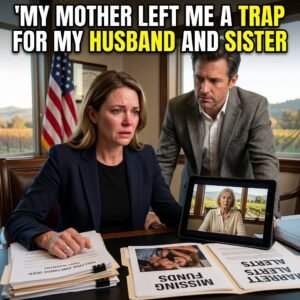
The office smelled like coffee and old paper. The blinds were half closed. Harrison stood when I entered, locked the door behind me, and placed a black tablet on the desk.
He did not begin with small talk.
“Your mother recorded this eleven days before she died.”
My knees weakened.
“Was she lucid?”
“Completely.”
He touched the screen.
My mother’s face appeared.
For a moment, I forgot everything else.
She was sitting in her bedroom, propped against pillows, wearing a blue cardigan over a white nightgown. Her hair was thinner than it had been, her face sharper, but her eyes were clear. The old fire was there, banked low but not out.
“Eliza,” she said on the screen, “if Harrison is showing you this, then I am gone, and I was right to worry.”
I pressed my fingers against my mouth.
Harrison looked away, giving me privacy.
My mother continued.
“I need you to listen without defending anyone. Especially me. I failed you in ways I did not understand until I got sick enough to stop managing everyone’s feelings.”
A tear slid down my cheek.
“I knew Garrett was wrong for you before you married him,” she said. “I should have said it plainly. I tried, then I softened it because you looked so tired, and I was afraid of taking away the one person you believed was holding you up.”
The screen blurred.
“But men like Garrett do not hold. They attach.”
I almost made a sound.
My mother took a breath.
“After David died, Garrett began asking questions no new friend should ask. Not about your heart. About account structures. Insurance. Whether David left you anything. Whether Sullivan Vineyards would pass to you or be divided. He asked Sienna similar questions, though I suspect he used different language with her.”
Harrison slid a small box of tissues toward me.
I did not take one.
I could not move.
“At first, I thought he was simply opportunistic. Then I learned he and Sienna had known each other before he met you.”
My blood went cold.
My mother’s voice remained steady.
“They met at a wellness retreat in Ojai last year. She never told you. He never told you. I have copies of messages. I have dates. I have proof they were communicating before he entered your life.”
Sienna.
My own sister.
The woman laughing by the fountain.
My mother looked straight into the camera.
“I do not know whether Sienna believes she is using Garrett, or whether Garrett is using Sienna. Perhaps both. That is often how weak people do damage. They mistake a shared appetite for loyalty.”
That sounded so much like my mother that grief cut through the fear.
“I have placed your inheritance in structures they cannot reach without your cooperation, and I have made that cooperation difficult by design. You may be angry at me for the restrictions. Be angry. Alive and angry is better than trusting and destroyed.”
I let out a broken laugh through tears.
Only my mother could sound bossy from beyond the grave.
The video continued.
“Harrison has a sealed packet with evidence. Messages between Sienna and Garrett. A copy of a private loan agreement connected to Garrett’s development company. Notes from my investigator. Garrett is in financial trouble, Eliza. Worse than he admits. Sienna is too. They both need money. And because you are grieving, they believe you are the easiest door.”
I thought of Garrett’s hand on my back at the funeral.
His coffee.
His soft voice.
His proposal in the vineyard.
The room seemed to tilt.
Then my mother’s expression changed.
It softened.
This was the part that nearly broke me.
“I know you loved David. I loved him too. He was the son I did not have and the husband I prayed you would find. I am sorry I could not protect him from that road. I am sorry I am leaving you so soon after him. But I can still protect what comes after.”
She leaned closer to the camera.
“Do not give Garrett access. Do not add him to accounts. Do not let him become co-trustee. Do not sign a power of attorney. Do not let anyone tell you that a good wife proves love with paperwork.”
My mother paused.
“And Eliza, if you discover I am right, do not confront them alone. Let the documents speak first. People who live by manipulation hate paper. Paper remembers.”
The video ended.
For several seconds, I heard nothing but my own breathing.
Then Harrison placed a thick envelope on the desk.
“Your mother hired a private investigator six weeks before she died,” he said. “Everything she referenced is here.”
I stared at the envelope.
“Did she know I married him?”
“Yes.”
“Why didn’t she stop me?”
Harrison’s face softened with pain.
“She tried to ask you to delay. You told her life was short.”
I closed my eyes.
I remembered.
My mother in bed, thin and tired, saying, “Are you sure about Garrett?”
Me, exhausted and defensive, saying, “Please don’t take this from me too.”
The shame of it burned.
Harrison leaned forward.
“Eliza, listen to me. Your mother did not blame you.”
“I should have listened.”
“You were drowning. Garrett found you in deep water and sold you a rope he planned to tighten later. That is not love. That is strategy.”
I looked down at my hands.
“What do we do?”
Harrison’s posture changed.
The old attorney returned.
“First, we protect you. Second, we let Garrett reveal his next move. Third, if Sienna is involved beyond the messages we have, we document it. Your recording from last night helps. A lot.”
“What about the vineyard?”
“Already protected. Your mother anticipated a spouse-access attempt. Sullivan Vineyards is held in trust with an independent board transition for eighteen months. You control the direction, but no spouse can acquire authority through marriage.”
“And the accounts?”
“Locked behind trustee review. Large transfers require dual authorization. No new power of attorney can access principal without court review.”
I laughed once, empty and stunned.
“She built a fence around me.”
“She built several.”
For the first time since hearing Garrett in the kitchen, I could breathe.
Not deeply.
But enough.
When I returned to the vineyard that afternoon, Garrett was waiting on the porch.
He wore a pale blue shirt, sleeves rolled, the picture of concerned husbandhood. Behind him, the vines moved in the wind. Beyond that, the tasting room patio held a dozen tourists laughing over flights of wine, completely unaware that my life was being quietly disassembled and rebuilt behind them.
“Where were you?” he asked.
“Harrison’s office.”
A flicker.
Small, but there.
“I thought we were going to talk before you met with him again.”
“No,” I said. “You said that.”
His smile strained.
“Eliza, I’m trying to help.”
“I know.”
The words came out gently enough that he relaxed.
That was when I understood how he had done it.
He listened for softness.
Then he moved toward it.
“I’ve been thinking,” he said, stepping aside to let me in. “You shouldn’t have to carry all of this. We should sit down with Harrison and discuss a management authorization. Something limited.”
“Limited?”
“Just so I can communicate on your behalf. Banks. Property managers. The vineyard board. That kind of thing.”
I set my purse on the entry table.
Sienna’s sunglasses sat there.
I looked at them.
Garrett noticed.
“She stopped by. She’s very upset.”
“I’m sure.”
“She feels abandoned.”
I turned toward him.
“My mother left her housing, medical support, treatment funding, and living expenses.”
“She left her controlled.”
“My mother left her alive.”
His face changed.
Only for a second.
Then the mask returned.
“That’s harsh.”
“So is asking for millions before the grave flowers wilt.”
Garrett went still.
I saw the calculation happen.
How much did she know?
How angry is she?
Can this still be turned?
He took a step closer.
“Eliza, grief can make people suspicious.”
“Yes,” I said. “It can also make them easy to underestimate.”
His eyes cooled.
I had never seen that version of him before.
Or maybe I had and called it calm.
“We need to be careful,” he said.
“We do.”
That night, I moved into my mother’s old bedroom and locked the door.
The next morning, Harrison filed the first documents.
Not divorce papers yet.
Not publicly.
First came protective notices to banks, trustees, property managers, vineyard management, insurance companies, and all relevant financial institutions: Garrett Vale had no authority to act for me, represent me, request information, access documents, or initiate transfers.
Then Harrison sent Garrett a formal letter.
It was beautifully cold.
It stated that any attempt to pressure, misrepresent, coerce, or induce me into changing fiduciary access would be documented as potential financial abuse and undue influence.
Garrett read it in the kitchen.
I watched him from the doorway.
His hand tightened around the paper.
“This is insulting.”
“It is accurate.”
“You’re letting Harrison poison you against your own husband.”
“No,” I said. “I’m letting my husband’s phone call explain my husband.”
His face went blank.
I took out my phone and played the recording.
Not all of it.
Just enough.
She doesn’t suspect anything.
Once I get access to those accounts, we’re set.
The kitchen went very quiet.
Outside, a crew truck rolled slowly past the window toward the lower block. Someone laughed in the distance. A normal vineyard morning went on without us.
Garrett set the letter down carefully.
“You recorded a private conversation?”
“You had a private conversation about stealing my inheritance in my kitchen.”
“I never said stealing.”
“You didn’t need to.”
His mouth hardened.
“You don’t understand the context.”
I almost smiled.
The final shelter of guilty people.
Context.
“Then explain it.”
He looked toward the door.
“Where’s Sienna?”
“Not here.”
Another lie.
I had seen her car parked near the old barrel barn when I came back from town.
Garrett knew I knew.
For the first time, panic showed through.
“Eliza, listen to me. Your sister is unstable. She says things. She exaggerates. I was trying to keep her calm.”
“With promises about my accounts?”
“I was buying time.”
“For what?”
He said nothing.
I stepped closer.
“Did you know Sienna before you met me?”
His face changed again.
This time, no mask could cover it fast enough.
“That’s not relevant.”
“It is to me.”
“She introduced us indirectly.”
“That’s not what I asked.”
He looked away.
I felt the last fragile thread snap.
“Get out.”
His head turned back slowly.
“This is my home.”
“No,” I said. “It was my mother’s home. Now it belongs to the trust. You have a suitcase upstairs and six weeks of marriage.”
His eyes went cold in a way that finally frightened me.
“You think money makes you strong?”
“No. But documentation helps.”
I walked to the front door and opened it.
Tom Alvarez stood on the porch.
So did Harrison.
So did a sheriff’s deputy I recognized from local community events, his hat in one hand and his expression professionally neutral.
Garrett looked from them to me.
His face drained.
Harrison stepped inside.
“Mr. Vale, you have been served with notice to vacate the premises pending further legal action. You may collect personal belongings under supervision. Any attempt to remove documents, devices, or property belonging to Mrs. Vale, the Sullivan Trust, or Sullivan Vineyards will be treated accordingly.”
Garrett laughed once.
Ugly.
“You planned this?”
I looked at him.
“No. You did.”
Sienna appeared then.
Of course she did.
She came through the side hall wearing oversized sunglasses and one of my mother’s old cashmere wraps, as if costume could create inheritance.
“What is happening?” she demanded.
No one answered.
Then her eyes landed on Harrison’s folder.
She knew.
For a moment, she looked very young.
Not innocent.
Just young.
“Eliza,” she said, “you don’t understand what he told me.”
Garrett turned sharply.
“Sienna.”
That one word told me everything.
I looked at my sister.
“What did he tell you?”
Her lips trembled.
“He said Mom was trying to cut me out forever. He said if we could get you to set up family access, I could challenge the restrictions later. He said you’d never help me unless someone made you.”
The words hurt, but not because they surprised me.
Because some part of her had believed them.
“I would have helped you stay alive,” I said. “That’s what Mom’s trust was for.”
Sienna’s face twisted.
“You don’t know what it feels like to have everyone think you’re the problem.”
“No,” I said quietly. “I know what it feels like to clean up after the problem while everyone asks me to be patient.”
She flinched.
Good.
Some truths should sting.
Garrett grabbed his jacket from the chair.
“This is ridiculous. You’ll regret making an enemy of me.”
Tom Alvarez stepped forward.
Tom was in his late sixties, broad-shouldered, sun-browned, and had worked for my mother since before I was born. He was not a dramatic man. He spoke only when words had ripened.
“You were an enemy when you came through the gate,” he said.
Garrett looked at him with contempt.
“You’re vineyard staff.”
Tom smiled without warmth.
“I’m the man who knows where every camera is.”
Garrett stopped smiling.
Harrison opened his folder.
“Speaking of which, Mr. Vale, we also have footage of you entering Margaret Sullivan’s private office twice after her death. The sheriff’s office will determine whether that requires further review.”
Garrett’s face went pale.
He left with two suitcases, his laptop, and none of the confidence he had carried into my life.
Watching him walk down the porch steps should have felt triumphant.
It didn’t.
It felt like vomiting poison.
Necessary.
Awful.
Not the same thing as victory.
Sienna stayed.
She sat at the kitchen island after everyone left, sunglasses off, face blotchy from crying. For once, she looked less like a storm and more like the wreckage after one.
“I didn’t know he was going to marry you,” she whispered.
I stood across from her.
“When did you meet him?”
“Last year. In Ojai.”
“At the retreat?”
She nodded.
“We were both a mess. He said he understood what it was like to be judged by people with money. He made me feel…”
“Seen?”
She looked up.
The word hurt both of us.
“He asked about Mom at first. Then about you. Then David died, and he said maybe he could help you. I thought…”
I waited.
“You thought what?”
“I thought if you trusted him, he could convince you to talk Mom into changing things for me.”
I stared at her.
“Sienna, Mom was dying.”
“I know.”
“Do you?”
Her eyes filled again.
This time, the tears were quieter.
“I hated her for not trusting me.”
“She wanted you in treatment.”
“She wanted to control me.”
“She wanted you alive.”
Sienna looked toward the window, where the vineyard rows dropped down the hill in clean green lines.
For a long time, neither of us spoke.
Then she said, “I didn’t know he was going after everything.”
I believed her.
That was the hard part.
I believed she had wanted leverage, pity, access, maybe money she could call independence. I believed she had justified it the way Sienna always justified things — by making herself the wounded one first.
But I did not believe she had understood Garrett fully.
Predators often borrow other people’s resentment to get close to the door.
Still, harm does not disappear because someone was used while causing it.
“You can’t stay here,” I said.
She closed her eyes.
“I know.”
“Harrison will keep the housing trust available if you enter the program Mom selected.”
Her jaw tightened.
Then loosened.
“She picked the one in Oregon?”
“Yes.”
“I hate Oregon.”
“I know.”
A small, broken laugh escaped her.
Then she cried.
Not loudly.
Not theatrically.
Just with her face in both hands at my mother’s kitchen island, while the house held both of us and all the years we had failed each other.
I did not hug her.
I wanted to.
But I did not.
Boundaries are cruel only to people who benefited from you not having them.
Sienna left two days later.
Tom drove her to the airport because I could not do it. Before she got into the truck, she turned back toward the house.
“Did Mom leave me anything else?”
I thought of the yellow raincoat.
“Yes,” I said. “Her raincoat.”
Sienna’s face crumpled.
“She kept that?”
“Of course she did.”
She nodded, wiped her cheek, and got into the truck.
The next year was not clean.
Stories like this rarely end the day the villain leaves the porch.
Garrett fought.
Of course he did.
He filed claims. He hinted at emotional distress. He suggested I had been unstable after losing David and my mother. He tried to position himself as a concerned husband shut out by greedy attorneys.
Then Harrison produced the recording.
The investigator’s packet.
The messages.
The footage from my mother’s office.
The financial records showing Garrett’s development company was drowning in private debt.
The letter he had drafted to request temporary authority over my accounts “for marital convenience.”
That phrase became famous in my mind.
Marital convenience.
Another silk cover over a blade.
By fall, Garrett’s lawyer advised settlement. The marriage was dissolved quietly, efficiently, and with no access granted to anything my mother had left behind.
He left Napa soon after.
I heard he tried Palm Springs for a while, then Austin. Men like Garrett rarely vanish. They simply change scenery and look for new doors.
Sienna stayed in Oregon longer than any of us expected.
At first, she sent angry emails. Then short ones. Then none for a while.
Six months in, a postcard arrived.
Rain here is annoying. I’m still here. Don’t tell Mom I admitted Oregon is pretty.
I stood in the vineyard office holding that postcard for a long time.
Then I placed it in my mother’s harvest journal.
Not because all was forgiven.
Because small honest things deserve somewhere safe to land.
As for me, I had to learn how to own something without letting it own me.
Sullivan Vineyards did not become mine in one dramatic moment. Not when Harrison read the trust. Not when Garrett left. Not even when I signed the final paperwork.
It became mine slowly.
In the mornings with Tom, walking the rows before the heat settled in.
In meetings where I learned which distributors my mother trusted and which ones she merely tolerated.
In the barrel room, tasting wine I did not yet have the vocabulary to describe.
In the old office, where my mother’s notes filled drawer after drawer: harvest dates, weather patterns, payroll reminders, names of workers’ children, grudges against vendors from 2004.
My mother had built the vineyard with discipline, but she had run it with memory.
I began to understand why she left it to me.
Not because I was the oldest.
Not because I was the responsible one.
Because I knew how to love something without needing it to applaud.
A year after my mother died, we held a small memorial dinner at the vineyard.
Not the polished kind with donors and white tablecloths and speeches people practiced in mirrors. This one was for the people who had known her in work boots.
Tom came with his wife.
The cellar crew came.
Harrison came and drank exactly one glass of wine, as always.
Sienna came too.
She was thinner, clear-eyed, nervous. She wore a simple blue dress and no makeup except lipstick. The yellow raincoat was folded over her arm even though there was no rain in the forecast.
For a moment, when she stepped from the car, I saw the little girl who had once stomped through mud behind our mother.
Then I saw the woman she was trying to become.
Both were true.
She walked up to me and stopped two feet away.
“I don’t know how to do this,” she said.
“Me neither.”
That helped.
During dinner, no one gave a grand speech. Tom told a story about my mother firing a consultant in 1998 because he called vineyard workers “labor units.” Harrison admitted she once made him rewrite an entire trust section because, in her words, “It sounds like a dead man sneezing.” Even Sienna laughed at that.
After sunset, I walked alone to the edge of the upper block.
The vines were dark under the last gold light. The valley stretched below, soft and layered, beautiful in that way that does not ask whether you are ready to look at it.
I thought of David.
His steady hands.
His Sunday calls to my mother.
The way he once told me, “Your mom doesn’t say love like normal people. She says it by making sure the roof doesn’t leak.”
He had been right.
My mother had not left me an easy inheritance.
She left me fences.
Locks.
Trustees.
Warnings.
A video.
A business with workers who depended on it.
A sister she refused to abandon but would no longer enable.
A fortune protected from the wrong hands, including mine when I was too broken to know what danger looked like.
For a long time, I thought love should feel soft.
Then I learned that sometimes love arrives as legal language, recorded warnings, restricted accounts, and a trusted attorney locking the door before pressing play.
Sometimes love says, “Do not sign.”
Sometimes love says, “Come alone.”
Sometimes love tells the truth you are too lonely to hear.
Behind me, footsteps moved through the grass.
Sienna came to stand beside me.
She did not speak for a while.
Then she said, “I’m sorry.”
Two words.
Not enough for everything.
But not nothing.
I looked at her.
“For what part?”
She swallowed.
“All the parts I understand. And probably a lot I don’t yet.”
That was the first apology from my sister that did not ask me to comfort her afterward.
So I nodded.
“I can accept that much.”
She looked out over the vines.
“Do you think Mom would be mad at me?”
I almost laughed.
“Yes.”
Sienna smiled through tears.
“Yeah.”
“But she’d be glad you came.”
We stood there until the lights came on in the tasting room below.
The next morning, I unlocked my mother’s office and sat at her desk.
For months, I had avoided that chair. It felt too large, too heavy, too full of her. But that day, with the valley waking beyond the window and harvest notes spread beneath my hands, it simply felt like work.
Good work.
Hard work.
Mine now.
Harrison had left a final envelope in the top drawer. He told me my mother wanted me to have it only after the first anniversary dinner, “assuming,” he said, “that no one had burned the vineyard down by then.”
Inside was a letter in my mother’s handwriting.
Eliza,
If you are reading this, you stayed.
That means more to me than the money, the land, or the name on the bottle.
I know I have asked too much of you. Mothers like me often do. We praise the steady child and rescue the collapsing one, then act surprised when the steady child grows tired. I am sorry for every time I confused your strength with your not needing me.
I pressed the paper flat with both hands.
The letter continued.
I built Sullivan Vineyards because I wanted something that could outlive fear. I am leaving it to you not because Sienna is worthless, and not because you must spend your life fixing everyone. I am leaving it to you because you know the difference between care and surrender.
Do not let grief make you generous to people who study your wounds.
Do not let loneliness sign documents.
Do not let any man, sister, lawyer, banker, or ghost — including mine — make you smaller than the woman I know you are.
If Sienna chooses life, help her carefully.
If she chooses chaos, love her from a distance.
If Garrett turns out to be what I fear, let Harrison enjoy himself.
I laughed so suddenly I cried.
My mother, even dying, had known exactly how much Harrison enjoyed a clean legal trap.
The final lines were shorter.
David loved you well. I am glad you had that.
I loved you imperfectly. I hope you know that too.
The vineyard is not your cage. It is your ground.
Stand on it.
Mom
I folded the letter and sat there until the morning sun reached the floor.
Outside, workers were already moving between the rows. A truck rattled past the barn. Somewhere down the hill, someone opened the tasting room doors for another day.
Life did not become simple.
It became honest.
That was better.
I kept the vineyard.
I sold the San Francisco building and used part of the proceeds to create a recovery housing fund in my mother’s name, with rules strict enough that she would have approved and flexible enough that I could sleep at night.
I kept the Carmel house for quiet weekends, though for the first year I went there mostly to cry where no one could find me.
I established a scholarship in David’s name for children of agricultural workers in Napa County who wanted to study engineering, mechanics, or environmental science — practical things he would have loved.
And I placed a framed copy of my mother’s final line on the wall of her office.
The vineyard is not your cage. It is your ground.
Stand on it.
Garrett became a story people whispered for a season, then forgot.
That is how it should be.
Some people enter your life like storms and expect to be remembered as weather. But once the damage is repaired, they are just names on old paperwork.
Sienna stayed in the program for eighteen months.
Then twenty-four.
The first time she came back for harvest sober, Tom handed her pruning shears and said, “We start at six.”
She looked offended.
Then she showed up at 5:55.
My mother would have pretended not to be impressed.
I cried in the office where no one could see.
As for love, I stopped treating loneliness like an emergency.
I missed David.
I still do.
Some mornings, grief catches me in ordinary places — at the gas pump, when I remember he always filled the tank; in the hardware aisle, when I see cabinet screws; on Sundays, when my phone stays quiet at 6:00 and I remember him calling my mother like clockwork.
But missing him no longer makes me want to hand my life to the first person who offers to stand beside me.
That was the lesson I paid for with almost everything.
Three days after my mother’s funeral, I thought I had inherited money.
I was wrong.
I inherited protection.
I inherited proof.
I inherited the last fierce shape of my mother’s love.
Garrett thought he had married a grieving widow with access to a fortune.
Sienna thought resentment could be converted into control.
Both of them thought I was too tired to notice the difference between comfort and capture.
Maybe I was.
But my mother noticed before I did.
And when the time came, she made sure the truth was waiting in a locked office, on a black tablet, with Harrison Whitfield sitting across from me like a man who had been preparing for war in a navy suit.
That is why Sullivan Vineyards still stands.
That is why my mother’s name is still on the bottle.
That is why, every morning when the fog lifts over the valley and the first light touches the vines, I walk the rows slowly and remember what she taught me.
Easy ground makes lazy growers.
Hard ground teaches roots to hold.

Leave a Reply