Chapter 1: The Sapphire He Thought He Could Take
My husband took the ring off my hand in the middle of a luxury jewelry store and handed it to the clerk.
“Resize it,” Adrian said.
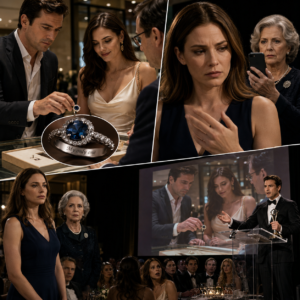
Then, without lowering his voice, without even pretending shame had entered the room, he added, “For her.”
Sabrina Keller stood beside him in a cream silk dress, smiling as though the sapphire had always been waiting for her finger instead of mine. The store was quiet in that expensive way only old money can afford: soft carpet underfoot, glass cases glowing beneath warm lights, a security guard near the door pretending not to watch too closely. Somewhere behind the counter, a polishing machine hummed gently, indifferent to humiliation.
The ring lay in the clerk’s gloved hand.
A deep blue sapphire, framed by small diamonds, with an inscription inside that read: My only one.
Adrian had given it to me on our fifth anniversary. He had stood in our dining room under candlelight, his voice low and his eyes bright, and told me he had designed it himself. For years, I wore it every day. Not because it was expensive, though it was, but because I had allowed it to become part of how I understood my life.
My marriage had weight.
My vows had shape.
My husband had chosen me.
That afternoon, I watched him offer that same ring to another woman like a piece of furniture he had decided to move into a different room.
The clerk looked at me first.
Not Adrian.
Me.
Her face held the careful panic of someone witnessing cruelty while being paid to remain professional.
“Sir,” she said softly, “this ring appears to be sized for—”
“My wife,” Adrian finished.
For half a second, his eyes met mine.
There was no apology there.
Only impatience.
“She won’t be wearing it anymore.”
Sabrina lowered her gaze to hide her smile, but not quickly enough.
I did not cry.
I did not slap him.
I did not reach across the counter and take back what was mine.
I simply stood there with my left hand bare, the pale circle of skin where the ring had rested for years suddenly exposed under the jeweler’s lights.
Behind me, near the antique display case, an older woman in a navy coat went very still.
Margaret Hale.
A retired judge. My mother’s closest friend. The woman who had once held my hand at my mother’s funeral and told me that composure was not the same thing as weakness.
She saw everything.
And without drawing attention to herself, she lifted her phone.
Adrian did not notice.
Men like Adrian rarely notice witnesses when they believe they are in control of the room.
When we stepped outside, winter air struck my face with a clean, almost merciful cold. The street was busy with late afternoon traffic, black cars moving past wet curbs, pedestrians rushing by with shopping bags and lifted collars. Sabrina walked ahead, already laughing into her phone.
Adrian stopped beside me near the curb.
“This was inevitable, Evelyn,” he said.
The words were calm.
That made them worse.
“You made it harder by pretending not to see reality.”
I looked through the jewelry store window, where the sapphire was already being carried away behind glass.
Then I asked the only question that mattered.
“Whose reality?”
He sighed, as if I had disappointed him by continuing to exist with dignity.
I said nothing else.
Because I had learned by then that silence could be sharper than explanation when you already had proof.
Chapter 2: The Kind of Man Who Listens
My name is Evelyn Carter, and if there is one thing I have learned about men like Adrian Vale, it is that they rarely begin with obvious lies.
Obvious lies are clumsy. They leave fingerprints. They can be caught too quickly by women who have learned to listen closely.
Men like Adrian prefer something more elegant.
They arrange truth in a way that leads you toward the wrong conclusion, then let you believe the path was yours.
When I first met him, Adrian was not yet the kind of man who could humiliate his wife in front of a jeweler. He was charming, attentive, almost careful. He worked in the same professional circle I did, though our worlds only touched at the edges: charity board meetings, educational fundraising events, leadership conferences where people wore polite smiles and said very little that was honest.
The first three times he asked me out, I said no.
I was clear.
Polite, but clear.
“I don’t mix work and personal life.”
“I appreciate the invitation, but I’m not interested.”
“I hope you understand.”
He always smiled as if my boundaries made him respect me more.
“Of course,” he said the first time.
“I admire clarity,” he said the second.
“Then I’ll simply enjoy your company from a professional distance,” he said the third.
That was what disarmed me.
Not persistence.
Adaptation.
He did not push in the obvious ways. He did not flood my phone or corner me after meetings. Instead, he listened. He remembered that I liked black coffee but only after noon, that I preferred handwritten notes to emails, that I grew rosemary because my mother had kept it on her kitchen windowsill.
He asked questions and let silence sit long enough to feel safe.
At the time, I mistook that for depth.
Now I know listening can be an act of intimacy, but it can also be an investment. Some men learn your wounds not to protect them, but to map where pressure will work later.
Eventually, I agreed to coffee.
We met at a quiet café near the riverwalk, where the city seemed softer because the water carried the noise away. It was late autumn. The trees along the river had turned copper and gold, and the wind moved leaves across the pavement like small bright warnings.
Adrian arrived before me.
That mattered then.
He stood when I approached. He did not check his watch. He had chosen a table near the window because, he said, I seemed like someone who liked to see the sky while thinking.
I laughed because it was true.
That was how it started.
Not with fireworks.
With recognition.
Or something that looked enough like recognition to fool me.
He spoke that day about fear in a way that seemed honest without becoming weak. He said failure did not frighten him as much as being forgotten. He said mediocrity felt like suffocation. He said he had spent his whole life trying to become someone no one could overlook.
I listened.
And I believed I saw the fracture underneath the polish.
A boy who had once felt invisible.
A man who had built himself into something impressive because he could not bear to be small.
I did not understand then that he had shown me exactly the part of himself most likely to make me generous. Not false, necessarily. That was what made it dangerous. Adrian rarely invented. He edited.
And people who edit themselves well can become more convincing than people who lie.
Two years later, I married him.
Chapter 3: My Only One
Adrian built ValeArc from nothing, or at least that was the story he preferred.
A folding table in an empty room. A borrowed laptop. A handful of investors who almost said no. Late nights, rejected proposals, risk, grit, genius. He told the story often enough that other people began telling it for him, smoothing the rough edges into legend.
There was truth in it.
But not all of it.
I continued teaching while his company grew. My life was grounded in classrooms, books, lesson plans, and the calm routine of students arriving every morning with unfinished homework and entire worlds behind their eyes. I loved teaching because it demanded attention to the person in front of you. Not the performance. Not the ambition. The person.
At night, I came home to Adrian’s restless energy.
Some evenings, he paced the living room with his phone pressed to his ear, speaking in sharp, fast phrases about capital, expansion, strategic positioning. Other nights, he sat at the dining table with his sleeves rolled up, surrounded by printed contracts, his hair falling over his forehead like the man I had first met by the river.
I helped where I could.
I read documents. I introduced him to donors from the education foundation who later became early supporters. I invested money from an inheritance my mother had left me, though Adrian preferred to describe it publicly as “private seed confidence from early believers.”
I let him.
At first, it did not feel like erasure.
It felt like marriage.
On our fifth anniversary, he gave me the sapphire ring.
I remember that evening with painful clarity. Rain tapped against the windows, and our apartment smelled of roasted pears and rosemary because I had made dinner instead of letting him book another restaurant. Adrian seemed almost nervous, which touched me because he had long ago trained himself not to appear uncertain in front of anyone.
He placed the black velvet box beside my plate.
“Open it,” he said.
Inside was the sapphire.
Deep blue, almost midnight, set in a delicate design of white gold and diamonds. I lifted it carefully, and he watched my face with an expression so soft I would later search my memory for proof that it had been real.
“I designed it,” he said. “Not the stone, obviously. But the setting. The inscription.”
I turned the ring toward the candlelight.
Inside, engraved in tiny letters, were three words.
My only one.
For a moment, I could not speak.
Adrian took my hand and slid the ring onto my finger.
“It should look like it has always belonged there,” he said.
And it did.
That was the cruelest part.
The ring became ordinary in the most intimate way. It clicked softly against coffee mugs, flashed while I wrote notes in margins, warmed under my gloves, caught chalk dust from classroom boards. I wore it until I stopped noticing its weight, which is how love sometimes becomes part of the body.
For a long time, I believed in what we had.
Or perhaps more accurately, I believed in the version of it I had been allowed to see.
Chapter 4: The Silence Beside Me
Betrayal rarely announces itself at the beginning.
It enters quietly.
A phone turned face down. A meeting added to a calendar without explanation. A shirt carrying a scent too sharp to belong to the places he claimed to have been. A laugh at a message he closed before I entered the room.
One detail means nothing.
Five details become weather.
I did not accuse him.
I observed.
Accusation without certainty gives a dishonest person room to rehearse. Observation gives you something harder to dismiss. So I watched the pattern form, piece by piece, until ignoring it would have required more effort than knowing.
Adrian came home later.
He looked at me less.
Not never. That would have been too easy. He still smiled at the right moments. He still touched my shoulder when guests were watching. He still said “my wife” in public with the polished warmth of a man who understood branding.
But in private, something had turned.
He no longer asked about my day unless someone else was in the room. He stopped noticing when I wore the blue dress he used to like. He began treating my calm as absence, my steadiness as dullness, my loyalty as a feature of the house.
His mother helped sharpen the wound.
Colette Vale had never insulted me loudly. Loud cruelty has witnesses. Colette preferred velvet.
“Evelyn, you are so calm,” she said one evening over dinner, watching me pour tea into porcelain cups she had chosen for the table. “Adrian has always needed a woman with a bit more… energy.”
Adrian cut into his steak and said nothing.
Another time, at a family brunch, she touched my wrist lightly and smiled.
“Quiet women are charming, of course,” she said, “but not every temperament can hold the attention of a man destined for larger rooms.”
A cousin laughed awkwardly.
I looked at Adrian.
He lifted his wineglass.
That was all.
Silence inside a marriage is rarely neutral. Sometimes it is exhaustion. Sometimes it is cowardice. And sometimes it is agreement without the inconvenience of speaking.
By then, I had started to understand.
Adrian was not failing to defend me.
He was allowing other people to say what he no longer wanted to hide.
Chapter 5: The Woman in the Third Row
I met Sabrina Keller at one of Colette’s gatherings.
It was a spring evening in a private garden behind a townhouse so old and expensive it seemed embarrassed by its own wealth. White lights were woven through the trees. Waiters moved between guests with trays of champagne. The air smelled of jasmine, cut grass, and money old enough to whisper instead of shout.
Sabrina arrived late.
Some people enter rooms.
Sabrina took possession of them.
She wore pale gold, the kind of dress that looked effortless because tremendous effort had gone into making it seem so. Her hair was swept to one side. Her laugh was low, never accidental, offered like a privilege. Colette greeted her with both hands.
Adrian’s face changed when he saw her.
Not dramatically.
Just enough.
His shoulders softened. His attention aligned. The room contained fifty people, but for three seconds, he looked as if only one had entered.
I noticed.
Women notice.
Not because we are paranoid, as men like to claim when they are hiding something, but because survival has trained us to recognize where warmth is being redirected.
Sabrina approached me later near the terrace doors.
“You must be Evelyn,” she said.
Must be.
Not “I’ve heard so much about you.”
Not “It’s lovely to meet you.”
Must be.
“Yes,” I said.
She looked at my ring.
“What a beautiful sapphire.”
“Thank you.”
“Adrian has good taste.”
I held her gaze.
“In some things.”
Her smile sharpened.
Across the room, Colette watched us with a satisfaction she did not bother to disguise.
From that night on, the pattern became impossible to ignore. Sabrina’s name appeared in conversations where it did not belong. Her opinions suddenly mattered to Adrian. She was at events I did not know she had been invited to. He laughed at her jokes with the relief of a man being admired by someone who had not seen him vulnerable.
Then, one evening, he left his tablet unlocked on the kitchen counter.
It was late. The house was quiet except for the dishwasher humming softly and the rain ticking against the dark windows. Adrian had gone upstairs to take a call, and the tablet lit once, then again.
I told myself not to look.
Then I saw Sabrina’s name.
There are moments when privacy becomes less sacred than truth.
I opened the messages.
Months of them.
Dinners under assumed names. Hotel bookings. Complaints about my presence. Jokes about my calmness, my clothes, my classroom life, the quiet routines Adrian had once claimed to love.
Then I found the message that made the room seem to tilt.
Sabrina: She’s just a placeholder, Adrian. You know that, don’t you?
Adrian: That’s the truth.
I sat down slowly.
The kitchen light hummed above me. The rosemary on the windowsill stirred in the draft from the old frame. My sapphire ring caught the light as my hand rested beside the tablet.
Placeholder.
Not wife.
Not partner.
Placeholder.
I scrolled farther.
Then I found Colette.
A shared conversation.
Her words were neat, vicious, and completely unsurprising.
Give her the ring. Evelyn was never worthy of it. She never had the stature for my son.
For a moment, I felt nothing.
That frightened me more than pain would have.
Then my hands began to move with a calmness I did not recognize.
I photographed everything.
Every message.
Every reservation.
Every sentence.
Every casual cruelty they had been foolish enough to write down.
Emotion would not serve me.
Precision would.
Chapter 6: The Jeweler’s Glass
Five days later, Adrian suggested we take my sapphire ring to be professionally cleaned before the upcoming ValeArc Foundation gala.
He said it over breakfast, pouring coffee into his cup without looking at me.
“The photographers will be everywhere,” he said. “The ring should look its best.”
I looked at the ring on my hand.
The sapphire sat there quietly, carrying five years of meaning he had already emptied from it.
“How thoughtful,” I said.
He glanced at me, perhaps searching for suspicion.
I gave him none.
That afternoon, we went to Bellamy & Co., a jeweler tucked between a private bank and an art gallery on a street where even the trees looked maintained by appointment. Inside, the air smelled faintly of polished metal and lilies. Glass cases displayed rings beneath soft lights, each stone glowing as if it had been given its own small moon.
Sabrina was already there.
She pretended surprise poorly.
“Adrian,” she said. “Evelyn. What a coincidence.”
I looked at Adrian.
He did not even have the decency to appear uncomfortable.
The clerk greeted us with practiced elegance.
“How may I assist you today?”
Adrian turned to me and held out his hand.
“The ring,” he said.
I slipped it off slowly.
Not because I wanted to obey him.
Because I wanted to see whether he would really do it.
The ring left my finger with a small resistance, as if skin and metal had grown reluctant to part. The pale circle beneath it looked indecently private under the store lights.
I placed it in Adrian’s palm.
He did not pause.
He handed it to the clerk.
“Resize it,” he said.
The clerk smiled faintly. “Of course. What size would you—”
“For her.”
He turned slightly toward Sabrina.
The store seemed to still.
Sabrina lifted her left hand, fingers spread delicately, already imagining the sapphire there.
I watched the clerk’s face change.
A professional face cracking at the edges.
“Sir,” she began carefully, “this ring appears to be—”
“My wife knows,” Adrian said.
That was the detail that almost made me laugh.
He did not say I agreed.
He said I knew.
He had always trusted knowledge to behave like consent when held inside a woman trained not to make scenes.
Behind us, Margaret Hale stood near a display of antique brooches.
I saw her reflection in the glass before I turned my head. She did not move toward me. She did not gasp. She simply lowered her gaze, opened her handbag, and lifted her phone in one smooth motion.
A retired judge never needed to be told what evidence looked like.
Adrian signed the resizing form.
Sabrina leaned closer to the counter, her perfume drifting toward me, sweet and sharp.
“It really is a stunning ring,” she said softly.
I looked at her.
“It has an inscription.”
Her smile flickered.
“How sentimental.”
“Yes,” I said. “Very.”
I did not tell her what it said.
Not yet.
Outside, Adrian acted as though a practical inconvenience had been resolved.
“This was inevitable,” he said as the valet brought the car around. “You made it harder by pretending not to see reality.”
I watched Sabrina slide into the back seat ahead of me, arranging herself carefully so her dress would not crease.
“Whose reality?” I asked.
Adrian’s jaw tightened.
Then he smiled.
The smile he used at investor meetings.
The one that made people believe outcome had already chosen him.
“The one everyone else sees.”
I turned toward the window.
The city moved past in streaks of light and wet pavement.
My left hand rested bare in my lap.
For the first time in years, I felt the absence of the ring not as loss, but as space.
Chapter 7: The Woman Who Waited Until the Applause
The ValeArc Foundation gala took place six nights later in a ballroom washed in gold light.
Two hundred people attended.
Investors, board members, philanthropists, reporters, Colette’s friends, Adrian’s admirers, and all the polished faces that gather around power hoping to be reflected in it. Crystal chandeliers hung above round tables dressed in white linen. Tall arrangements of blue hydrangeas and white roses stood at the center of each table, expensive and scentless.
Adrian loved rooms like that.
Rooms where applause could be mistaken for truth.
He wore a black tuxedo. Sabrina sat in the third row, dressed in deep red, her left hand bare for now. Colette sat beside her with the calm satisfaction of a woman who believed the evening had already been arranged to her liking.
I sat at the front table in a midnight blue dress.
No ring.
Several people noticed.
No one asked.
That is how polite society works. It sees everything and saves curiosity for private cruelty.
Adrian took the stage to accept an award for leadership and integrity.
Integrity.
The word appeared on the screen behind him in elegant white letters.
For a moment, I almost admired the universe for its sense of timing.
He spoke beautifully.
That was one of Adrian’s gifts. He knew how to shape language into architecture, how to build sentences people wanted to stand inside. He thanked the board, the foundation, the investors who believed in him. He spoke about vision, perseverance, responsibility.
Then he thanked me.
“My wife, Evelyn,” he said, turning his eyes toward me with public tenderness. “Her quiet strength has been a constant support.”
The applause began.
I stood.
Not abruptly.
Not dramatically.
I simply rose from my chair.
The applause faltered as I walked toward the stage. Adrian’s smile held for the first few steps, then tightened. Colette’s face changed at once. Sabrina sat very still.
Adrian leaned slightly toward the microphone.
“Evelyn?”
I reached the podium and stood beside him.
The lights were warm on my face. Beyond them, two hundred people waited in a silence that arrived slowly, row by row, as though the room were realizing something unrehearsed had entered it.
“My husband has spoken beautifully about integrity and honor,” I said.
My voice sounded calm.
That helped.
“I think it would be useful to discuss what those words look like when no one is filming.”
The room went completely quiet.
Adrian’s hand closed around the edge of the podium.
“Evelyn,” he said softly. “Don’t.”
I looked at him.
There are some moments in a marriage when a single word contains years. His “don’t” held fear, warning, entitlement, and astonishment that I had not remained where he placed me.
I turned back to the room.
“For months, my husband has been involved with Sabrina Keller, seated in the third row.”
Two hundred heads moved almost as one.
Sabrina’s face went white beneath the chandelier light.
Colette stood halfway.
“Evelyn, this is not the place—”
“No,” I said. “That was the jeweler.”
The silence sharpened.
From my small evening bag, I removed the sapphire ring.
A soft murmur moved through the ballroom.
“The ring was given to me on our fifth anniversary,” I said. “Inside it, Adrian had three words engraved.”
I held it up.
My only one.
Adrian looked as if the air had left him.
“Last week,” I continued, “he removed this ring from my hand at Bellamy & Co. and instructed the jeweler to resize it for Sabrina.”
Someone gasped.
Then another.
I did not look at Sabrina.
I did not need to.
“Fortunately,” I said, “a witness was present.”
Behind me, the screen changed.
Margaret Hale’s recording appeared.
The jewelry store.
The glass cases.
Adrian’s hand taking the ring.
His voice, clear enough for everyone to hear.
Resize it. For her.
Sabrina’s smile.
The clerk’s hesitation.
My bare hand.
In the ballroom, the first whispers began like rain.
Adrian reached toward the microphone.
I moved it away.
“No.”
The word did not need volume.
He stopped.
“You had every opportunity to handle this privately,” I said. “You chose public humiliation. I chose public truth.”
But I was not finished.
Because betrayal was only the door.
The house behind it was much larger.
“Adrian has built his career on the idea that he created ValeArc alone,” I said. “That is not accurate.”
His face changed again.
Not embarrassment now.
Fear.
“The initial capital came from me. The early bridge funding came through my private accounts. And as of this morning, I hold thirty-five percent of the company.”
A sound moved through the room, not quite a gasp, not quite a whisper.
Board members looked at one another.
Investors leaned toward their spouses.
Colette’s mouth parted slightly.
Adrian took one step toward me.
“Evelyn, stop this.”
I looked at him for a long moment.
Then I said, “No.”
The screen behind me changed again.
Copies of early funding agreements.
Shareholder documents.
Board notices.
Legal filings.
A summary page prepared by my attorney.
“This morning,” I said, “I initiated a legal audit into the use of company funds, related-party transactions, and undisclosed personal expenses. The board will receive the preliminary findings at nine a.m. tomorrow.”
The ballroom seemed to inhale and hold it.
Adrian’s public face — the one he had spent years perfecting — cracked in front of everyone who had ever applauded it.
“You can’t do this,” he said.
I almost smiled.
Not because I was happy.
Because even then, after all of it, he thought permission was still his to give.
“I already did.”
Then I placed the sapphire ring on the podium between us.
It looked very small under the lights.
Much smaller than the marriage it had represented.
I stepped back.
The audience parted for me as I walked down from the stage.
No one touched me.
No one stopped me.
At the ballroom doors, I heard Colette say my name.
Not sharply.
Not cruelly.
Almost afraid.
I did not turn around.
Chapter 8: The Collapse of a Beautiful Lie
The fallout was immediate.
Not loud at first. Public collapse rarely begins with shouting. It begins with emails. Calls. Emergency meetings with blinds drawn. Lawyers reading documents under fluorescent lights. Investors asking questions in voices that sound polite until you understand what politeness is hiding.
By Monday afternoon, two major projects were suspended pending review.
By Wednesday, a partner firm issued a statement about reassessing its relationship with ValeArc.
By the end of the week, three investors requested access to internal records.
Reporters did what reporters do.
They found the gala video.
Then the jeweler recording.
Then the public filings showing my ownership stake.
The story wrote itself because Adrian had been arrogant enough to provide all the symbols: the ring, the mistress, the stage, the word integrity glowing behind him as I revealed what he had done in the dark.
Sabrina left before the second week ended.
Not because she discovered morality.
Because she discovered risk.
Her resignation was written in careful language about personal priorities and future opportunities. Her social media changed overnight. Photos disappeared. Captions were edited. She became, with impressive speed, a woman who had barely known Adrian Vale.
Colette lasted longer.
Pride is stubborn in women who have mistaken status for blood.
But invitations stopped coming. Calls went unanswered. At a luncheon she had once treated like a court she ruled, someone asked very sweetly whether she had known about the ring. Someone else mentioned, with surgical softness, that Evelyn had carried herself beautifully.
Colette left early.
That, according to Margaret Hale, was the first sensible thing she had done in years.
Adrian called me seventeen times.
I answered none.
His messages moved through stages.
Anger first.
Then legal threats.
Then disbelief.
Then memory.
Do you remember our fifth anniversary?
You know I loved you in my way.
We built this together.
That last one almost made me answer.
Almost.
Because yes, we had built it together. That was precisely the point. He had spent years turning my contributions into his mythology, then acted shocked when I finally placed evidence where applause used to be.
On the eighteenth day, one voicemail came through differently.
His voice was rough.
“I didn’t think you’d actually do it.”
I stood in my apartment kitchen listening to the message while rosemary simmered in a pot on the stove. Outside, evening light moved across the walls in long amber lines.
That was the problem, Adrian, I thought.
You never thought I would choose myself in a room full of witnesses.
Chapter 9: The Life After the Ring
Six months later, I live in a space filled with light.
Not the grand house Adrian loved to photograph for magazines. Not the glass-and-stone monument to success where every surface reflected an image of us more polished than true. My apartment is smaller, warmer, quieter. Morning sun enters through wide windows and rests on wood floors. Rosemary grows on the balcony beside basil and thyme, stubborn little plants that lean toward light without needing permission.
Silence lives here too.
But it is different now.
In Adrian’s house, silence had been full of withheld words. It pressed against the walls. It sat between us at dinner. It followed me upstairs after Colette’s insults and Adrian’s failure to defend me. It grew larger every time I chose not to ask a question because I already knew the answer would hurt.
Here, silence is clean.
It lets me hear water boiling, pages turning, the small scrape of a chair against the floor. It does not ask me to disappear inside it.
I continue teaching.
People sometimes find that surprising, as if ownership and money should have turned me into someone who abandoned the work that kept me human. But I never wanted to become a woman built only from reaction. Adrian took enough years. I would not give him my purpose too.
The legal audit continues.
So does the divorce.
So does life.
The sapphire ring sits in a small velvet box in my desk drawer. I have not decided what to do with it. Some days I think I will sell it and fund scholarships for girls who need a door opened quietly. Other days I think I will reset the stone into something that belongs only to me.
Not a ring.
Perhaps a pendant.
Something that rests near the heart but does not promise itself to anyone.
People say I destroyed Adrian that night.
They are wrong.
He had been destroying himself for years — one omission, one arrogance, one public smile at a time. I did not create the collapse. I only stopped standing under the structure, holding it up while he called himself the architect.
Once, I thought revenge would feel like fire.
It did not.
It felt like air.
Like stepping out of a room where everyone had been speaking over you and realizing the world outside was still wide. Like waking in clean sheets with no performance waiting. Like placing your bare hand on a windowsill and feeling sunlight touch the pale place where a ring used to be.
The mark is gone now.
Skin forgets eventually.
So does the heart, though more slowly.
And when people ask what happened to the woman who stood silently in the jewelry store while her husband resized her anniversary ring for another woman, I tell them the truth.
She was not silent because she was weak.
She was waiting.
And when the truth finally entered the room, it did not need to shout.
It only needed to be seen.






Leave a Reply