THE WOMAN HE CALLED THE GIFT SHOP GIRL
Chapter One: The Text Beneath the Capitol Dome
The text arrived while Dr. Evelyn Hart was reviewing a federal preservation budget that would determine whether three endangered Indigenous-language archives survived another year.
Her phone lit up beside a stack of acquisition proposals, climate-control reports, and a briefing folder marked:
House Committee Visit — January 14
The message was from her older brother, Miles.
Evie, about New Year’s Eve. We’re keeping it small this year. Just Amara’s political circle. She’s a congresswoman now, and there’ll be donors, staff, maybe a senator. It’s not really your kind of room. You work at the museum gift shop or visitor desk or whatever. Hope you understand.
Evelyn sat back slowly in her chair.
Outside her third-floor office window, Washington, D.C. glowed beneath a pale December sky. The National Mall stretched wide and cold toward the Capitol Building, where the dome rose clean and white against the winter light.
She had a call with the Library of Congress in twelve minutes.
A meeting with the Smithsonian secretary at two.
A keynote to finish for the International Cultural Heritage Summit.
Seventeen department heads waiting for approval on exhibition priorities.
And her brother still thought she sold postcards.
For a long moment, she simply looked at the message.
Not because it surprised her.
Because it did not.
That was the part that hurt most.
Miles had always needed Evelyn to be smaller than him.
When they were children, he called her “the quiet one,” though she was only quiet around people who interrupted her. When she won a national scholarship at seventeen, he told their parents she was “good at school stuff” and changed the subject to his debate trophy. When she earned her doctorate in cultural anthropology from Yale, he called it “a niche degree.” When she became deputy director of the Metropolitan Museum of Art, he said, “That’s cool. So you manage exhibits?”
When she was appointed executive director of the National Museum of American Memory, he asked if that meant she finally got her own office.
She did.
A corner office overlooking the Mall.
With national collections under her supervision, congressional funding hearings on her calendar, and enough responsibility to make sleep a rumor.
But Miles had never Googled her.
That was the whole tragedy in one sentence.
Her professional biography was public. It took less than eight seconds to find.
Dr. Evelyn Hart, Executive Director, National Museum of American Memory.
Former deputy director, Metropolitan Museum of Art.
Yale PhD.
UNESCO advisory board.
Recipient of the National Humanities Medal.
Witness before the House Appropriations Subcommittee on cultural preservation.
Her name appeared in journals, newspapers, museum programs, federal hearing transcripts, donor reports, and international conference brochures.
Miles had never looked.
Their mother had not looked either.
When Evelyn received the National Humanities Medal, her mother called three days later.
“Your aunt saw something online,” she said. “Why didn’t you invite us?”
“I did.”
“Oh.” A pause. “I thought that was just one of your work things.”
One of your work things.
That was what her family called the life she had spent twenty years building.
Not out of cruelty, exactly.
Something quieter.
More durable.
They had written a version of Evelyn early and continued reading from it long after the real woman had walked out of the room.
In that story, Miles was the impressive one. The attorney. The confident son. The man with courthouse victories, tailored suits, a townhouse in Georgetown, and now a fiancée whose face appeared on campaign banners and Sunday political shows.
Congresswoman Amara Voss.
Young.
Brilliant.
Disciplined.
One of the youngest members of the House Subcommittee on Arts, Education, and Public Memory.
Miles loved saying her title.
He said Congresswoman the way some men say my wife when they are still learning how to own proximity to power.
Evelyn read the text once more.
You work at the museum gift shop or visitor desk or whatever.
Then she placed the phone facedown on her desk.
Her assistant, Noah, knocked once and entered with a folder.
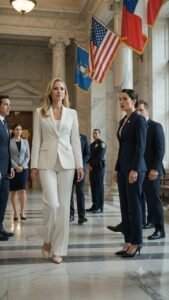
“The Smithsonian secretary moved your two o’clock to one-thirty,” he said. “Also, Congresswoman Voss’s office confirmed the official tour for January fourteenth.”
Evelyn looked up.
“Congresswoman Voss?”
“Yes. Chair’s office requested the research wing, archives, conservation lab, and your briefing on the federal digitization initiative.”
There it was.
The universe, for once, showing a sense of timing.
Noah glanced at her phone.
“Everything okay?”
Evelyn smiled faintly.
“Apparently I’m not the right level for New Year’s Eve.”
Noah blinked.
Then, wisely, decided not to ask.
Chapter Two: The Man Who Never Asked
Miles called ten days later.
Evelyn was in the conservation wing, wearing white gloves, standing over a damaged field journal from 1891 that smelled faintly of smoke and river mud. One of the paper conservators was explaining the stabilization plan when her phone buzzed.
Miles.
She stepped into the hallway.
“Hi.”
“Evie,” he said quickly. “Quick thing. Amara has a museum visit on January fourteenth.”
“I know.”
“Oh. Right. Of course. Since you work there.”
“I do.”
“So, I need you to not make it weird.”
Evelyn looked through the glass wall at the conservators bent over history with tiny brushes and surgical patience.
“Make what weird?”
“The family thing.”
She said nothing.
Miles continued, rushing now, the way he did when he wanted to get past a sentence before its ugliness caught up with him.
“She thinks you’re, like, in visitor services or events coordination. Maybe the gift shop. I don’t know. I didn’t want to overexplain because she’s very busy and it’s not relevant.”
“Not relevant,” Evelyn repeated.
“Come on. You know what I mean. She’s coming in an official capacity. I don’t want her feeling awkward because my sister is, you know, staff.”
Evelyn closed her eyes briefly.
Not because she was wounded.
Because she was tired of being expected to translate disrespect into insecurity and then manage it for everyone else.
“Miles,” she said, “do you actually know what I do at the museum?”
A pause.
Then he laughed lightly.
“Evie, I know you work at the museum.”
“That wasn’t the question.”
“I have court in ten minutes.”
“Of course you do.”
“Just don’t mention we’re related unless she brings it up. Please. I’m trying to protect everyone from awkwardness.”

Leave a Reply