THE HOUSE HE LOCKED ME OUT OF
Chapter One: The Window
At 11:14 p.m. on Christmas Eve, my father locked me outside in the snow.
Not metaphorically.
Not emotionally.
Literally.
He shoved me through the front door of our house on Maple Drive in nothing but a navy cable-knit sweater, thin socks, and the kind of silence a family uses when they have already agreed not to save you.
The temperature was twelve degrees below zero.
The cold did not feel like cold at first. It felt sharp. Precise. Like a blade sliding under my skin one inch at a time.
Snow fell in thick white sheets across the porch steps. Six inches had already gathered over the lawn, over the hedges I had trimmed that morning, over the driveway I had shoveled before guests arrived. My socks soaked through immediately, then stiffened as the moisture began to freeze around my ankles.
Behind me, the deadbolt clicked.
Inside the house, Christmas continued.
That was the part I remember most.
Not the wind.
Not the numbness.
The warmth I could still see through the bay window.
The living room glowed gold. The nine-foot Douglas fir blinked with red and amber lights, every antique glass ornament hung by my hands that afternoon while my stepmother Brenda drank mulled wine and told guests I had “such a natural servant’s heart.”
Thirty people filled the room.
Neighbors.
My father’s colleagues from First Meridian Bank.
Rotary Club friends.
Women from church.
People who had eaten the ham I glazed, the pies I baked, the potatoes I sliced until my wrists ached.
My father, Richard Dawson, stood near the fireplace in a cashmere cardigan, pouring himself another glass of vintage champagne like the benevolent king of a house he had not cleaned, cooked for, or decorated.
Beside him, Brenda laughed with one hand on his arm.
My stepsister, Kelsey, sat curled on the velvet sofa under the red blanket I had folded that afternoon. In her lap was the new iPhone my father had just given her. One of six presents.
She looked up and saw me through the glass.
For one second, our eyes met.
I thought maybe she would gasp.
Maybe she would get up.
Maybe some human part of her would remember that I was twenty-one years old, barefoot in freezing weather, locked outside my own home on Christmas Eve.
Instead, Kelsey smiled.
A small, pitying curve of her mouth.
Then she lifted her fingers and waved.
Slowly.
Delicately.
Like she was saying goodbye to someone beneath her.
Then she reached over and pulled the heavy velvet drapes shut.
The golden room disappeared.
The porch went dark.
I wrapped my arms around myself, but my hands were already too stiff to make fists. My breath came out in thin white bursts. My jaw shook so violently my teeth clicked together.
I had been locked out because I asked one question.
That was all.
“Dad, is there a present for me?”
No accusation.
No screaming.
No drama.
Just a question from a daughter who had cooked the dinner, decorated the tree, set the table, wrapped gifts for people who never wrapped one for her, and finally wondered aloud whether she existed anywhere in her father’s Christmas.
Richard called it disrespect.
Brenda called it ruining the joy.
Kelsey called it “typical Evelyn.”
My father grabbed my arm in front of everyone, marched me to the door, opened it to the storm, and pushed me onto the porch.
“You want to talk back?” he hissed. “Do it outside. Come back when you learn gratitude.”
Then he locked the door.
Now I stood there as the cold moved through my body in stages.
First pain.
Then burning.
Then numbness.
The numbness scared me most because some buried part of me knew that when the body stops hurting, it is not because danger has passed.
It is because the body is retreating.
Pulling blood inward.
Choosing organs over fingers.
Heart over feet.
Life over everything unnecessary.
I sank slowly onto the porch step.
The wood was slick with ice.
I could hear music inside the house, muffled through walls and glass. Jazz. Laughter. A burst of applause. Someone calling for another slice of cake.
The cake I had baked at three in the morning because Brenda decided two desserts “looked cheap.”
I pressed my forehead against the railing.
“Mom,” I whispered, though my mother had been dead for twelve years. “I don’t know what to do.”
For one terrifying moment, I considered lying down.
Just for a minute.
Just to stop shaking.
Then headlights cut across the snow.
Not from a neighbor’s sedan.
Not from a delivery truck.
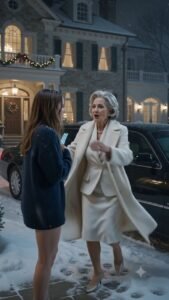
A long black limousine rolled silently to the curb.
It looked impossible on Maple Drive. Too sleek. Too dark. Too deliberate. Its headlights swept over the lawn, the porch, my frozen hands, the window where my family still laughed behind curtains.
The driver got out first.
Then a man in a gray suit stepped onto the snow with a briefcase in one hand.
Then the rear door opened.
A woman emerged.
White cashmere coat.
Silver hair swept into a low chignon.
A single gold ring on one hand.
She was old, but not fragile.
She stood like a woman who had spent her entire life making rooms rearrange themselves around her.
For a second, I thought I was hallucinating.
Then she saw me.
The woman stopped.
Her face changed so violently that even through the snow, I could feel it.
Shock.
Recognition.
Horror.
Then rage.
She crossed the yard faster than anyone her age should have been able to move. Her coat opened behind her like a white flag turned into armor.
“Little Star,” she choked.
I knew that voice.
Not from memory exactly.
From somewhere deeper.
From jasmine perfume on a cemetery wind.
From warm hands around my face when I was nine.
From a promise buried under twelve years of lies.
She dropped to her knees in the snow and wrapped her coat around my shoulders.
It was heavy.
Warm.
Soft enough to hurt.
Her hands cupped my frozen cheeks.
“I know you,” I whispered through chattering teeth. “From the photo.”
Her eyes filled.
“I’ve been looking for you for twelve years.”
Then she turned her head toward the house.
Toward the golden windows.
Toward the guests.
Toward the man who had locked me out.
Her face went still.
When she spoke, her voice was not loud.
It was worse.
It was final.
“Douglas.”
The man with the briefcase stepped forward.
“Yes, Mrs. Hartwell.”
Vivian Hartwell looked at the house my father had spent twelve years pretending was his kingdom.
Then she said one word.
“Demolish.”
Chapter Two: The Woman He Buried Alive
To understand why that word shattered my father before he even understood it, you have to know what he stole first.
Not the house.
Not only the house.
Me.
My mother, Margaret Hartwell Dawson, died when I was nine.
I remember the funeral in pieces.
The sky was the color of wet iron. My patent leather shoes pinched. Someone kept telling me to be brave, as if grief were a performance children could pass if they stood still enough.



Leave a Reply