“No,” I said.
I picked up the bracelet and let the faded threads rest in my palm. Thirteen-year-old me had made it believing love could be handcrafted and handed over and treasured if only you tried hard enough. That child deserved better than a return shipment.
I put it in my desk drawer.
That evening, my father called from an unknown number when I stopped answering his own.
I almost didn’t pick up. Almost.
“Nicole,” he said, voice tight, “your mother is unwell.”
I leaned against the kitchen counter. “Is she in the hospital?”
“No, but—”
“Then she’s not unwell. She’s upset.”
He inhaled sharply. “You are being needlessly cruel.”
Needlessly.
I looked across the room at Adam, who was chopping herbs at the counter, sleeves rolled back, face calm and intent.
“No,” I said. “I’m being new.”
My father went silent.
Then: “We invited you back into this family.”
I actually smiled.
“That’s interesting,” I said. “I don’t remember leaving. I remember being managed.”
His tone hardened. “Don’t be smart.”
“Too late.”
He lowered his voice, the way he used to when I was little and he wanted me to feel the floor disappear beneath me. “This wedding of yours is making people talk. We can still fix the optics if you stop acting impulsively.”
There it was again. Optics. Family as image, daughter as public relation issue.
“My wedding?” I repeated. “You mean the one you won’t be attending.”
He laughed once, disbelieving. “Nicole—”
“I mean it.”
“You can’t possibly be serious.”
“I’ve never been more serious in my life.”
He started to say my name, maybe to command, maybe to threaten. I hung up first.
Two days later, Claire sent me a message that should have hurt more than it did.
You’re enjoying this way too much. If you wanted Adam, fine. But don’t pretend you aren’t using him to punish everyone.
I read it three times and then showed Adam.
He looked tired in a way I hadn’t seen before. “She messaged me too.”
I turned. “What?”
He handed me his phone.
Claire:
I know things are messy.
I also know you’re smart enough to see Nicole has always had a flair for victimhood.
If you ever want the honest version of this family, call me.
Under it, another message sent an hour later.
Also, Brent’s looking at aviation tech funding. Thought it could be mutually beneficial.
I laughed so hard I had to sit down.
Somewhere inside that laugh was the last shred of confusion leaving my body.
They were all the same in the end. Not identical. But orbiting the same hunger—status, control, advantage, the right version of a story.
The week before the wedding, Adam and I met with a planner to finalize our guest list.
It was not a large wedding. I had thought I’d want something big when I was younger, maybe because I had spent so many years imagining a room where people actually looked happy to see me. But by then I understood that intimacy is not the opposite of grandeur. Sometimes it’s the only real luxury.
We chose a rooftop garden downtown. Late spring. White chairs. My closest friends. His sister and her husband. Lena. Mrs. Whitaker. Aunt Gina, after I thought about it for a while and decided late courage still counts for something. No parents. No Claire. No Brent. No one who needed the day to double as a networking event or reputation cleanse.
The night before the wedding, the venue manager called.
“Just a heads up,” she said. “Someone claiming to be your mother asked for the rehearsal access code. We didn’t provide it.”
I sat very still on the couch after that.
Adam came in from the terrace and saw my face. “What happened?”
I told him.
He crouched in front of me, took both my hands, and said the words I had needed my whole life without knowing it.
“They do not get to force their way into your joy.”
My throat closed.
That night I barely slept.
The city lights moved across the ceiling. The sheets twisted around my legs. At some point near dawn, my phone buzzed once with a blocked voicemail notification.
I didn’t play it.
I didn’t need to.
Because when morning came bright and clear and too beautiful for the kind of family I had grown up in, I already knew they would try one last time.
And as I stood in front of the mirror in my wedding dress, hearing the elevator doors open somewhere down the hall below, I had one sharp clear thought:
Let them come.
This time, I was not the one without an invitation.
Part 11
The rooftop garden sat above the city like a held breath.
By late afternoon the sky had turned the soft gold that makes buildings look kinder than they are. The railings were wrapped in white roses and green ivy. Small glass lanterns hung from shepherd’s hooks and flickered when the wind moved. Someone somewhere below was grilling onions, and every now and then that warm savory smell drifted up through the flowers and the polished air. It was imperfect and real and, to me, more beautiful than anything my mother had ever staged.
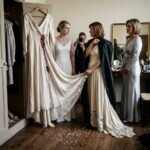
My dress was ivory, simple through the waist with a low back and sleeves of sheer embroidered tulle. Not the kind of gown Claire would have picked. Not the kind that begs to be admired from far away. The kind you wear when you want to feel like yourself, only braver.
Lena stood behind me in the bridal suite pinning the last section of my hair into place. “You good?” she asked, catching my eyes in the mirror.
“No,” I said honestly.
She grinned. “Excellent. Honest brides are my favorite.”
There was a knock at the door.
The venue manager stepped in with professional calm and the unmistakable energy of a person carrying drama in a sealed envelope. “Nicole,” she said softly, “there are three people downstairs requesting entry. They say they’re your immediate family.”
For one weird second, all I could hear was the zipper pull on my garment bag swaying against the closet door.
Lena said something that would have made my mother faint.
I sat down slowly.
Not because I was weak.
Because I wanted my answer to come from the deepest, clearest part of me and not from panic.
The manager waited.
“Who?” I asked, though I knew.
“Your parents and your sister.”
Of course Claire had come too. Why miss the climax?
Adam appeared in the doorway a moment later, already dressed, black tuxedo fitting him like it had been tailored in another, better universe. He looked from my face to the manager’s and understood immediately.
“Do you want me to handle it?” he asked.
That was the old question in a new form. Do you want rescue, or do you want your own voice?
“No,” I said. “I do.”
We took the service elevator down together.
The hallway outside the lobby smelled like polished stone and orchids. My heels clicked once, twice, then seemed to find a rhythm with my heartbeat. Adam didn’t touch me, but his presence moved beside me like a wall I could lean on if I chose.
My parents were waiting near the reception desk.
My mother wore navy silk and pearls. Of course she did. My father was in a dark suit with a tie I had bought him one Father’s Day when I still mistook effort for investment. Claire wore blush, which made me laugh internally because apparently she could not resist competing with a bride even when no one had actually let her in.
For a moment, nobody spoke.
Then my mother’s face crumpled on cue. “Nicole.”
I stopped several feet away. The distance felt right.
“You cannot be here,” I said.
My father stepped forward. “This has gone far enough.”
“Has it?”
“We are your family.”
I looked at him. At the man who had once introduced me as the quiet one. At the man who emailed my fiancé to warn him that I was delusional. At the man who found my stolen summer acceptable collateral for Claire’s schedule.
“No,” I said. “You’re my relatives.”
That landed like a slap.
My mother pressed her fingers to her mouth. “Please don’t do this on your wedding day.”
“You mean set a boundary? I should have started earlier.”
Claire folded her arms. “You are so addicted to turning yourself into a tragic heroine. Mom’s been crying for days.”
I turned to her.
The lobby lights were cool and flat, unkind to everyone.
“Claire,” I said, “you stole a future from me and rolled your eyes when I found out. If you ever speak to me again, it will be because you ignored a direct request not to.”
For once, she had nothing.
My father tried another angle. “Whatever happened in the past, we can resolve it privately. But if people see us turned away—”
There it was. Not grief. Optics.
I smiled.
Not sweetly.
“You still don’t understand,” I said. “I am not doing this to humiliate you. I’m doing it because I finally believe what you are.”
My mother took one stumbling step toward me. Tears had loosened her mascara slightly at the corners, and for a second she looked less like my mother than like a woman caught too late without her costume.
“We loved you,” she whispered.
I held her gaze.
“You loved the version of me that didn’t inconvenience Claire.”
She started crying harder. Maybe it was real. Maybe parts of it were. Pain can be sincere even when it’s deserved.
It changed nothing.
I reached into my small satin bag and took out the bracelet.
The old one. Faded threads. My thirteen-year-old hope, returned to sender and then reclaimed for what it really was.
I placed it on the reception desk between us.
“You can keep the symbol,” I said. “I’m done carrying the story.”
My mother stared at the bracelet like it was a body part.
My father’s face turned hard at last, all pretense burned off. “If you walk away now,” he said, “don’t expect to come back.”
The old me would have flinched.
The old me would have translated that into terror.
The woman standing in a wedding dress under lobby lights just nodded once.
“That is the first honest offer you’ve ever made me,” I said.
Then I turned.
I did not wait to see whether they followed. Security and the manager handled that. I heard voices behind me rise, crack, protest, fade. The elevator doors slid shut with a whisper.
Inside, I finally exhaled.
Adam looked at me, eyes dark and steady. “How do you feel?”
I thought about it.
My cheeks were wet; I hadn’t even noticed I was crying. My hands trembled. My chest ached. Somewhere below the pain, though, something brighter was opening up.
“Free,” I said.
When the elevator opened to the rooftop again, the wind lifted the edge of my veil. The music started. My friends stood. The city stretched around us in gold and glass and possibility.
And for the first time in my life, I walked toward a future with no one in front of me trying to decide whether I deserved it.
Part 12
I wish I could tell you the ceremony erased everything.
That’s not how healing works. It doesn’t descend like a movie soundtrack and make the past turn soft at the edges. It just gives the present enough truth that the past stops being in charge.
I walked down the aisle alone.
Not because I had no one.
Because I chose to.
The white runner moved gently under my shoes in the wind. Lanterns flickered. Lena cried openly in the front row, not even trying to be dignified about it. Aunt Gina held a handkerchief in both hands like a confession. Mrs. Whitaker smiled at me with the same steady pride she’d worn the first time I stayed late in her art room and showed her a charcoal sketch I almost didn’t submit.
Adam waited at the end of the aisle with his face completely unguarded.
That sight nearly undid me.
Not his tuxedo. Not the skyline behind him. Him. The man who had seen me on a hospital roof holding blueprints in bad shoes and somehow kept seeing me more clearly each time the story got uglier.
When I reached him, he took both my hands.
The officiant spoke. The wind moved through the leaves. Somebody laughed quietly when a rose petal stuck to Adam’s sleeve and he didn’t notice. I could hear the traffic below, muted and constant, like the city itself acknowledging that life goes on while private worlds are remade.
Our vows were simple.
I promised not to disappear inside silence again.
He promised never to ask me to earn being loved.
That one nearly made half the audience cry with Lena.
When we kissed, it was not dramatic. It was better. Warm, certain, grounding. The kind of kiss that says we are here, we know what happened, and we are still choosing this.
Afterward, during the reception, I stepped briefly to the edge of the rooftop alone.
The city glowed below me. Music floated behind me—jazz, low conversation, the occasional burst of laughter. The air smelled like roses, champagne, and the toasted sugar from the dessert table. My wedding ring caught the light when I lifted my hand.
I thought I would feel haunted.
Instead, I felt oddly quiet inside.
Not empty. Settled.
Adam joined me a minute later and slipped an arm around my waist. “Any regrets?”
I looked out over the buildings, the river cutting a dark line through them, the last orange light thinning along the horizon.
“Only that I learned so late,” I said.
He kissed my temple. “Late is still learned.”
We did not invite my parents back into our life after that.
They tried, at first. Emails. Voicemails. A letter from my mother written in blue ink on expensive stationery, full of phrases like misunderstood and difficult season and a mother’s heart. Not once did she write the words I hid your acceptance or I laughed while you were being humiliated.
My father sent one message six weeks later:
When you’re ready to behave like an adult, we can discuss moving forward.
I did not answer.
Claire tried once too, in a way that almost impressed me for its shamelessness.
Hope married life is good. If Adam ever wants to talk investments, Brent’s pivoting sectors.
I blocked her number and went out for ice cream with Lena.
People sometimes imagine refusing forgiveness feels hot. Fiery. Vindictive. For me, it felt cool. Clean. Like opening a window in a room that has smelled wrong for years.
Months passed.
Adam and I built a life that was almost aggressively ordinary in the ways I had once feared ordinary. Grocery lists on the fridge. Sunday laundry. Arguing gently over lamps. Cooking pasta too late at night. Sitting in companionable silence while rain moved over the windows. I went back to sketching seriously. I applied for a design fellowship I would have talked myself out of before and got it. I framed one of my old drawings and hung it in the hall where I had to pass it every day and remember that talent buried is still talent.
One Saturday in early fall, I opened my desk drawer looking for stamps and found the bracelet again.
I held it for a long moment.
Then I wrapped it in tissue paper—not white this time, but bright yellow—and mailed it to myself at our home with no note. When it arrived two days later, Adam raised an eyebrow over the package.
“What’s that?”
“Proof,” I said.
“Of what?”
I smiled and untied the ribbon.
“That something handmade can survive being put in the wrong drawer.”
I kept it after all.
Not because it reminded me of my mother.
Because it reminded me of the girl who kept trying to offer love even in a house that measured worth by utility and shine. She deserved to be remembered. She deserved better than to be the quiet one forever.
So that is the ending.
Not reconciliation.
Not a dramatic family reunion.
Not my parents finally understanding me under soft holiday lights.
I did not forgive them. I did not go back. I did not trade my peace for their comfort or let their regret arrive late and call itself love.
I married the man who saw me.
I chose the life that fit me.
And the last time I heard a helicopter overhead, I looked up, smiled, and felt no urge at all to prove anything to anyone.
THE END!
Disclaimer: Our stories are inspired by real-life events but are carefully rewritten for entertainment. Any resemblance to actual people or situations is purely coincidental.