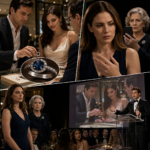
Her hand moved across the table with practiced smoothness, reaching as if to adjust my place card, which had shifted slightly askew during dinner. A perfectly innocent gesture. Helpful, even.
But as her palm glided over my champagne flute, it tilted.
Just slightly.
The colorless liquid from the tiny glass vial she held in her palm fell into my glass and dissolved instantly into the bubbles. The carbonation hid everything—no color change, no residue, nothing to indicate that anything had changed.
She pulled her hand back quickly, repositioning my place card with a satisfied little smile.
She thought no one saw.
But Sutton had forgotten about Adeline.
My best friend since law school sat at the VIP table directly across from us, positioned with a perfect view of the head table. While Sutton had been so focused on me, on Sterling, on making sure we didn’t notice her little trick, she’d completely overlooked the woman with the criminal defense lawyer’s eye for detail—and the instincts of someone who’d spent years studying how people commit crimes.
Adeline had seen everything. The gliding hand. The falling liquid. Sutton’s smirk.
My phone, lying face up on the table next to my champagne flute, buzzed.
Bzzzzzed.
The sound was subtle, lost in the ambient noise of two hundred guests celebrating, but I felt it, saw the screen light up with an incoming message. I glanced down.
An iMessage from Adeline. Five short words. All in capitals.
“SWAP GLASSES. SHE DRUGGED IT.”
My heart stopped. Actually stopped—then started again with a painful thud that I felt in my throat, my chest, my fingertips.
The world tilted slightly, the chandelier light suddenly too bright, the sounds around me suddenly too loud. I froze, every muscle in my body locking into place.
But years of client presentations, of high-stakes meetings, of maintaining composure when campaigns crashed or executives panicked— all of that training kicked in.
My face remained calm. Neutral. Perhaps a touch concerned, as any bride might be reading a text during her reception, but nothing more.
I glanced up slowly, carefully, catching Adeline’s eye across the room.
She gave me the smallest nod. Decisive. Certain.
She’d seen it. She was sure.
I looked down at the champagne flute in front of me. The golden liquid sparkled innocently, bubbles still rising in those perfect streams. It looked exactly like Sterling’s glass, exactly like David’s, exactly like Sutton’s.
But it wasn’t.
This was no longer ordinary sibling jealousy. This wasn’t Sutton throwing a tantrum or making demands or crying to our parents.
This was a calculated, targeted attack designed to ruin my reputation in front of my husband’s family.
She’d planned this. Had waited for the perfect moment.
She wanted me to drink that glass. Wanted me to become disoriented, confused, sloppy. Wanted Sterling’s family—the prestigious, old-money family she was so obsessed with—to see me make a fool of myself.
To see their new daughter-in-law as a drunk. As someone unfit for their son. Someone who couldn’t handle her alcohol at her own wedding.
The people-pleaser in me—the one who’d spent 29 years swallowing my feelings and accommodating Sutton’s tantrums and nodding when our parents demanded I make her happy—that version of Pamela died in that moment.
I knew I had to act. Had to swap the glasses somehow. Turn Sutton’s plan back on her.
But she was right there, less than two feet away, her attention fixed on both champagne flutes like a hawk watching prey.
I sat frozen in my chair, hyper-aware of every detail: the weight of my phone in my hand, the condensation forming on the outside of the poisoned champagne flute, the sound of Sutton’s breathing beside me—quick and excited, anticipating her victory.
She was watching those glasses. Both of them.
I couldn’t move. Couldn’t act. Not while her eyes were on them.
I needed an opportunity. A distraction.
I sat there, heart pounding, waiting.
Sterling squeezed my hand, mistaking my tension for wedding-day nerves.
“You okay?” he murmured.
“Perfect,” I managed, the lie smooth and practiced.
And then fate sent me the most powerful woman I’d ever met.
I heard it—the click of heels on hardwood. Expensive heels, the kind that cost more than some people’s car payments.
The sound came from behind us, from the direction of the VIP waiting room, a private space the hotel had designated for immediate family to use for touch-ups and moments of quiet.
The door opened.
Mrs. Eleanor stepped out.
Sterling’s mother was a force of nature contained in a 5-foot-6 frame. Her Oscar de la Renta gown—navy silk with intricate beading that probably cost more than my car—fit her perfectly.
Her silver hair was styled in an elegant chignon. Diamond earrings caught the light. She’d clearly been touching up her makeup, her lips now a fresh shade of classic red.
She walked along the back of our row of chairs, her path taking her directly behind the head table.
Click. Click. Click.
The sound of her heels was distinctive in the brief lull between courses, audible over the soft conversation.
I felt Sutton stiffen beside me.
If there was one thing my sister couldn’t resist, it was an opportunity to impress someone important. And Mrs. Eleanor was the most important person at this wedding—the matriarch of a family whose name appeared on buildings and scholarship funds, whose opinion could open doors or close them forever.
Sutton’s head whipped around so fast I’m surprised she didn’t get whiplash.
She practically leaped from her chair, stepping directly into Mrs. Eleanor’s path with the enthusiasm of a golden retriever seeing its owner after a long day.
“Oh, Mrs. Eleanor,” Sutton gushed.
Sutton’s voice went up an octave, dripping with manufactured sweetness.
“Were you resting in the VIP room too? I hope the reception isn’t too overwhelming for you. I know these events can be absolutely exhausting, especially with so many people wanting your attention.”
She’d turned her back completely to the table. To me. To the glasses.
In my head, Adeline’s text blazed like neon.
Swap glasses.
This was it. My only chance.
My hands moved to the bases of both champagne flutes. My fingers were steady—years of handling delicate presentation materials had given me precision I’d never appreciated until this moment.
I didn’t lift the glasses. That would be too obvious, too noticeable, even with Sutton’s back turned. Someone might see: a guest, a server, even Sterling if he happened to glance down.
Instead, I slid them.
Meanwhile, my sister’s voice echoed behind me.
“I must say,” Sutton continued, not waiting for a response, reaching out to lightly touch the sleeve of Mrs. Eleanor’s gown, “this Oscar de la Renta dress was absolutely born for you. The beading, the cut—it’s perfection. You have the most incredible eye for fashion.”
The silk tablecloth was perfect for this—expensive, smooth, with just enough friction to control the movement but not enough to resist it.
I applied gentle pressure to the bases of both glasses, pushing my drugged glass toward Sutton’s position while simultaneously pulling her clean glass toward mine. They glided across the fabric like figure skaters on ice, moving just one millimeter above the surface, the liquid inside barely rippling.
Swish.
I rotated the new glass slightly in my position, turning it so the faint lipstick mark Sutton had left on the rim faced away from where she’d been sitting.
The entire process took five seconds—exactly the time it took Sutton to finish her effusive compliment about the dress and start in on how much she admired Mrs. Eleanor’s philanthropic work with the Children’s Hospital.
No one noticed.
The servers were at the far end of the ballroom. The guests were engaged in their own conversations. Sterling was watching his Uncle Richard, who had indeed cornered my great-aunt Miriam near the bar.
But Adeline noticed.
I glanced toward the VIP table. She was holding her wine glass, but her eyes were on me. When our gazes met, the corner of her mouth lifted in the smallest smile.
She raised her glass fractionally—a toast only I could see.
My network of allies had worked perfectly, and I knew with absolute certainty that Adeline wouldn’t take her eyes off my sister for the rest of the night. She’d watch. She’d document. She’d be ready.
Mrs. Eleanor extracted herself from Sutton’s attention with the practiced grace of someone who’d been handling social climbers for decades.
“How kind of you to say so, dear. If you’ll excuse me, I should return to my table.”
She glided away, leaving a cloud of expensive perfume in her wake.
Sutton turned back to her seat and practically bounced into her chair, her face flushed with triumph.