WHEN I ANNOUNCED MY PREGNANCY, MOM SAID: ‘GREAT!, ANOTHER BURDEN. YOUR SISTER IS BUYING A HOUSE—THAT’S WHAT WE’RE CELEBRATING THIS MONTH.’ DAD NODDED: ‘WE WISHED YOU NEVER BORN—AND NOW THERE’LL BE 2 OF YOU.’ I SMILED AND LEFT THE TABLE. WHAT I HAD ALREADY SET IN MOTION THAT MORNING WOULD TAKE EVERYTHING FROM THEM
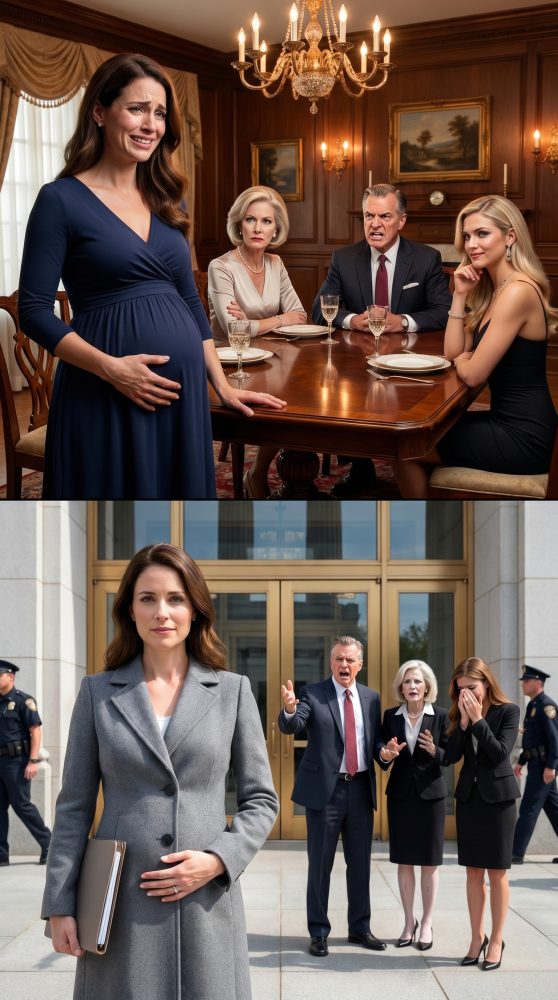
The room went quiet so fast I could hear the ice crack in my mother’s glass. Then she smiled, slow and cruel, and said, “Great. Another burden. Your sister is buying a house—that’s what we’re celebrating this month.”
My father didn’t even look ashamed. He just nodded, cut into his steak, and said, “We wished you were never born. And now there’ll be two of you.”
For one second, the whole dining table blurred. The chandelier above us shimmered like broken teeth. My sister Vanessa lowered her eyes, pretending not to enjoy it, but the twitch at the corner of her mouth gave her away. She loved this. She loved winning in a game I had never agreed to play.
I placed my hand over my stomach and smiled.
Not because it didn’t hurt.
Because pain was no longer useful.
“Congratulations on the house,” I said softly.
Then I stood, picked up my coat, and left the table before they could see the satisfaction in my eyes. Behind me, my mother scoffed. “There she goes. Always dramatic.”
No. Dramatic would come later.
Outside, the night air sliced through my lungs. I walked to my car with steady steps, even though my hands were shaking so hard I almost dropped my keys. I sat behind the wheel and stared at my reflection in the windshield: pale face, wet eyes, mouth set like stone.
At 9:12 that morning, before I ever stepped into that house, I had filed three documents, sent two encrypted folders, and triggered one investigation.
By dinner, none of them knew their lives had already started collapsing.
They thought I was the family failure. The disposable daughter. The one who was always “too sensitive,” “too quiet,” “not hungry enough.” Vanessa got the praise, the gifts, the introductions. Vanessa got the family business position, even though I had built half their expansion strategy from the shadows. Vanessa got the down payment for her dream house, though the money came from accounts I had quietly helped stabilize for years.
I got mockery. I got unpaid labor. I got told I owed them for the privilege of being tolerated.
What they never understood was that I had spent ten years learning every weak seam in the empire my father worshipped. I was their in-house counsel before I resigned. Their fixer before I disappeared. The daughter they insulted at dinner was the same woman who knew where every shell company was buried, every forged signature hidden, every tax lie polished for auditors.
And that morning, after finding out I was pregnant, I decided my child would never inherit my silence.
My phone lit up on the passenger seat.
A message from Adrian, my former colleague: Received. Regulators have everything. Freezing order likely by tomorrow. Are you safe?
I looked back once at the glowing windows of my parents’ house.
Inside, they were probably laughing.
I typed back: I am now.
Then I started the engine and drove into the dark, carrying the first peaceful breath I had taken in years.
By noon the next day, my father was calling me six times an hour.
I let every call ring out.
At 1:47 p.m., Vanessa finally texted: What did you do? Dad is furious.
I smiled at the screen and kept walking through the marble lobby of Hensley & Rowe, the firm that had hired me three months after I left my family’s company. I had gone from being invisible in my father’s office to becoming the attorney corporations called when their executives started sweating through custom suits.
Turns out being ignored had made me dangerous. People talk freely around women they don’t respect.
My boss, Marianne, met me outside the conference room. “The injunction held,” she said, handing me a file. “Accounts are frozen pending review. Fraud unit wants a formal statement this afternoon.”
“Good,” I said.
She studied my face. “You slept?”
“Enough.”
“You sure you want to do this while pregnant?”
That question, asked with real concern, nearly broke me more than my parents’ cruelty had. I inhaled carefully. “That’s exactly why I’m doing it.”
Inside the file was the collapse of everything my father had spent twenty-five years pretending was success. Embezzlement routed through supplier contracts. Tax evasion disguised as consulting fees. False property transfers. Money siphoned from minority partners. And the cleanest blade of all: the down payment for Vanessa’s new house had come directly from a corporate reserve account that legally could not be touched.
She hadn’t just bought a house.
She had walked into evidence.
At 3 p.m., I gave my statement.
At 5 p.m., my mother appeared in the firm lobby wearing pearls and panic. She had always treated public spaces like theater stages, but today her makeup couldn’t hide the fear leaking through her skin.
“You vindictive little snake,” she hissed the moment we were alone. “How dare you humiliate this family?”
I held her gaze. “You did that yourselves.”
She laughed sharply. “You think anyone will believe you? You were always unstable. Emotional. Jealous of your sister.”
The old words. The polished knives.
But old knives don’t cut when you’re wearing armor.
“I’m not asking anyone to believe me,” I said. “I gave them records.”
Her face changed. Just a flicker. Just enough.
So she hadn’t known how much I had.
Good.
She stepped closer. “Listen carefully. If your father goes down, you go down with him. You worked there.”
“I documented every objection. Every refusal. Every illegal instruction. Dated, archived, witnessed.” I leaned in slightly. “You taught me to keep receipts, remember?”
For the first time in my life, my mother looked small.
That evening, Vanessa made her move. She posted a glowing photo in front of the half-built house with the caption: Some women create life. Some women create legacy. Proud to be the daughter who builds.
Thousands of likes.
Dozens of comments.
A perfect, smug little crown.
An hour later, the financial crimes unit served a notice on the property developer, attaching the house lot to an active investigation.
By sunrise, the post was gone.
By noon, Vanessa was at my apartment door, mascara streaked, rage vibrating off her like heat from asphalt.
“You ruined my house!”
I opened the door just wide enough to look at her. “No. Dad did.”
“You could have warned us!”
I almost laughed.
Warned them?
After years of insults. After they treated my child like trash before it was even born. After my father moved money, forged approvals, and used my work to protect himself while calling me worthless at his table.
Vanessa jabbed a finger toward me. “You think you’ve won because you found paperwork?”
“No,” I said quietly. “I won because you all thought paperwork was beneath me.”
She stared, suddenly uncertain, as if seeing me clearly for the first time.
That was the moment she understood.
They had not humiliated the weak daughter.
They had cornered the one person who knew how to bury them lawfully.
The hearing was set for nine on a rain-soaked Thursday, one week after that dinner.
My father arrived in a navy suit that cost more than most people’s rent, flanked by lawyers who looked irritated to be associated with him. My mother sat rigid beside him, lips bloodless. Vanessa came last, stripped of glamour, wearing desperation like a second skin.
I entered with Marianne and took my seat without looking at them.
The courtroom wasn’t grand, but it didn’t need to be. Power doesn’t always roar. Sometimes it just waits under fluorescent lights with a stack of certified exhibits.
My father leaned across the aisle before proceedings began. “You still have time to fix this.”
I turned to him slowly. “No. You had time.”
His jaw clenched. “You ungrateful girl. Everything you have came from me.”
I almost pitied him. Men like my father mistake proximity for authorship. He had seen me in the building and assumed he had built me.
When the examiner began, the collapse was methodical.
Bank transfers. Internal approvals. Mismatched tax declarations. Testimony from two former partners. A digital trail tying reserve funds to Vanessa’s housing payment. Audio clips I had never told them existed—my father instructing accounting to “move it until after the audit,” my mother telling staff to backdate vendor contracts, Vanessa laughing that “no one checks family companies closely.”
Then came the final cut.
The examiner asked why I had stayed silent for so long.
I answered truthfully. “Because I was raised to believe surviving cruelty was loyalty. Then I found out I was having a child. And I understood silence is how poison becomes inheritance.”
The room went still.
Even the rain seemed to hesitate against the windows.
My mother broke first. “She’s lying! She always wanted to destroy us!”
Marianne slid forward one last exhibit: the email chain proving I had repeatedly warned them, in writing, to stop the transfers, stop the falsifications, stop using me as legal cover. Their replies were all there—dismissive, mocking, arrogant.
One from my father read: Do your job and stop acting like family means nothing.
Another from my mother: Your sister deserves this investment more than you ever deserved anything.
Vanessa started crying, but it was too late for tears to look human. They looked strategic.
By afternoon, temporary criminal referrals were issued. Corporate control was suspended. Several accounts remained frozen. The property purchase was voided. My father’s board forced his resignation before sunset. My mother, once adored in charity circles, found her invitations vanish like smoke. Vanessa’s fiancé ended things within forty-eight hours, citing “misrepresentation, reputational harm, and trust concerns.”
Three months later, I signed papers for a sunlit townhouse with a small garden.
Not a mansion. Not an empire. Just peace.
My son was born in early spring, pink and furious and perfect. When I held him the first night, the hospital room was dim and golden, and for the first time in my life, I understood what family was supposed to feel like: not fear, not debt, not competition—safety.
News of my parents reached me in fragments. My father was fighting charges and selling assets. My mother had moved in with a cousin she once mocked. Vanessa was trying to sue the developer, the bank, anyone who might help her pretend she was a victim.
I never responded.
One evening, I sat on my back steps with my son asleep against my chest, the air warm, the sky streaked with violet. My phone buzzed with a message from an unknown number.
You tore this family apart. Was it worth it?
I looked at the garden lights, the quiet house, the tiny hand curled against me.
Then I typed the only answer they would ever get.
No. You tore it apart. I just made sure it couldn’t keep swallowing us alive.
I blocked the number, kissed my son’s forehead, and listened to the silence.
It sounded like victory.