Everyone Feared the Mafia Boss – and His Deaf Daughter
No waiter dared speak to Adrian Voss’s deaf daughter, no guest dared stare, and even the silverware seemed afraid at table nine—until Hannah Reeves noticed the untouched fish, the lonely card, and the child behind all that fear, then signed the words everyone else was too scared to say.
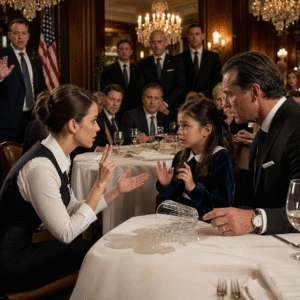
Do not look at his hands, do not look at his face, and for the love of God, Hannah, do not look at the little girl, Mr Ross whispered.
His fingers dug into Hannah Reeves’s shoulder hard enough to leave crescents through the thin cotton of her uniform, but she barely felt the pressure anymore.
Beyond the swinging kitchen doors, The Whitestone Room had fallen into a silence so complete the silverware seemed afraid to touch the plates.
The restaurant was built for people who never lowered their voices because money had taught them the world would lower itself first.
Crystal chandeliers burned above marble floors, waiters moved like shadows between white linen tables, and every bottle of wine cost more than Hannah’s rent.
Yet that evening, all the power in the room had gathered around one corner table near the tall windows overlooking the rain slicked avenue.
Adrian Voss sat there with his back to the wall, black suit unwrinkled, dark eyes calm, hands folded beside an untouched glass.
Every newspaper in the city had printed his name beside words like syndicate, empire, investigation, missing witness, and suspected execution.
No one ever said those words inside The Whitestone Room, not while Adrian Voss was eating there, and certainly not while his daughter sat beside him.
The girl was nine, small inside a pale blue dress, her dark hair pinned behind her ears with pearl clips.
Her name, Hannah had heard from the terrified servers, was Elise Voss, and everyone treated her like an unexploded grenade wrapped in silk.
Not because she screamed, not because she threw tantrums, not because she carried any visible weapon, but because she belonged to him.
And because Elise was deaf, the staff feared every mistake would happen in a language they could not understand until Adrian Voss punished them for it.
A busboy had once set sparkling water instead of still water beside her plate, and he had quit before dessert, shaking so badly he forgot his coat.
A hostess had smiled too brightly at Elise and received one cold look from Voss; by morning, her husband’s failing business loan was suddenly called due.
Those stories grew in the kitchen like mold, dark and sticky, until Elise became less a child than a warning no one wanted to touch.
So when Hannah saw the little girl staring at the bread basket with both hands clenched in her lap, something inside her shifted.
She had grown up with silence too, though not the expensive kind surrounding marble tables and dangerous men with drivers outside.
Her younger brother, Caleb, had lost most of his hearing after meningitis when he was six, and Hannah had learned sign language before algebra.
She knew the look Elise wore because Caleb had worn it in classrooms, churches, and birthday parties where adults talked over him.
It was the look of a child being treated like a locked door when she was really just waiting for someone to knock correctly.
Mr Ross leaned closer, his voice breaking. Table nine needs water. Nothing else. You pour, you leave, and you pretend you are furniture.
Hannah nodded because she needed the job, because rent was due, because her mother’s medical bills still arrived with cheerful threats.
Then she picked up the chilled glass bottle, pushed through the kitchen doors, and walked into the silence everyone else had chosen.
Every eye followed her. The lawyer at table six stopped mid-whisper. A woman in diamonds lowered her fork without chewing.
Adrian Voss did not move, but Hannah felt the weight of his attention before she reached the table, like winter entering her lungs.
She poured water into his glass first, careful and quiet. Then she turned toward Elise, who stared down at her empty plate.
The little girl’s shoulders were tight, and her lips pressed together with the practiced patience of children used to being misunderstood.
Beside her napkin sat a small card printed with three words in neat black letters: Do Not Disturb.
Hannah knew instantly it had not been written by Elise. It was too hard, too final, too adult in its loneliness.
She should have poured the water and left. She should have obeyed Mr Ross. She should have protected herself.
Instead, Hannah lowered the bottle, caught the little girl’s gaze, and signed with both hands, Hello. My name is Hannah.
The room did not gasp because no one understood what had happened yet, but Adrian Voss’s head lifted one deliberate inch.
Elise blinked. Her mouth parted. For a second, she looked frightened, as if kindness were a trap adults had used before.
Then her small fingers rose from her lap and answered, Your name is Hannah? You sign? I have not seen anyone sign here.
Hannah smiled gently, keeping her hands slow and clear. Yes. My brother is deaf. Do you want bread or something different?
Elise’s face changed so quickly it hurt to watch. The guarded stillness cracked, and under it was a hungry, lonely child.
I wanted soup, Elise signed. But they brought fish. I hate fish. Papa thinks I am not hungry.
Hannah glanced at the untouched plate, then at Adrian Voss. His expression had not changed, but his eyes were no longer calm.
They were fixed on Hannah’s hands as if they had become a weapon, a key, and a betrayal all at once.
For the first time that night, Voss spoke. What did she say? His voice was low enough to make nearby guests stop breathing.
Hannah’s throat tightened. She could have softened it. She could have lied. She could have spared everyone the truth.
But Elise was watching her, waiting to see whether this new language would become another cage controlled by adults.
So Hannah straightened her spine and said, Sir, she said she wanted soup, not fish. She said she hates fish.
The silence deepened. Somewhere near the bar, a glass slipped against wood with a tiny, terrified click.
Adrian looked at his daughter. Elise looked back, chin trembling, hands clutched together now that the truth had entered the room.
Slowly, clumsily, Adrian lifted his own hands. His fingers formed shapes that were stiff, uncertain, and painfully rehearsed.
Soup? he signed.
Elise froze. Hannah froze. Even the rain seemed to hesitate against the windows.
The most feared man in Chicago, a man whose name made federal agents cautious and rival bosses disappear, knew one word in his daughter’s language.
One word, and judging by the effort in his hands, it had cost him something private to learn it.
Elise nodded once. Her eyes filled, but she did not cry. She signed back, You learned that?
Adrian swallowed. His mouth barely moved. Slowly, he signed another word. Trying.
That was when Hannah understood the real tragedy at table nine. It was not that a mafia boss had a deaf daughter.
It was that every person around him had been so afraid of his power that they had abandoned the child inside it.
Fear had built walls around Elise, and Adrian, terrifying as he was, had mistaken those walls for protection.
Hannah turned toward Mr Ross, who stood near the kitchen doors looking ready to faint. Tomato soup, no fish, please.
No one argued. Three cooks nearly collided making it. A waiter dropped a spoon, cursed under his breath, and crossed himself.
When Hannah returned with the soup, Elise signed thank you so quickly her fingers almost blurred with excitement.
Hannah signed back, You are welcome. It is nice to meet you, Elise.
Adrian watched every movement. Then he said, You will serve us whenever we come here.
It was not a request, but it was not exactly a threat either. It sounded like a door opening in a locked house.
Over the next month, table nine became Hannah’s table. Every Thursday at seven, Adrian Voss arrived with Elise and two silent bodyguards.
The whispers never stopped, but they changed. People no longer stared at Elise as if she were cursed.
They stared because she laughed.
She told Hannah about school, about a teacher who talked too fast, about a classmate who tried to learn her name sign.
She complained about vegetables, asked for extra chocolate cake, and confessed she pretended to like opera because her grandmother loved it.
Hannah listened, translated when Elise wanted her father included, and refused to turn the girl into entertainment for curious strangers.
Adrian learned more signs. Slowly. Badly. With the same severe concentration other men reserved for loading guns or counting money.
More. Finished. Good. Tired. Home. Sorry.
The first time he signed sorry, Elise stared at him for nearly ten seconds before signing, For what?
Adrian’s hands lowered. His jaw tightened. Then, in a voice even Hannah barely heard, he said, For being late.
He did not explain late to what. Childhood, perhaps. Language. Love. All the small doors a father should have opened sooner.
Then one Thursday, Adrian arrived without Elise.
The dining room tightened instantly. His suit was darker than usual, his bodyguards stood closer, and rain streaked the windows like warning lines.
Hannah approached with water, heart already pounding. Mr Voss, is Elise all right?
His eyes cut to hers. For once, the calm was gone. She is at home. Someone followed her school transport yesterday.
The bottle nearly slipped from Hannah’s hand. Followed her?
A black sedan. No plates. My men lost it. He paused. Elise saw more than they thought.
Hannah understood before he asked. You want me to ask her?
I want you to talk to my daughter, he said. Not like police. Not like soldiers. Like someone she trusts.
Every survival instinct in Hannah told her to refuse. This was not soup, not bread, not a lonely child in a restaurant.
This was the world behind Adrian Voss’s headlines, the violent machinery everyone pretended not to understand.
But then she imagined Elise sitting somewhere guarded and frightened, carrying important details no one could reach because fear kept interrupting language.
I can help her describe what she saw, Hannah said carefully. But I will not scare her for you.
For the first time, Adrian Voss looked almost human. I know.
He took Hannah to a townhouse with iron gates, cameras, and men who spoke quietly into sleeves. Inside, Elise sat in a library.
She ran to Hannah the moment she entered and threw her arms around her waist.
Hannah hugged her back, feeling the child tremble. Then she knelt and signed, You are safe with me. Tell me slowly.
Elise described the sedan, the cracked rear window, the silver bird sticker, and the man with a scar through one eyebrow.
She remembered because silence had made her observant. People underestimated her because she did not speak, so they forgot she watched everything.
Adrian stood across the room, listening to Hannah translate each detail. With every sentence, his face hardened into something colder than anger.
When Hannah finished, he turned to his men and gave three quiet instructions that made them leave as if the floor had caught fire.
Then he faced Hannah. You may have saved her life.
Hannah wanted to say she had only listened. But maybe that was the point. Listening had become rare enough to look like bravery.
The next morning, Chicago woke to rumors of a kidnapping plan stopped before it began, a rival crew dismantled without a single public shot.
No newspaper mentioned a waitress. No headline mentioned a deaf girl whose eyes had noticed what armed men missed.
But at The Whitestone Room, everything changed.
Mr Ross stopped touching Hannah’s shoulder. Servers stopped whispering warnings about Elise. The card reading Do Not Disturb disappeared forever.
Adrian still came on Thursdays, but now he sat beside his daughter instead of across from her.
He practiced signs over dinner, sometimes wrong enough to make Elise laugh until her soup nearly spilled.
The first night he signed I love you, he did it so stiffly Hannah almost looked away from the tenderness of it.
Elise did not laugh. She pressed both hands to her chest, then answered him with a softness no one in that room deserved to witness.
Months later, people would still tell the story incorrectly. They would say a fearless waitress charmed a mafia boss and survived.
But the truth was that Hannah had seen a little girl inside a fortress of fear and understood silence was not emptiness.
The truth was that Elise Voss had never needed pity, only access, respect, and one person willing to meet her where she lived.
And the truth was that Adrian Voss, feared by an entire city, had been defeated by his daughter’s first smile.
After that, nobody at The Whitestone Room avoided Elise Voss again. They made space for her hands. They watched her face. They learned to wait.
In a city ruled by men who believed power was the ability to make others silent, one waitress proved the opposite.
Real power was hearing the person everyone else had been too afraid, too proud, or too careless to understand.
