At my wedding, my parents wore black funeral attire.My mother took the microphone: “We’ll stay here until you sign the house transfer papers for your sister!”My sister laughed.My husband calmly stood up and pointed at the screen.What appeared on the screen made them flee the venue.
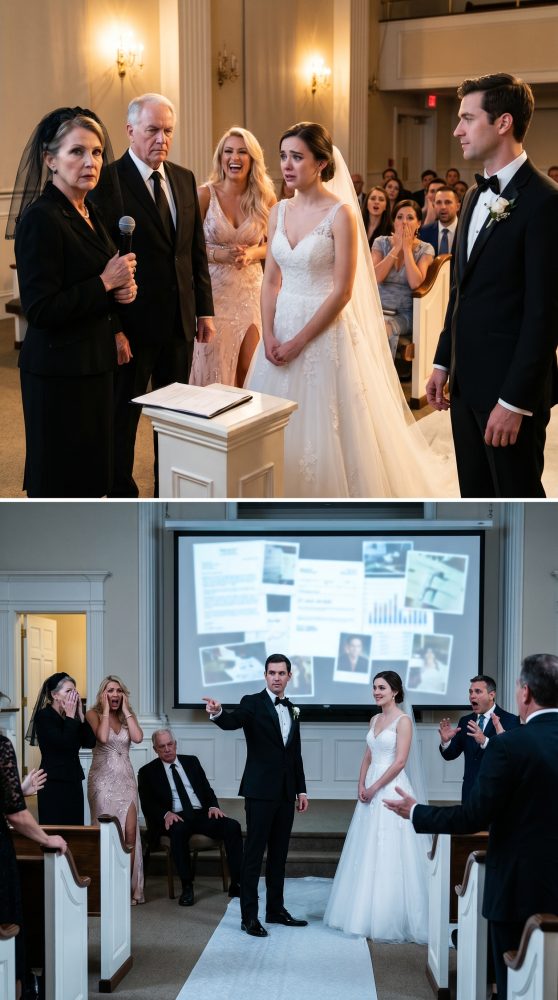
The first thing my mother did at my wedding was mourn me like I had died. The second was smile while doing it.
When the chapel doors opened, every guest turned, expecting silk and celebration. Instead, my parents walked in wearing black funeral clothes, my mother in a severe velvet dress with a lace veil, my father in a dark suit with a black tie pinned like mourning ribbon. Behind them came my sister Vanessa, laughing under her breath, dressed in pale ivory that almost passed for white. She wanted attention the way fire wanted oxygen. My mother wanted obedience. My father only wanted whatever kept trouble away from him. Together, they had come to bury me before I said my vows.
A murmur swept the room. I stood at the front beside Adrian, my soon-to-be husband, and felt every eye cut toward me. My pulse kicked once, then settled. I had spent my life being trained for humiliation. This one was simply better dressed.
My mother reached the first pew and looked me over as though inspecting a coffin. “Still time to do the right thing,” she said.
Vanessa linked her arm through our father’s. “She won’t. She likes pretending she earned things.”
The house they wanted had belonged to my grandmother, the only person in my family who had ever loved me without conditions. She left it to me because I was the one who sat beside her through chemo, paperwork, and those long gray afternoons when everyone else was too busy. Vanessa only visited when she needed money. My parents called that youth.
For months they had pressured me. Sign the transfer. Be generous. Your sister has children. Your sister deserves stability. When guilt failed, insults followed. When insults failed, threats arrived dressed as family concern. I refused every time.
The officiant cleared his throat. “Shall we continue?”
“No,” my mother said, loud enough to split the room.
She stepped forward, took the microphone from the wedding singer, and turned toward the guests with the confidence of a woman who had never been denied in public.
“We will stay right here,” she announced, “until my ungrateful daughter signs the house transfer papers for her sister.”
Gasps rippled through the chapel. Vanessa laughed, bright and ugly. My father stared at the floor. A cousin covered her mouth. Someone whispered, “My God.”
My mother lifted a folder. “I brought the papers. We can do it now.”
Adrian’s hand brushed mine. Warm. Steady. Waiting.
I looked at the folder, then at my family, and for one suspended second I let them believe what they always had: that I would freeze, cry, fold. That the quiet daughter was the weak daughter. That kindness meant helplessness.
Instead, I smoothed my veil, met my mother’s stare, and said softly, “You really chose today?”
Vanessa smirked. “Best day. You can’t make a scene.”
Adrian exhaled once, almost amused.
That was when I knew they still had no idea who they had cornered. Yet. Still.
My mother mistook my silence for surrender. She always did.
She marched to the signing table near the altar and spread the papers with theatrical precision, as if this were holy ritual and not extortion in a church. Vanessa followed, tossing her hair over one shoulder, glowing with the arrogance only protected people possess. My father stood behind them with the look of a man praying disaster would choose another address.
Guests shifted in their seats, embarrassed and fascinated. Phones appeared, discreet at first, then openly. Humiliation had become entertainment. My mother didn’t care. Public pressure had always been her favorite weapon.
“Don’t drag this out,” she said into the microphone. “You’ve caused enough pain.”
“Pain?” Adrian asked, calm.
Vanessa gave him a sweet, poisonous smile. “This is family business.”
He looked at her as if she were dirt on polished marble. “You made it everyone’s business the second you hijacked our wedding.”
A few guests chuckled. My mother flushed.
She shoved a pen toward me. “Sign, Lena.”
I did not move.
“You told people I was selfish,” I said. “You told them Grandma changed her will because I manipulated her.”
My mother lifted her chin. “Because you did.”
“Interesting.”
Vanessa crossed her arms. “Why are you acting mysterious? It’s a house. You got lucky. It should have gone to me.”
“No,” I said. “It went where Grandma wanted.”
Vanessa’s smile sharpened. “She was confused.”
That struck harder than the ambush. They could insult me all day. But they would not erase the mind of the woman who built her life from nothing, balanced accounts at eighty-two, and knew exactly what she was doing when she rewrote her estate.
Adrian squeezed my fingers once. It was the signal.
At the back of the chapel, Noah, his best man, tapped his phone. The projector screen meant for our wedding video flickered awake.
Vanessa frowned. “What is this?”
My mother spun toward the booth. “Turn that off.”
“Not yet,” Adrian said.
His voice was quiet, but it traveled. The room stilled.
For the first time that morning, uncertainty moved across my mother’s face.
Because Adrian was not simply the patient groom they had dismissed. He was a litigation attorney who prepared like war was coming. And I was not the cornered bride they thought they could shame into obedience. I was a forensic accountant who had spent six months following a trail my family didn’t know they had left.
I looked directly at Vanessa. “You should have stopped after the forged caregiving invoices.”
Her color changed.
My father blinked. “What invoices?”
My mother snapped, “Don’t answer her.”
Too late.
The first image appeared on the screen: bank transfers highlighted in red. Then reimbursement requests. Then messages. Then dates lining up so neatly they looked like gravestones.
Guests leaned forward.
Vanessa took one step back.
And in that moment, under the hot chapel lights, my sister learned the most dangerous thing a predator can discover too late.
The prey had been collecting evidence.
The screen filled the chapel with truth, and truth was uglier than any funeral dress.
Slide after slide rolled forward. Vanessa had submitted fake caregiving expenses during my grandmother’s illness, billing the estate for nurses who never existed, medications never bought, transportation never arranged. She routed money into an account our mother helped open under a shell business name. My mother’s signature appeared on approval forms. Then her voice came through the speakers: “Take the reimbursement now. She won’t last long enough to notice.”
The room turned to stone.
“No,” my father whispered.
Then came the next blow. Messages between Vanessa and a broker, dated two weeks before Grandma died. Price discussions. Renovation plans. Notes about “removing Lena fast” after the transfer. She planned to sell the house.
Vanessa lunged toward the screen. “This is illegal. You can’t show private messages.”
Adrian stood. “Actually, I can. They were produced through lawful discovery after your fraudulent invoices triggered a preservation order.”
My mother gripped the microphone. “You set us up.”
I faced her. “No. I gave you chance after chance to stop.”
Her eyes went wild. “She is our daughter,” she cried.
“And Grandma was your mother,” I said. “You stole from her while she was dying.”
That landed harder than any scream.
My father looked at the screen, then at my mother, then at Vanessa. “Tell me this isn’t true.”
Neither of them spoke.
A murmur exploded through the chapel. An aunt stood and called my mother disgusting. A cousin began crying. Someone said Noah had sent the evidence package to the police. Adrian had planned for panic and lies.
Vanessa recovered first. She pointed at me with a shaking hand. “You ruined your own wedding for a house.”
I almost pitied her.
“No,” I said. “You ruined your lives for one.”
At the chapel entrance, two officers stepped inside. A complaint had been filed that morning, timed after confirmation that my mother intended to force the transfer in public. The funeral clothes, the papers, the microphone stunt, everything helped establish coercion, fraud, elder financial abuse, attempted extortion.
My mother went pale. Vanessa fled first, heels slipping on the polished floor, but the officers intercepted her before she reached the doors. My father sank into a pew.
As they were escorted out, my mother turned back and hissed, “You’ll regret this.”
I looked at Adrian, then at the flowers and altar, and felt something inside me uncoil.
“I already survived you,” I said. “This is the part where I stop paying for it.”
Six months later, the house was restored, sunlight pouring through the windows my grandmother loved. The court had frozen Vanessa’s assets, my mother had taken a plea deal, and my father was living alone, calling relatives who no longer answered. Adrian and I kept the wedding photo from after the arrests, the one where I am laughing without fear.
People still call it a scandal.
They are wrong.
It was a burial.
Just not mine.
At last.





