I CAME HOME FROM WORK TO FIND MY BABY CRYING IN THE RAIN—SOAKED, SHIVERING, ABANDONED. MY MOM STOOD IN THE DOORWAY: ‘I DON’T RAISE BASTARDS.’ MY SISTER LAUGHED, ‘SERVES YOU RIGHT, FILTHY LITTLE WHORE.’ I GRABBED MY SON AND…
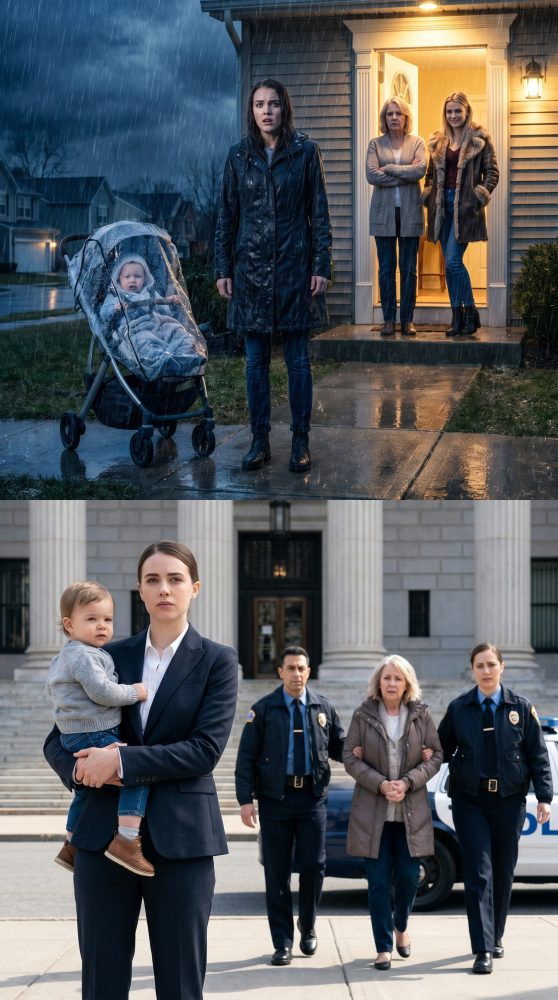
My son was screaming so hard he could barely breathe. He was strapped into his stroller in the middle of the rain, soaked to the skin, his tiny fists blue with cold, while my mother stood under the porch light like she was watching trash wash down a gutter.
“I don’t raise bastards,” she said.
My sister, Lena, leaned against the doorway with a wineglass in her hand, smiling like cruelty was a private joke. “Serves you right, filthy little whore.”
For one second, the whole world narrowed to the sound of rain hitting plastic, to my baby’s broken cries, to the electric taste of fury rising in my throat. Then instinct took over. I tore him free of the straps, wrapped him inside my coat, and pressed his wet head against my neck.
“It’s okay,” I whispered, though my hands were shaking so badly I could hardly hold him. “Mommy’s got you.”
“You should be thanking us,” my mother snapped. “Maybe now you’ll learn shame.”
I looked up at her. Really looked. Her lipstick was perfect. Her hair was dry. Lena’s manicure glinted in the porch light. They had done this carefully. Deliberately. They had listened to him cry and chosen not to stop.
Something inside me went silent.
I walked past them without another word, stepped into the house, grabbed the diaper bag, the formula tin, the medical folder, and the small gray fireproof box from my bedroom closet.
Lena laughed behind me. “Running to your mystery boyfriend?”
I turned at the door. “No,” I said quietly. “Running from my last mistake.”
They thought I meant the baby.
They were wrong.
At the emergency clinic, the pediatric nurse took one look at Noah’s trembling body and called the doctor himself. Mild hypothermia, they said. Dangerous, but caught in time. He’d be okay. I sat beside the warming crib, still in wet clothes, and let the rage settle into something colder, harder, cleaner.
Then I made three calls.
The first was to my lawyer.
The second was to Child Protective Services.
The third was to Detective Alan Rowe, who had been waiting for my answer for six weeks.
When he picked up, his voice was low and sharp. “Ms. Vale?”
“I’m ready,” I said, staring through the glass at my son. “I’ll testify.”
There was a pause. Then: “Did something happen?”
“Yes.”
“Are you safe?”
I looked down at the fireproof box in my lap. Inside it were copies of account transfers, shell company registrations, forged signatures, and property deeds my mother thought I had never noticed. For months, I had been documenting everything—because my family’s favorite sport had always been theft dressed up as entitlement. They had already siphoned money through my late father’s business. They had already tried to force me to sign away my share. Tonight, they made the one mistake that could not be negotiated, explained, or forgiven.
“They touched my child,” I said.
Detective Rowe’s voice changed. It turned professional in the way a blade turns bright.
“Then don’t worry,” he said. “They just made this easy.”
By midnight, Noah was sleeping under a warm blanket, his breathing soft and even. I sat beside him and signed the statement I should have signed long ago.
Outside, the storm kept pounding the windows.
Inside, I finally stopped being afraid of what I was about to do.
By morning, my mother was already rewriting the story.
“She ran off hysterical,” she told relatives over the phone. “Accusing us of abuse because she can’t handle motherhood.”
Lena posted a photo of herself at brunch an hour later with the caption: Some women open their legs and call it a personality. Her friends filled the comments with laughing emojis and fake concern. She wanted me humiliated in public. She wanted me desperate enough to come crawling back.
Instead, I moved into the penthouse suite my company kept for executive security cases and turned off my phone for everyone except five people: my lawyer, Detective Rowe, my pediatrician, my assistant, and the bank’s fraud division.
At noon, my mother arrived at my office building in pearls and indignation, demanding to see me. She still believed I was just the quiet daughter who handled paperwork, kept her head down, and let louder people win. The receptionist called upstairs.
“Should I send her away, Ms. Vale?”
I smiled for the first time in twelve hours. “No. Send her to Conference Room B.”
When I walked in, she was already sitting at the table like she owned the building. Lena was with her, sunglasses in her hair, legs crossed, expression dripping contempt.
My mother folded her arms. “You’ve embarrassed this family enough.”
I set Noah’s medical report on the table. Beside it, I placed printed screenshots of Lena’s post, a copy of the clinic timeline, and a still image from the neighbor’s security camera showing my son left outside in the rain at 6:14 p.m.
Lena’s smile slipped.
“Where did you get that?” she asked.
“Next door,” I said. “Mrs. Hargrove saves everything.”
My mother recovered fast. “You’re being dramatic. He was outside for a minute.”
“Twenty-six minutes.”
“That old woman can’t tell time.”
“The footage can.”
Lena leaned forward. “What do you want, money?”
I almost laughed. They really had no idea.
“No,” I said. “I want accuracy.”
I slid another folder across the glass. This one made my mother go still. It contained transfer records from my father’s company, the one she had claimed was failing when he died. It had not been failing. It had been stripped. Slowly. Quietly. Through vendor accounts that didn’t exist, consultant invoices that looped back to Lena’s lifestyle brand, and one holding company registered under a name my mother used only on old tax filings.
“You went through my papers?” she whispered.
“I audited the estate two months ago.”
Lena barked a laugh that sounded too loud. “So what? You’re an accountant. Crunching numbers doesn’t make you dangerous.”
I met her eyes. “Chief forensic accountant for the state attorney’s office,” I said. “Actually, it does.”
The silence hit like a dropped curtain.
My mother stared at me as if seeing a stranger. That was the moment I knew they had truly underestimated me. For years they had treated my work like some boring little clerical hobby because I let them. Because quiet women are easiest to rob when arrogant people mistake silence for weakness.
“You wouldn’t dare,” my mother said finally.
I leaned back. “I already did.”
Right on cue, the conference room door opened. Detective Rowe stepped in with another officer and a woman from Child Protective Services. Lena’s face drained white. My mother stood so fast her chair scraped hard against the floor.
“This is harassment,” she hissed.
Rowe set a warrant on the table. “No, ma’am. This is procedure.”
Lena looked at me like she wanted to claw my eyes out. “You set us up.”
“No,” I said. “You just never imagined I was worth being careful with.”
Then the CPS investigator turned to my mother and asked the question that cracked the room open clean in half.
“Mrs. Mercer,” she said, “why did you tell three witnesses you don’t raise bastards while a six-month-old infant was left outside in a storm?”
For the first time in my life, my mother had no answer.
The arrests happened forty-eight hours later.
Not for what they did to Noah—though the child endangerment charge landed first and hard—but for everything wrapped around it like rotten silk: fraud, embezzlement, tax evasion, forged estate documents, and conspiracy. Once the warrants hit their house, the rest came fast. Hidden ledgers. Burner phones. Jewelry bought with company funds. Lena’s influencer life collapsed in a spray of seizures and subpoenas.
They had stolen for years. They had bullied witnesses, manipulated clergy, lied to relatives, and fed on the certainty that nobody would ever challenge women who performed respectability so well. What they never understood was that numbers are loyal when people are not. Money leaves footprints. And cruel people always think terror is enough to keep smarter people obedient.
It wasn’t.
The final confrontation happened in court.
My mother sat at the defense table in navy wool and outrage, as if dignity could be tailored. Lena looked wrecked under her makeup, her usual smirk replaced by a twitchy, hunted glare. They both stared at me when I took the stand with Noah’s silver rattle tucked inside my bag like a promise.
Their attorney tried to paint me as vindictive, unstable, immoral. A single mother. Emotional. Compromised.
I answered every question in a level voice.
Yes, I had documented irregularities.
Yes, I had backed up all relevant files.
Yes, I had waited because I wanted enough evidence to make prosecution stick.
Yes, my child had been used as a weapon against me.
Then my lawyer played the audio.
Not dramatic music. Not some miracle witness. Just Lena’s own voice memo, recovered from cloud backup, sent to a friend the night before the storm:
Mom says if we scare her hard enough, she’ll sign anything. Leave the brat outside for a bit. She folds when she panics.
The courtroom went silent in that terrible, hungry way silence does when truth finally arrives.
Lena made a choking sound. My mother closed her eyes.
I turned and looked at them both. “You were right about one thing,” I said when the prosecutor asked if I had anything further to add. “I did panic. For exactly thirty seconds. After that, I remembered who I was.”
My mother’s voice cracked across the room. “You ungrateful little—”
The judge slammed his gavel. “One more outburst and I’ll have you removed.”
She stared at me, and for the first time there was no contempt in her face. Only fear.
Sentencing took three weeks. Child endangerment. Financial crimes. Restitution orders. Asset seizure. Probation denied. Lena sobbed when she heard the term of imprisonment. My mother did not sob. She simply looked old, suddenly and completely old, like her cruelty had been the scaffolding holding her upright and now it was gone.
Three months later, spring came soft and gold.
Noah sat in the grass of our new backyard, laughing as sunlight flickered through the trees. My house was quiet, white-walled, full of windows and warmth. Safe. The court had restored my father’s company share and granted full control of the remaining assets through a restitution settlement. I sold the old family home. I donated half the furniture. I kept nothing that smelled like them.
People still sent gossip sometimes. Lena’s followers vanished. Her brand died in a week. My mother’s church friends stopped visiting after the news reports and trial transcripts spread through town like fire through dry paper. Reputation had been their favorite weapon. Losing it was, I think, the wound they felt most deeply.
That evening, I lifted Noah into my arms and held him against my chest as the sky turned amber.
He was warm. Dry. Safe.
Once, they had stood in a doorway and decided my child was disposable, and I was weak enough to survive it quietly.
Now the doorway was mine.
And when the wind moved through the garden, all I heard was peace.