WHEN I COLLAPSED AT MY GRADUATION, THE DOCTORS CALLED MY PARENTS. THEY NEVER CAME. INSTEAD, MY SISTER TAGGED ME IN A PHOTO: ‘FINALLY—PARIS FAMILY TRIP, NO STRESS, NO DRAMA.’ I SAID NOTHING. DAYS LATER, STILL WEAK AND HOOKED TO MACHINES, I SAW 65 MISSED CALLS — AND A TEXT FROM DAD: ‘WE NEED YOU. ANSWER IMMEDIATELY.’ WITHOUT THINKING TWICE, I…
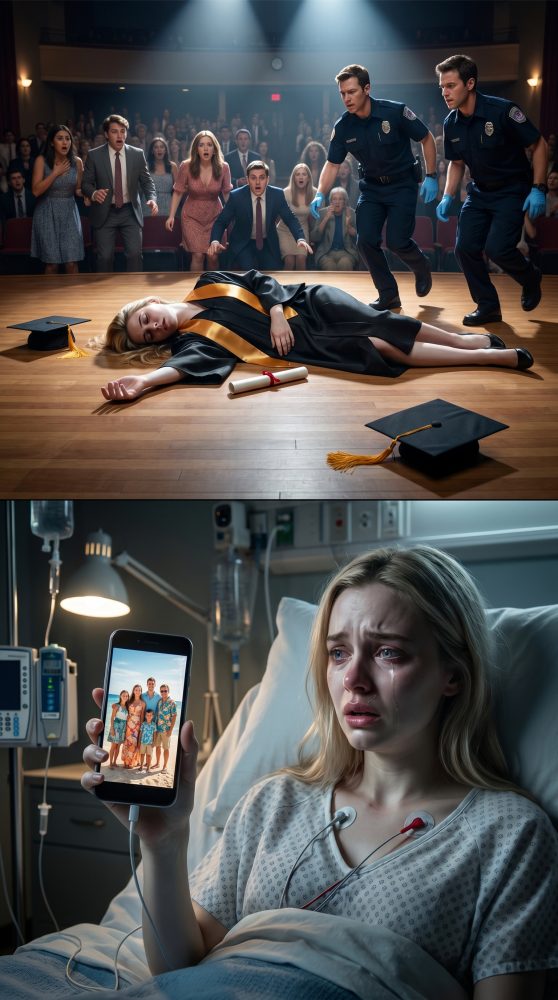
I hit the gymnasium floor before the applause finished. One second I was holding my diploma under the hot white lights, and the next I was tasting blood, hearing screams, and watching my graduation cap roll away like something detached from my own life.
When I woke up, the room smelled like antiseptic and plastic. A monitor ticked beside me. My chest ached. My arm was pinned under IV lines. A nurse noticed my eyes open and said, “Easy. You collapsed twice. Severe arrhythmia. We called your emergency contacts.”
“My parents?” My voice scraped.
Her silence told me everything. “We reached them,” she said. “They said they were out of the country.”
An hour later, my phone buzzed on the tray. I dragged it close and saw the notification that split me deeper than the pain in my chest.
My sister Vanessa had tagged me in a photo. She stood on a Paris balcony, champagne raised, grinning like victory. My parents posed beside her in matching coats, the Eiffel Tower burning gold behind them. The caption read: FINALLY—PARIS FAMILY TRIP. NO STRESS, NO DRAMA.
No stress. No drama. As if I were the stain they had finally scrubbed off the family portrait.
I said nothing. I had years of practice.
Vanessa broke things and got called “spirited.” I fixed them and got called “cold.” She crashed cars, forged signatures, vanished with stolen cards, and somehow remained the favorite. I earned scholarships, worked nights, cleaned up their financial messes, and still got treated like an unpleasant obligation. My mother liked to say Vanessa was easy to love. Dad preferred to say I made people uncomfortable because I remembered details.
Two days later, I was still weak, still wired to machines, still sleeping in fragments. That was when I checked the rest of my phone and found sixty-five missed calls. Dad. Mom. Vanessa. Under them sat one text from my father.
WE NEED YOU. ANSWER IMMEDIATELY.
I laughed so suddenly the heart monitor jumped.
Dad called again before I could decide whether to ignore him. I answered on speaker and said nothing.
“Where are you?” he demanded.
“In the hospital.”
A pause. “Still?”
Not Are you okay. Not We’re coming. Just annoyance that I was still inconvenient.
Then his voice dropped. “Listen carefully. There’s a problem with the trust paperwork. We need your login, your authorization, and the Rothwell file. Now.”
My pulse steadied instead of spiking. The Rothwell file.
Months earlier, when Dad’s accounting firm started bleeding clients, he had transferred several family holdings into a structure I designed. He called it temporary cleanup. What he never understood was that I read every clause I drafted, every consent, every emergency trigger. He signed papers the way careless men load guns.
“You need me?” I asked.
“Yes,” he snapped. “So stop being dramatic and do your part.”
For the first time, I heard the fear under his contempt.
For the first time, I realized something beautiful.
They had abandoned the wrong child.
I did not give them anything that night. I asked for water, let the silence stretch, and listened to my father breathe like a man standing on rotten ice.
“What problem?” I said.
“The Rothwell account is frozen.”
“That sounds serious.”
“Don’t play games with me, Elise.”
I looked at machines reflecting in the window. “You left me in a hospital bed while you toasted yourselves in Paris.”
My mother cut in, sharp. “We did not leave you. We had nonrefundable reservations.”
Vanessa laughed somewhere nearby. “God, she’s milking this.”
The cruelty no longer hurt. It clarified.
Dad tried on reason. “There was a misunderstanding with one of the bridge loans. We only need your credentials so we can release funds and calm everyone down.”
One of the bridge loans. Meaning several. Meaning he was lying.
“Send me the documents,” I said. “All of them.”
He hesitated. “There’s no time.”
“There is if you want my help.”
He swore, then hung up.
The files hit my inbox twenty minutes later. Even through the medication haze, I saw the pattern instantly. Dad had pledged trust assets as collateral without approval. Vanessa had signed as a managing member she had never legally been. My mother had routed money through a shell charity to cover personal spending. Paris was not a vacation. It was a shopping spree funded with assets they thought I could unlock on command.
They forgot one detail.
I had never made Dad sole controller. I had made myself contingency director upon medical incapacity, fraud, or abandonment by designated fiduciaries.
The next morning, I made three calls.
The first was to Mara Singh, my supervising attorney from the legal clinic. She answered on the second ring. “Elise?”
“I need emergency corporate enforcement and a witness.”
By noon, she was in my room with coffee, a tablet, and eyes that turned icy as she read. “They used your medical emergency as a window,” she said. “They assumed you were too weak to notice.”
“They assumed right about weak,” I said. “Wrong about notice.”
The second call was to Evan Rothwell, son of the firm’s biggest client and one of the few people who liked me. He had been at graduation. He had seen me collapse.
When he heard the word collateral, his voice went flat. “Send me everything.”
The third call was to the bank’s fraud unit.
By evening, my family had become smug again. Dad texted that he had “handled” the bank. Vanessa sent a selfie in designer sunglasses with the caption: Try not to die before fixing this. Mom left a voicemail saying I owed them for raising me.
I saved every message.
At 9:14 p.m., the fraud investigator called back. “Ms. Vale, thank you for reporting this. We have enough to initiate an immediate hold and notify counsel.”
“Good,” I said.
Outside my room, thunder rolled over the city.
Inside, I signed the papers that transferred control exactly where it had always been waiting to go.
To me.
They came back three days later, straight from the airport.
I was sitting up when the door opened and my family entered like a scene they expected to control. Dad carried anger like a briefcase. Mom wore outrage and perfume. Vanessa looked immaculate, bored, dangerous.
Then they saw Mara. They saw Evan. They saw two bank investigators and a security officer near the window.
Vanessa stopped first. “What is this?”
I smiled. “A meeting.”
Dad recovered quickly. “Good. Then you can fix this in front of everyone. The hold is destroying us.”
Mara slid a folder onto the table. “Actually, Mr. Vale, this is notice of fiduciary suspension, fraud referral, and emergency removal from all trust-related authority.”
Mom laughed. “That’s absurd.”
“No,” Evan said quietly. “What’s absurd is using client-backed collateral to fund your daughter’s shopping vacation while Elise was in cardiac monitoring.”
Dad turned on me. “You reported us?”
“I documented you,” I said. “The reporting came naturally after that.”
His face darkened. “You ungrateful little—”
Security moved before he finished. One step. Enough.
Vanessa folded her arms. “Please. This is all paperwork. Daddy will clean it up.”
I looked at her. “You signed documents claiming authority you never had. That’s impersonation, wire fraud, and conspiracy, depending on which prosecutor gets excited first.”
For the first time in her life, my sister lost color.
Mom tried tears. “Elise, sweetheart, families make mistakes. We can settle this privately.”
“You posted a photo from Paris while I was unconscious,” I said. “You called me drama while doctors were trying to keep my heart stable. Private ended there.”
Mara opened another folder. “There’s more. Ms. Vale activated a protective clause triggered by abandonment during medical emergency. Control of the trust, the holdings, and the Rothwell file transferred lawfully to her forty-eight hours ago.”
Dad stared at me. “You planned this.”
“No,” I said. “You planned to use me. I just stopped cooperating.”
One investigator stepped forward. “We’ll need devices, statements, and a full accounting. Today.”
Vanessa grabbed her phone. Evan spoke without looking at her. “Already preserved.”
Dad’s confidence cracked then. “If Rothwell pulls out, the firm collapses.”
Evan met his eyes. “We already did.”
Mom sank into the chair. Dad started talking too fast, offering explanations no one wanted. Vanessa whispered, “This can’t happen,” as if denial were a legal strategy.
I watched them unravel with a calm that felt holy.
Six months later, I stood on a terrace overlooking the river, the evening wind cool against my skin and my heart finally steady. The firm was gone. Dad had lost his license and was facing charges. Mom’s charity had been dissolved under investigation. Vanessa took a plea and sold half her designer closet.
I had finished recovery, passed the bar, and joined Mara’s firm.
My phone buzzed once with an unknown number, then went still when I deleted it.
Below me, the city lights came on one by one.
No stress. No drama.
At last, those words belonged to me.
