At my grandmother’s will reading, my mother took my hand and whispered, “If you inherit a single penny, I will make your life a living hell.” The lawyer read the first five pages—all the assets belonged to my mother. Then he said, “There was an amendment filed three days before she died.” My mother’s face turned pale.
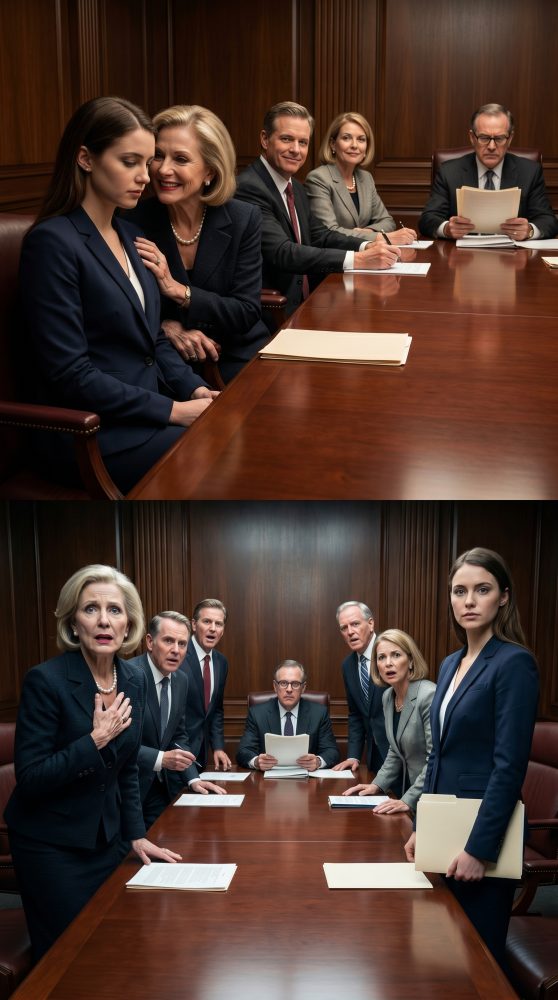
My mother threatened me before my grandmother’s coffin was cold. At the reading of the will, she gripped my arm so hard her nails bit through my sleeve and whispered, “If you get a single penny, I will make your life a living hell.”
I turned to look at her. Eleanor Vale—perfect hair, pearls, grief arranged like stage makeup—smiled at the relatives gathering in the law office as if she were hosting brunch instead of circling an estate worth millions.
“Let go,” I said.
Her fingers tightened once, then released. “Don’t embarrass yourself, Clara. For once.”
That was her favorite sentence. She had used it when I was thirteen and cried at my father’s funeral. When I was nineteen and refused to drop out of law school to “support family priorities.” When I stopped answering her midnight calls because every conversation ended with the same poison: I was ungrateful, dramatic, weak.
Weak was useful. Weak made people careless.
The office smelled like leather, old paper, and rain. My grandmother’s attorney, Mr. Bellamy, sat at the head of the long table with a folder thick enough to stop a bullet. Around us, my mother’s allies arranged themselves for victory: Uncle Ron with his hungry little eyes, Aunt Denise pretending to dab tears, my stepbrother Gavin slouched back with the lazy smirk of a man who had never earned anything but still expected everything.
Grandmother had been dead six days.
Six days since I stood alone in the hospital corridor while my mother told a nurse she was “handling all family matters.” Six days since they shut me out of the penthouse, changed the security codes, and boxed up my childhood photographs like contaminated evidence.
Mr. Bellamy adjusted his glasses. “We’ll begin.”
Page one. Charitable donations.
Page two. Jewelry, artwork, trust allocations.
Page three. The Manhattan penthouse to Eleanor Vale.
Page four. The Hamptons house to Eleanor Vale.
Page five. Voting shares in Vale Biotech to Eleanor Vale.
My mother leaned back slowly, triumph glowing through her grief costume. Gavin chuckled under his breath. Uncle Ron gave me a pitying look so fake I almost admired the craftsmanship.
“Oh, Clara,” my mother murmured, loud enough for everyone. “I’m sure Grandma meant to leave you something sentimental. A scarf, maybe.”
Laughter cracked softly around the table.
I kept my hands folded in my lap. “Keep reading.”
Her smile sharpened. “Listen to her. Still pretending she matters.”
Mr. Bellamy didn’t smile. He turned the page, then stopped.
The room changed.
It was a tiny shift at first—the kind a courtroom makes just before a verdict lands. He reached into the folder, removed a sealed document, and set it carefully on the table.
“There is,” he said, voice flat and precise, “an amendment filed three days before your grandmother’s death.”
My mother’s face lost all color.
For the first time that morning, she looked afraid.
And I knew she remembered exactly why.
Because three nights before Grandma died, while the family was busy celebrating what they thought was the end, I had been sitting at a hospital bedside, holding an old woman’s hand, listening to the truth she had saved like a blade.
My mother recovered fast. She always did.
“That’s impossible,” she snapped, leaning forward. “My mother was medicated. She was confused. If there’s some last-minute nonsense, I’ll contest it immediately.”
Mr. Bellamy broke the seal without looking at her. “This amendment was executed in the presence of two witnesses, a private physician, and a court-certified notary.”
Silence dropped like a guillotine.
Gavin sat up. Uncle Ron stopped blinking. Aunt Denise lowered her tissue.
My mother laughed, but it came out thin. “Then read it.”
He did.
“In light of recent evidence concerning coercion, financial misconduct, and deliberate isolation imposed upon me by my daughter, Eleanor Vale, I revoke all prior sole-beneficiary distributions.”
My mother shot to her feet. “No.”
Mr. Bellamy kept going.
“The penthouse, Hamptons residence, and all personal controlling interest in Vale Biotech shall be transferred to the Clara Vale Protective Trust.”
Now everyone stared at me.
I met their eyes one by one and gave them nothing.
Mother’s voice cracked into something animal. “Protective trust? She can’t control a trust. She’s never controlled anything.”
Mr. Bellamy finally looked at her. “Your daughter is the trustee.”
The room exploded.
“She manipulated her!” Gavin barked.
“This is fraud,” Uncle Ron hissed.
Aunt Denise found her voice. “Clara, tell them you didn’t poison her against her own family.”
I almost smiled. Poison was their specialty.
Mother rounded on me, fury burning through the polished mask. “What did you do?”
“Less than you did,” I said.
That was when Mr. Bellamy placed a second folder on the table.
“I was instructed,” he said, “that if anyone challenged the amendment, these materials were to be submitted to probate court and forwarded to the district attorney.”
No one moved.
Inside were copies of account transfers, forged authorization attempts, and private nursing complaints. Security logs from the penthouse. Audio transcripts. Emails from my mother ordering staff to deny my grandmother outside visitors unless personally approved. A pattern. A cage built with signatures, money, and fear.
My mother went still in the worst way possible, like a snake deciding whether to strike or run.
“You bitch,” Gavin whispered at me. “You recorded us?”
“No,” I said. “Grandma did.”
That landed harder than anything else.
Because my grandmother had looked fragile near the end. Soft voice, trembling hands, oxygen tubes, silk blankets. They saw a dying woman. They forgot she had built a biotech empire in a room full of men who underestimated her for forty years.
She had hidden tiny cameras in the study, duplicated account records, and paid an outside forensic team before the family realized she suspected them. When she finally told me, her hand was cold but steady.
“They think cruelty is power,” she had whispered. “Let them keep thinking it.”
Back in the law office, my mother took one slow breath, then another. “Clara,” she said, voice turning syrupy, desperate, “whatever misunderstanding happened, we can fix this privately.”
There it was. Not remorse. Strategy.
I rose from my chair.
For years, they had trained themselves to look down at me. It must have been disorienting when I stood and they realized I was no longer beneath them.
“No,” I said. “We fix it publicly.”
Then I pulled my own folder from my bag.
Because Grandma’s amendment had been the first bullet.
Mine was the second.
The sound of the folder hitting the table was small. The damage it carried was not.
“I spent four years in estate litigation,” I said. “Mostly with people exactly like you—greedy, loud, certain that intimidation counts as a legal argument.”
Gavin’s mouth opened. Closed.
My mother’s eyes narrowed. She truly had not known. She had been so committed to the story of me—the fragile daughter, the disappointing shadow—that she never bothered to ask what I did after law school. She only cared that I had stopped needing her.
I opened the folder.
“Three weeks ago, I petitioned for an emergency preservation order after a hospital staff member reported unusual access restrictions around my grandmother.” I slid the court-stamped copy toward Bellamy. “Two weeks ago, a judge authorized a forensic freeze on all estate-related digital transfers pending probate review.”
Uncle Ron went gray.
“That means,” I said, looking at him, “the four shell transactions you routed through Meridian Holdings are already flagged.”
His chair scraped backward. “I want my attorney.”
“You’ll want a criminal one,” I replied.
Mother lunged for the papers. Bellamy pulled them out of reach.
“What did you tell her?” she shouted. “What lies did you feed my mother?”
I stepped closer, calm enough to make her shake harder. “Nothing. She heard your voice herself.”
Bellamy pressed a button on the conference speaker.
At first, all that came through was hospital static, a rustle of fabric, a door shutting softly.
Then my mother’s voice.
Cold. Impatient. Real.
“She won’t last the week. Once she’s gone, Clara gets nothing. Change the penthouse code tonight.”
Another voice—Gavin’s—laughing. “And if the old woman asks for her?”
“Tell staff Clara didn’t come.”
The recording ended.
No one breathed.
Aunt Denise started crying for real this time. Uncle Ron stared at the tabletop like it might open and swallow him. Gavin looked at my mother with the first flicker of panic I had ever seen on his face.
Mother turned to me, and for one second the performance vanished completely. What remained was naked hatred.
“You ruined your own family.”
I held her gaze. “You did that when you thought no one was listening.”
Two sheriff’s deputies entered before she could answer. I had asked the court for standby enforcement in case the meeting turned volatile. Realistic revenge is mostly paperwork until the moment it isn’t.
My mother tried dignity first. Then outrage. Then tears. Gavin tried to leave and was stopped at the door. Uncle Ron began talking too fast, the way guilty men do when they sense everyone else preparing to save themselves.
The fallout was brutal and beautifully ordinary. Probate litigation. Fraud charges. Civil suits from minority shareholders after the internal theft became public. Board removal. Asset seizure. The kind of ruin that arrives not with flames, but signatures.
Six months later, spring sunlight filled the penthouse my mother once locked me out of.
The place felt different without her perfume in the walls. Cleaner. Honest.
Vale Biotech had a new board. The employee assistance fund my grandmother always wanted was finally real. The Hamptons house had been sold, with the proceeds divided between her charities and the trust. I kept only this apartment, my grandmother’s books, and her chess set.
As for my mother, she was awaiting trial from a rental condo in New Jersey, abandoned by half the people who used to orbit her. Gavin took a deal. Uncle Ron lost everything. Aunt Denise vanished into some cousin’s guest room in Florida.
That evening, I stood by the window with a glass of wine and watched the city ignite in gold beneath the sunset.
On the table beside me sat the final photo of my grandmother and me, taken years before any of this. We were both laughing. We looked untouchable.
Maybe, in the end, we were.
I touched the frame and smiled into the quiet.
They had mistaken my silence for helplessness, my distance for weakness, my patience for surrender.
That was their final mistake.
And in the peace they could no longer touch, I finally understood revenge at its most satisfying: not rage, not chaos, not screaming across a courtroom.
Just truth, carefully prepared.
Then released at exactly the right moment.