A broke mechanic helped a disabled girl — and her billionaire mother was left in tears… Ethan Cole had spent his whole life on the outskirts of Austin, Texas, working in a small, worn-down garage that barely made enough for him to get by. Despite his old tools and cracked concrete floor, he gave his full effort to every repair. Customers trusted him because he was honest, fair with prices, and never turned away someone who needed help. One warm Thursday morning, as he wiped grease from his hands, he heard the quiet hum of a high-end engine outside — a sound that didn’t belong in his neighborhood…
By the time the black SUV turned off the highway and limped into Ethan Cole’s gravel lot, the October sun had already bleached the edges of everything in town. It was one of those hard Texas afternoons when the sky looked baked into place and the heat rose off the concrete in wavering sheets, making distant things look less certain than they were. Ethan was under the raised hood of a 1998 Silverado with half his arm buried in the engine bay, listening to a knock that should not have been there, when he heard the grinding approach of expensive machinery trying not to die in public.
He slid out from under the truck, wiped his hands on a rag darkened by years of use, and looked toward the front of the lot.
The SUV was black and glossy in the way vehicles get when they are washed often and driven by people who can pay to keep the world from leaving marks on them. Even limping, it looked expensive. The left front wheel was carrying its weight wrong, the steering slightly off, and the sound coming from somewhere underneath told him before he bent down that something in the front suspension had lost the argument with a pothole and was now trying to survive on resentment.
He came out from beneath the shade awning with the steady, unhurried walk of a man who had long ago learned that broken things did not improve when you rushed toward them.
The woman behind the wheel killed the engine and sat still for a moment before opening the door. She stepped out with a kind of contained grace that looked less like elegance than discipline. She was probably in her early forties, wearing a cream blouse without a wrinkle in it, tailored slacks, and low heels sensible enough for movement but expensive enough to announce they had never come from a sale rack. Her hair was pinned back neatly, and her face had that particular composure you see in people who have been forced to master themselves because too many others depend on them staying intact.
She looked at the garage, then at Ethan, taking in the rusted sign out front, the weathered building, the line of old trucks and farm equipment waiting their turn, and the row of mismatched planters his late mother had once painted bright blue to make the place seem friendlier.
“Are you Ethan Cole?” she asked.
He nodded. “That depends who’s asking.”
Something almost like a smile moved across her face, brief enough to disappear before anyone could claim it had been there. “Valerie Crane.”
He knew the name, or thought he did. Not from personal experience. From the sort of half-heard local reverberation that attaches to wealth. Crane Biomedical. Crane Foundation. Crane Wellness Pavilion over at the county hospital. Her family’s name was on things. Not everywhere, not in the loud way some names are on things, but often enough to suggest money that had become infrastructure.
“Your car’s not happy,” he said.
“No,” she replied. “It isn’t.”
She did not launch into a speech about urgency or expense or what she expected. She simply stepped back and let him approach. He respected that.
He crouched by the front wheel, checked the angle of the tire, then slid underneath just far enough to shine his flashlight upward. The control arm was compromised. The stabilizer link wasn’t right either. The tire had taken damage on the inside edge. Someone had hit something hard and recently.
He came back up. “You hit a curb?”
Her eyes shifted very slightly. “A median. Avoiding another driver.”
“That’ll do it.” He stood and wiped his hands again. “I can fix it, but I’ll need a few hours if I’ve got the parts, maybe till morning if I don’t.”
“That’s fine.” She turned back toward the rear passenger door. “Amelia?”
The sound that came from the back seat was small and frustrated, not the complaint of a child unwilling to wait but the quieter sound of a person whose body has made some ordinary task harder than it had any right to be.
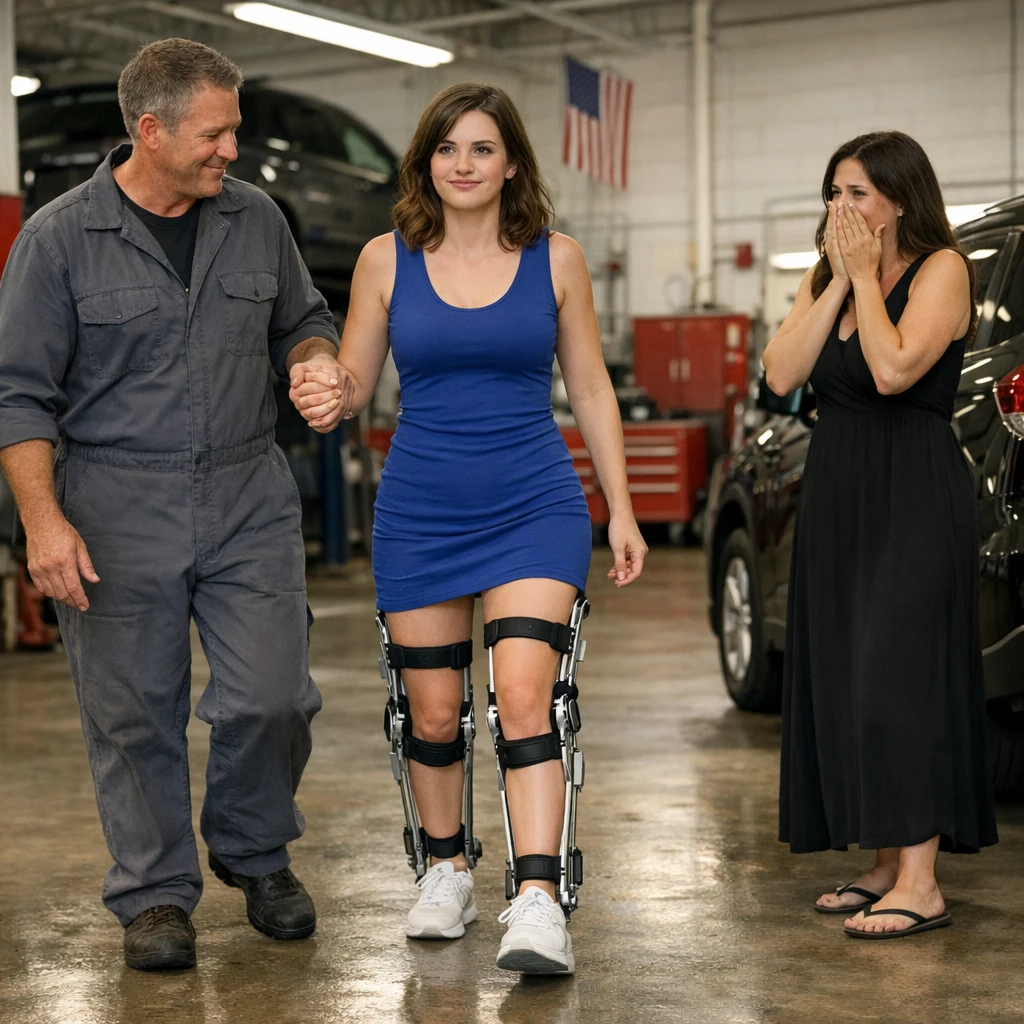
Ethan glanced over before he meant to. A girl of maybe sixteen sat angled toward the door, one hand on the seat for leverage while she adjusted the metal braces on both of her legs. She had dark hair pulled into a loose ponytail and her mother’s controlled eyes, though hers were younger and more openly tired. The braces ran from mid-thigh to her shoes, medical-grade and expensive-looking, articulated at the knee and ankle with a kind of engineered complexity he recognized without knowing the terminology for it. They should have looked sleek and efficient. Instead they looked like they had been designed by someone who understood materials more than motion.
The girl looked up and caught him seeing.
He didn’t look away fast, which would have been rude in a different way. He just nodded once like he would nod to anyone who had had a rougher afternoon than expected.
“You need a hand?” he asked.
The girl’s mouth twitched. “I usually need two, but one is fine.”
Her mother moved toward her immediately, but the girl lifted a hand to stop her. She braced herself, swung one leg carefully out, then the other, and rose with the measured concentration of someone who had learned that standing was not a background activity. Ethan noticed the way her hips compensated, the angle of the right brace under load, the fraction of delay before the left foot committed to the ground. He noticed because he noticed everything that had to do with weight transfer and misalignment and mechanical stress. It was how his mind worked. He saw systems the way other people saw faces.
Valerie gave him insurance information, signed the work authorization, and asked if there was anywhere nearby they could wait.
“There’s a diner half a mile up,” he said. “Or if you want, there’s a bench out back by the shade tree. Not exactly luxury, but it’s cooler than the highway.”
Amelia let out a quiet laugh. “The bench sounds less embarrassing than me trying to navigate a diner booth in public.”
Valerie looked at her daughter with the soft guardedness of someone always measuring how much help to offer and how much independence to allow. “You sure?”
“Yeah.”
Ethan pointed them around the side of the garage toward the pecan tree behind the oil drums and scrap pile, where an old wooden bench sat facing the field beyond his property. He’d built it when his father’s back had gotten too bad for standing during long afternoons. The bench was sturdy and ugly and exactly comfortable enough to earn a person’s trust if they sat on it more than once.
He went back to work on the SUV.
For the next forty minutes he was mostly under the car, loosening bolts, assessing which parts were salvageable and which weren’t, but his mind kept half returning to the braces. Not because he was intrusive by nature. Because there was something wrong with them in a language he understood better than he should have.
They were fighting the girl.
He had spent his whole life around things built to carry weight. Suspension systems, support arms, joints under tension, components designed to absorb force and redirect it so the machine could keep moving. The braces looked high-end, yes, but built according to some average geometry that had never met the actual person wearing them. Too rigid in one place, too loose in another. Too much bulk where she needed response. Not enough give where she needed cooperation. They were doing what a lot of engineers did when they built for abstractions instead of bodies: imposing a solution instead of studying the movement.
When he finished the initial diagnosis, he walked around back and found Valerie on the bench answering emails on her phone while Amelia sat with one leg stretched out, rubbing at the straps near her knee.
“It’s the control arm and stabilizer link,” Ethan said. “Tire took some uneven wear too. I can patch the alignment enough to make it safe by tonight, or replace what needs replacing and have it right by tomorrow.”
“Tomorrow is fine,” Valerie said. “We can stay in town.”
Amelia winced as she adjusted the left brace again.
Ethan looked before he could stop himself. “That thing pinching?”
Amelia glanced down. “It always pinches.”
Valerie’s eyes came up, alert now in a different way. “She’s fine.”
The sentence came too fast. Defensive. Not because she was rude. Because she had been through too many well-meaning conversations that ended in pity or bad advice.
Ethan nodded once. “Didn’t mean anything by it.”
He started to leave. Then stopped.
“Can I ask something without you deciding I’m out of line?”
Valerie’s posture tightened. “Depends what it is.”
He jerked his chin toward the braces. “Can I look at those?”
Amelia and Valerie both stared at him.
Ethan shrugged. “I’m not a doctor. Don’t know anything about your condition. But I know bad load distribution when I see it. The left side is making you compensate at the hip. The knee joint’s resisting you half a beat too long before it lets go. That’s why you’re always adjusting the strap there. It’s not the strap. It’s the angle.”
A long silence followed.
Amelia looked down at the brace. Then back at him. “How do you know that?”
He rubbed the rag between both hands. “Because it’s built wrong for the way you move.”
Valerie stood slowly. “Mr. Cole, with respect, these were custom-made by a team of orthopedic engineers at Johns Hopkins.”
“Then they had a nice lab,” Ethan said. “I’m not insulting them. I’m saying whoever designed those built for the condition, not for her.”
Amelia was looking at him now with open interest, the first unguarded expression he had seen on her face. Valerie, however, looked caught between offense and desperation, which was a place he recognized because it lived near hope and people hated being caught hoping in front of strangers.
“She has Charcot-Marie-Tooth disease,” Valerie said after a moment. “Her lower leg muscles are severely affected. We’ve been through specialists in Baltimore, New York, Houston. These braces were made after six months of measurements and testing.”
“And?”
“And they are the best available.”
The girl spoke softly. “They still hurt.”
Valerie closed her eyes for one second, a blink that carried the weight of too many appointments and too many invoices and too many promises that had turned into tolerable disappointment.
Ethan looked at the girl. “You want me to look?”





