I walked into the hospital with a gift for my sister’s newborn… then froze outside her door when I heard my husband laughing inside. “Claudia still has no idea,” he said. My mother answered, “Let her keep paying the bills. At least she’s useful for something.” Then my sister said the one line that made my whole marriage collapse in a single second: “When Diego divorces her, we’ll finally be a real family.”
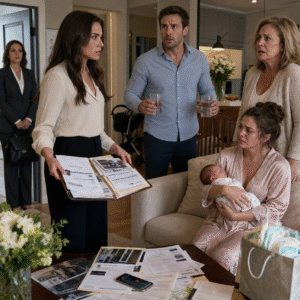
Diego did not know you had stopped being his wife that night.
He still moved through the apartment like a man protected by routine. He dropped his keys in the ceramic bowl you bought in San Miguel, loosened his tie, opened the refrigerator, and asked what was for dinner as if he had not spent the day holding your sister’s newborn son.
You watched him from the kitchen island.
For six years, you had mistaken his comfort for intimacy. You had thought it meant home, trust, marriage. Now you understood it was only arrogance wearing slippers.
“Pasta,” you said.
He smiled.
“My favorite.”
Of course it was.
You had spent years learning his favorites while he spent your money building a nursery for another woman.
He kissed your cheek, and your skin did not even flinch. That scared you more than anger would have. Anger would mean something inside you still wanted to fight for the marriage. This calm meant the marriage had already been buried.
You served dinner.
You asked about his “meeting.”
He lied beautifully.
He said Santa Fe traffic had been terrible. He said the client was difficult. He said he barely had time to eat lunch. He even sighed and said he wished he could have gone to the hospital with you because family mattered.
You nodded at the right moments.
You cut your pasta into small pieces and tasted nothing.
Across the table, Diego told you he was proud of Valeria for being “so brave.” Your mother texted the family chat a photo of the baby’s tiny hand, calling him a blessing. Valeria replied with a heart.
You stared at the screen.
A blessing paid for with your salary.
A crib bought with your credit.
A secret family built from the bones of your humiliation.
That night, when Diego fell asleep, you got out of bed quietly.
You opened your laptop in the living room and began to work.
Not cry.
Work.
That was always your gift.
Numbers had never frightened you. They told the truth when people would not. They held dates, amounts, patterns, and proof. If someone lied inside a bank statement, you could usually hear the lie breathing.
By sunrise, you had built a timeline.
The first transfer to Valeria happened eleven months earlier.
That meant the affair began before the pregnancy.
Maybe long before.
There were hotel charges disguised as client dinners. Pharmacy payments near Valeria’s neighborhood. Ride services between Diego’s office and the apartment in Del Valle. Cash withdrawals on the same days your mother told you Valeria “needed support but felt too ashamed to ask.”
You laughed once when you saw that.
Too ashamed.
Valeria had not been ashamed enough to take your husband.
Your mother had not been ashamed enough to help hide it.
Diego had not been ashamed enough to spend your money.
But they had all expected you to feel ashamed of not having children.
You saved everything to three places.
Your laptop.
A secure cloud folder.
A flash drive hidden inside an old makeup bag Diego would never touch because he thought anything feminine was beneath his attention unless it was attached to a woman he wanted.
At 6:30 a.m., Lucía called.
“I reviewed the first batch,” she said. “Claudia, this is worse than you thought.”
You looked toward the bedroom door.
“How much worse?”
“He didn’t just spend marital funds. He may have used your digital signature on at least two credit authorizations.”
Your fingers went cold.
“What?”
“Check the documents attached to the furniture purchase and the Del Valle lease guarantee. Your name appears.”
“I never signed.”
“I know.”
You sat very still.
For a moment, betrayal moved into another room inside you. Not love anymore. Not family. Not even marriage.
Fraud.
Diego had not only cheated.
He had forged you into his lies.
“What do I do?” you asked.
Lucía’s voice sharpened.
“You do not confront him. You do not warn him. You do not leave the apartment yet unless you feel physically unsafe. Today, you freeze any individual accounts he can’t legally access, move your direct deposit, and request authentication records from the banks.”
You wrote every instruction down.
“Claudia,” she added, softer now, “he thinks you are emotional. Let him keep thinking that. You are not emotional right now. You are an audit.”
That sentence became your armor.
You are an audit.
For the next two weeks, you performed your marriage like an actress in a role she had already quit.
You made coffee.
You answered your mother’s calls.
You asked about Valeria’s recovery.
You watched Diego pretend to be tired from work while he texted your sister in the bathroom. You watched him delete messages. You watched him smile at his phone with a tenderness he had stopped giving you years ago.
Every night, you documented.
Every morning, you prepared.
Lucía filed preliminary financial protections. A forensic accountant began tracing the transfers. Your bank issued a security review. The lease company confirmed an IP address connected to Diego’s office had submitted your signature on the Del Valle guarantee.
The trap tightened.
And the three people betraying you kept walking straight into it.
Your mother called on a Thursday.
“Claudia, we’re having a small family dinner Sunday to welcome the baby home.”
You closed your eyes.
Of course.
A celebration.
Another room where everyone would smile while your life burned behind the wallpaper.
“Sunday?” you asked.
“Yes. At Valeria’s apartment. Diego said he might stop by if work allows.”
You almost dropped the phone.
Diego said.
So your mother was not even pretending anymore.
She was coordinating your husband’s attendance at your sister’s apartment while inviting you like a harmless relative.
“That’s nice,” you said.
Your mother sighed.
“Please don’t come with one of your cold faces. Valeria needs peace. She’s a new mother.”
You stared at your reflection in the microwave door.
There it was again.
Valeria needed peace.
Valeria needed support.
Valeria needed forgiveness before you even had the chance to be hurt.
“And what do I need?” you asked.
Your mother paused.
“What?”
“What do I need, Mom?”
She laughed lightly, uncomfortable.
“You’re strong, Claudia. You always have been.”
That old sentence.
That polished cage.
Strong meant no one had to help you.
Strong meant your pain could wait.
Strong meant your sister could take and take and take because you were expected to survive anything.
“I’ll be there,” you said.
Your mother sounded relieved.
“Good. Bring something practical. Diapers maybe. The baby is expensive.”
You nearly smiled.
The baby had already cost you enough.
Sunday arrived warm and bright, the kind of day that made betrayal look even uglier because the sky refused to match it.
You wore a simple cream blouse, black trousers, and small gold earrings. Diego pretended to receive a work call at noon and left the apartment before you. He kissed your forehead and said, “I’m sorry I can’t go with you. Tell everyone I’m stuck.”
You touched his tie.
“Of course.”
He smiled.
He had no idea you had already arranged for Lucía and the forensic accountant to be nearby.
Valeria’s Del Valle apartment looked expensive in the exact way your bank statements had warned you it would. Walnut crib. Soft beige sofa. Designer stroller near the hallway. Fresh flowers on the table. Your mother opened the door wearing perfume and the proud smile of a grandmother who had chosen her favorite daughter’s sin and renamed it happiness.
“Claudia,” she said. “You made it.”
You stepped inside with a gift bag.
Diapers.
Very practical.
Valeria sat on the couch in a silk robe, the baby in her arms. She looked beautiful and tired, glowing in the way people glow when they have been protected from the consequences of their own choices.
Then Diego came out of the kitchen holding two glasses of water.
He froze.
Your mother froze too.
Valeria’s face went white.
You let the silence stretch.
Then you smiled.
“I thought you were stuck at work.”
Diego recovered first.
The man was talented.
“Clau,” he said, setting the glasses down. “I stopped by quickly. Your mom called and said Valeria needed help moving something.”
“Did she?”
Your mother stepped in.
“Yes. I did. It was nothing. We didn’t want to bother you.”
You looked around the apartment.
The apartment you had helped pay for without knowing.
“Oh, I’m not bothered.”
Diego came toward you, lowering his voice.
“Can we talk outside?”
“No.”
His eyes sharpened.
That was the first time he heard something new in your voice.
Valeria adjusted the baby, nervous now.
“Claudia, please. Not in front of the baby.”
You looked at the child.
He was small, innocent, sleeping with one fist pressed to his cheek. You felt no hatred for him. Only a deep sadness that the adults around him had built his first home out of theft.
“You’re right,” you said. “He didn’t choose this.”
Your mother exhaled.
Then you turned back to them.
“But you did.”
The room went still.
Diego’s expression darkened.
“Claudia.”
You pulled your phone from your purse and placed it on the coffee table. It was recording, but they did not know that yet. Then you took out a folder.
Valeria’s eyes dropped to it.
“What is that?”
“The reason I’m not screaming.”
Diego tried to laugh.
“This is ridiculous.”
“No. Ridiculous was telling me you were in Santa Fe while standing in the hospital hallway telling my sister I only existed to pay your lies.”
Your mother gasped.
Not because she was ashamed.
Because you had heard.
Diego’s face changed.
Valeria started crying immediately.
You watched the tears begin like a curtain being pulled.
“Claudia, I never wanted to hurt you,” she whispered.
You opened the folder.
“Then you should have chosen a man who wasn’t married to me.”
Your mother stood.
“Enough. This is not good for the baby.”
You looked at her.
“You helped them.”
Her mouth tightened.
“I protected my daughter.”
“I am your daughter.”
For the first time, that sentence did not sound like a plea.
It sounded like evidence.
She looked away.
That was answer enough.
You began placing papers on the table.
Transfer records.
Prenatal payments.
Apartment lease.
Furniture invoices.
Screenshots.
Credit authorizations.
The forged signature report.
Diego lunged for the documents, but you placed your hand over them.
“Touch them and I call Lucía in right now.”
He froze.
Your mother blinked.
“Lucía?”
The doorbell rang.
Perfect timing.
You stood and opened it.
Lucía entered in a charcoal suit, holding a briefcase and wearing the face that had made half the family court attorneys in Mexico City afraid of her. Behind her stood a notary and your forensic accountant, Patricia.
Diego went pale.
Valeria clutched the baby tighter.
Your mother’s eyes flashed with panic.
Lucía looked at Diego first.
“Mr. Ortega. I’m Claudia’s attorney. I suggest you stop speaking unless you want to make my morning easier.”
The apartment became very quiet.
Your mother found her voice.
“This is family. You have no right to invade my daughter’s home.”
Lucía smiled slightly.
“Which daughter?”
Your mother flinched.
You almost thanked Lucía right there.
Instead, you sat down.
Patricia opened her laptop and began reviewing the financial trail. She spoke calmly, clearly, brutally. Funds from your joint marital account had been diverted to Valeria. Diego’s income did not support the apartment expenses. Your salary covered most of the credit card payments. Your digital signature had been used without authorization.
Then Lucía placed one final document on the table.
A notice of divorce filing.
Diego stared at it.
“You filed?”
“This morning,” you said.
His mouth opened, then closed.
For once, no lie arrived quickly enough.
“You can’t just—”
“I can.”
“Claudia, don’t do this here.”
You looked around the apartment.
“At the home you built with my money for my sister and your child?”
He swallowed.
Valeria cried harder.
Your mother sat beside her and glared at you as if your calm were the cruelest thing in the room.
“You’re punishing a newborn,” she said.
You turned to her slowly.
“No. I am protecting myself from his parents.”
Your mother slapped you.
The sound shocked everyone.
Even the baby woke and began to cry.
Your cheek burned.
For a second, you were eight years old again, being scolded for not sharing a toy with Valeria. Fifteen, being told not to outshine her at school. Thirty-two, being told infertility made you less of a woman while your sister carried your husband’s child.
Then you returned to your body.
You looked at Lucía.
“Add that to the record.”
The notary, pale but professional, made a note.
Your mother’s face collapsed.
“Claudia…”
“No,” you said. “You don’t get to hit me and then say my name like you love me.”
Diego stepped forward.
“This has gone too far.”
Lucía turned to him.
“Mr. Ortega, if you interfere, we will request immediate emergency financial restrictions and pursue the forgery issue separately.”
He stared at her.
“Forgery?”
You slid the lease guarantee toward him.
“Did you think I wouldn’t check?”
His silence betrayed him.
Valeria looked at him.
For the first time, uncertainty entered her face.
“You said she signed because she didn’t care about the apartment.”
You laughed once.
It came out cold.
“That’s what he told you?”
Valeria’s lips trembled.
“He said the money was partly his.”
“It was our marital account. Mostly funded by me.”
She looked at Diego.
He avoided her eyes.
That was the first crack between them.
You stood.
“I’m leaving now.”
Your mother reached for you, but you stepped back.
“Do not touch me.”
She stopped like the words had slapped her instead.
You looked at the baby one last time.
“He deserves better than this mess.”
Then you turned to Diego.
“And so did I.”
You walked out without waiting for anyone to answer.
In the elevator, your cheek throbbed.
Lucía stood beside you silently until the doors closed.
Then she said, “You did well.”
You looked at your reflection in the metal doors.
Your face was pale.
Your cheek was red.
Your eyes were dry.
“I don’t feel well.”
“You’re not supposed to,” she said. “You’re supposed to be free.”
That was the first moment you cried.
Not loud.
Not dramatically.
Just a few silent tears for the woman who had spent years trying to be easy to love by making herself easy to use.
The legal machine moved fast.
Lucía filed for divorce, emergency financial protection, reimbursement of diverted marital funds, and investigation into unauthorized signatures. The bank froze the shared credit line within seventy-two hours. Diego’s access to joint funds was restricted. The Del Valle lease company opened a fraud inquiry.
Diego called you thirty-four times.
You did not answer.
Then came the messages.
First anger.
You’re destroying everyone.
Then blame.
You forced me to hide things because you’re impossible to talk to.
Then pity.
Valeria has postpartum stress. How could you do this to her?
Then romance.
I loved you first.
That one almost made you throw the phone.
Instead, you sent everything to Lucía.
Your mother sent only one message.
You broke your sister’s family.
You stared at it for a long time.
Then you replied with the only sentence that mattered.
She built it inside mine.
Your mother did not answer.
For the first week, you stayed with Lucía.
Not because you were afraid Diego would hurt you, though part of you was. But because the apartment you had shared with him felt contaminated. Every mug, every pillow, every framed vacation photo seemed to ask how you had missed what was happening in front of you.
Lucía gave you her guest room, strong coffee, and no pity.
That was exactly what you needed.
On the sixth night, you woke at 3:00 a.m. and walked into the kitchen. Lucía was awake too, reviewing court documents under a small lamp.
She looked up.
“Can’t sleep?”
You shook your head.
“I keep thinking about the baby.”
Lucía closed the file.
“He’s innocent.”
“I know.”
“That doesn’t mean you owe his parents your silence.”
You sat across from her.
“I wanted a child so badly.”
The words came out before you could stop them.
For years, infertility had been the hidden room in your marriage. The tests. The appointments. The injections. The whispered comments from your mother. Diego holding your hand in clinics while secretly creating life with your sister.
Lucía’s face softened.
“That is the part I hate most for you.”
You looked down.
“I used to think not having children made me incomplete.”
“And now?”
You thought of the hospital hallway. The apartment. Your mother’s slap. Diego’s silence when confronted with the forged signature.
“Now I think being surrounded by people who needed me empty made me feel incomplete.”
Lucía nodded.
“That’s the first honest thing you’ve said all week.”
You almost smiled.
The first hearing was brutal.
Diego arrived with an expensive attorney and a face designed to look wounded. Valeria did not come, but your mother did. She sat behind him, holding a rosary, dressed in black as if mourning the consequences of her own betrayal.
You entered with Lucía.
Diego looked at you like he expected you to soften.
You did not.
His attorney argued that the financial transfers were “family support” and that you had been aware of Valeria’s difficult pregnancy. He suggested your reaction was fueled by emotional distress over infertility. He called the situation tragic but private.
Lucía stood.
By the time she finished speaking, “private” sounded like a dirty word.
She presented the bank trail. The forged authorization. The lease guarantee. The hospital overheard statements documented in your sworn affidavit. The slap witnessed by a notary. The timeline showing Diego lied repeatedly about work obligations while using marital funds for another household.
The judge looked at Diego.
“Mr. Ortega, did your wife authorize these transfers?”
Diego’s attorney whispered to him.
Diego swallowed.
“She knew I helped her sister sometimes.”
The judge repeated, “Did she authorize these transfers?”
Diego looked down.
“No.”
Your mother shifted in her seat.
The sound of her rosary beads clicking together was the only noise in the room.
Temporary financial protections were granted. Diego was ordered not to access joint accounts. He was required to provide full financial disclosure. The forged signature issue was referred for further review.
Outside the courtroom, your mother approached you.
“Claudia.”
You stopped, but Lucía stayed beside you.
Your mother’s face looked older than it had two weeks before.
“Please,” she said. “Valeria is not well. She cries all day. Diego is overwhelmed. The baby feels the stress.”
You stared at her.
“What do I feel?”
Her mouth trembled.
“I know you’re hurt.”
“No. You know I’m useful. You know I’m quiet. You know I usually swallow whatever Valeria needs me to swallow.”
Tears filled her eyes.
“That’s not fair.”
You stepped closer.
“You told my husband and sister that I only served to pay their lies. Was that fair?”
She looked away.
There it was again.
The truth she could not look at.
“I was angry,” she whispered.
“At me?”
“At life,” she said, as if that explained anything. “You were always so closed off. Valeria needed love in a way you never did.”
You laughed, and it hurt.
“I needed love. I just stopped asking you because you kept giving mine to her.”
Your mother began to cry.
This time, you did not comfort her.
That was new.
That was necessary.
The divorce dragged through months of paperwork and ugly revelations.
You discovered Diego had planned to divorce you after securing a larger promotion, because he wanted enough income to support Valeria without needing your accounts. He had consulted an attorney about minimizing what he owed you. He had even drafted a narrative about “irreconcilable differences caused by Claudia’s emotional distance and obsession with infertility.”
That one nearly broke you.
He had planned to use your deepest grief as his defense.
Valeria began calling then.
At first, you ignored her.
Then one afternoon, curiosity won.
You answered.
For a few seconds, she only cried.
“Claudia,” she whispered.
You said nothing.
“I didn’t know everything.”
You closed your eyes.
There it was.
Not “I’m sorry.”
Not “I betrayed you.”
A softer lie.
“I didn’t know everything.”
“You knew he was married.”
She sobbed.
“Yes.”
“You knew he lived with me.”
“Yes.”
“You knew our mother was helping you hide it.”
Her crying became louder.
“Yes.”
“So what part didn’t you know? The exact percentage of my salary paying your rent?”
She went quiet.
You could hear the baby fussing in the background.
“I loved him,” she said.
You looked out the window at the city below Lucía’s apartment.
“No. You loved being chosen over me.”
The silence that followed was more honest than her apology would have been.
Then she whispered, “Maybe.”
That surprised you.
It was the first true thing she had said.
“Diego is angry all the time now,” Valeria said. “He says you’re ruining him. He says the baby cries too much. He says everything was easier before.”
You felt no satisfaction.
Only cold recognition.
Men who build love on theft often resent the people they stole for once the bill arrives.
“That is your household now,” you said.
“I’m scared.”
Your heart tightened despite everything.
Valeria was your sister. The girl who used to crawl into your bed during thunderstorms. The girl you protected from bullies. The woman who later helped turn you into the family sacrifice.
Both were true.
“Call a lawyer,” you said.
“I thought maybe you—”
“No.”
She inhaled sharply.
“I can’t do this alone.”
“You should have thought about that before helping everyone make me alone.”
She began crying again.
You did not hang up immediately.
You waited until she quieted.
Then you said, “I will not pay for your life anymore, Valeria. But if you are unsafe, call emergency services. Call a women’s shelter. Call a lawyer. I will send numbers. That is all.”
She whispered, “Do you hate me?”
You thought carefully.
“No. But I don’t trust you.”
That was worse, and she knew it.
The criminal review of Diego’s forged signature became the turning point.
He tried to claim you had given verbal permission. Then the authentication records showed the documents were submitted from his office computer while you were in Querétaro for a work conference. Hotel records, meeting attendance, and your own location data backed it up.
Diego’s attorney requested settlement talks immediately.
Lucía smiled when she read the email.
“Now he’s afraid.”
You were sitting in her office, wearing a green blouse you had bought after moving into your own apartment. A color Diego once said made you look “too serious.” You loved it now.
“What does afraid look like legally?” you asked.
“Better for us.”
The settlement meeting happened in a glass conference room overlooking Reforma.
Diego looked thinner. His suit was still expensive, but his confidence had started to rot at the seams. Your mother was not there. Valeria was not there. For the first time, Diego had to face you without the women he had used as shields.
He tried tenderness first.
“Clau.”
“No,” you said.
He stopped.
Lucía did not hide her smile.
His attorney spoke for most of the meeting. Repayment schedule. Asset division. Agreement to cover legal costs. Written admission of unauthorized financial transfers. Separate confidential handling of the forged signature claim to avoid formal charges if restitution was made.
You listened.
Then you asked one question.
“Did you ever love me?”
Lucía turned slightly, surprised.
Diego looked relieved.
Feelings were easier territory for him than documents.
“Of course I did.”
“When?”
His brow furrowed.
“What do you mean?”
“When did you love me? When you were using our fertility appointments as a cover for prenatal payments to my sister? When you told her I only served to pay your lies? When you forged my name? I’m asking for a date, Diego, since you were so good at keeping records.”
His face flushed.
“That’s cruel.”
You looked at him.
“No. Cruel was letting me buy a blanket for your son with my sister.”
He had no answer.
You did not need one.
The settlement was signed two weeks later.
You received reimbursement for diverted funds, a larger share of marital assets due to financial misconduct, and formal protection against debts tied to Valeria’s apartment. Diego avoided immediate criminal prosecution only by signing strict restitution terms and accepting liability in civil documents. One missed payment would reopen everything.
He signed with a shaking hand.
You did not feel triumphant.
You felt clean.
There is a difference.
Your relationship with your mother ended quietly.
Not with screaming.
Not with a dramatic final scene.
She came to your apartment three months after the settlement, carrying a container of soup and a face full of rehearsed sorrow. You let her in because some part of you still wanted a mother, even after everything.
She sat at your small dining table.
“You look thin,” she said.
You almost laughed.
That was her opening after helping your husband and sister betray you.
“I’m fine.”
She pushed the soup toward you.
“I made your favorite.”
You looked at it.
It was Valeria’s favorite.
Your mother realized it too late.
The silence between you stretched until she began to cry.
“I don’t know how to fix this,” she said.
You folded your hands.
“Start with the truth.”
She wiped her face.
“I thought Valeria needed me more.”
“I know.”
“I thought you could handle it.”
“I know.”
“I thought Diego would leave you gently.”
That sentence stopped your breath.
There it was.
The full truth.
Not that she was shocked.
Not that she got swept up.
She knew the plan.
She expected you to be abandoned, but gently, as if softness would make the knife acceptable.
You stood.
“Leave.”
Her face crumpled.
“Claudia, please.”
“You heard him say I only served to pay his lies. You said I was difficult, dry, childless. You stood there while they planned to replace me with my own sister, and your concern was that he do it gently?”
She sobbed.
“I’m your mother.”
“No,” you said, voice breaking. “You are Valeria’s mother. You gave birth to me, but you mothered her.”
The words shattered something in both of you.
She left the soup on the table.
You threw it away after she left.
Not because you hated her cooking.
Because you were done eating crumbs from people who owed you a feast of accountability.
A year later, you bought a small apartment of your own.
Not fancy.
Not huge.
But the deed had only your name.
The first night, you slept on a mattress on the floor because the furniture had not arrived. You opened every window. The city noise came in like proof that life was still happening.
You made coffee in the morning and drank it standing barefoot in your empty kitchen.
No Diego asking where his shirt was.
No mother telling you to forgive.
No sister crying because consequences were uncomfortable.
Just you.
At first, peace felt like loneliness.
Then, slowly, loneliness began to feel like space.
You filled that space carefully.
A blue sofa.
Plants you nearly killed but rescued.
Bookshelves.
A framed print from a street artist in Coyoacán.
A small silver rattle you never gave to Valeria’s baby.
You kept it in a drawer for months, unsure why.
Then one day, you donated it to a women’s shelter with baby clothes, diapers, and a check you could afford because your money was finally yours again.
You wrote no note.
You needed no credit.
You just wanted one child somewhere to receive something clean from you.
Your career grew.
That was the part Diego had never seen coming.
He thought your salary was useful but your ambition was not. While he was managing lies, you had been managing risk portfolios worth more than his ego could understand. After the divorce, you accepted a promotion you once delayed because Diego said the hours would “hurt the marriage.”
The marriage was dead.
Your calendar opened.
You became director of financial compliance within eighteen months.
The irony was delicious.
You now taught executives how to detect exactly the kind of misconduct your ex-husband committed.
During one seminar, a young woman asked, “What’s the biggest red flag in financial abuse?”
You thought of Diego’s smile.
Your mother’s silence.
Valeria’s apartment.
Then you answered, “When someone tells you not to look at the numbers because love should be enough.”
The room went quiet.
They wrote it down.
Two years after the hospital hallway, Valeria asked to meet.
You almost said no.
Then you learned from Lucía that Diego had left her too.
Not for you.
Not for freedom.
For another woman from his office, younger, impressed, unaware.
Valeria had discovered transfers to a new account and messages that sounded painfully familiar. Diego had told the new woman that Valeria was unstable, postpartum, clingy, impossible.
The script had only changed names.
You met Valeria in a park, not a café, because parks had exits in every direction.
She arrived with the little boy.
Mateo.
That was his name.
He had Diego’s eyes and Valeria’s mouth. He ran ahead toward the pigeons, laughing, innocent and bright beneath a blue cap. You felt something inside you loosen painfully.
Valeria looked older.
Not physically, exactly.
Truth had aged her.
She sat beside you on a bench.
“I know I don’t deserve this meeting,” she said.
“You don’t.”
She nodded.
“I’m sorry.”
You waited.
Not because you wanted her to suffer.
Because you wanted to know whether the apology had roots.
“I’m sorry I slept with your husband. I’m sorry I took money I knew wasn’t mine. I’m sorry I let Mom make you the villain so I could feel less disgusting. I’m sorry I wanted your life and then complained when it became mine.”
You looked at her.
That last sentence was honest enough to hurt.
Valeria cried, but quietly this time.
No performance.
No reaching for you.
No demanding comfort.
“I thought being chosen meant I won,” she whispered. “But he chose me because I was willing to betray you. I don’t know why I thought that made me special.”
Mateo chased a pigeon and fell, then popped back up laughing.
Both of you watched him.
“He’s beautiful,” you said.
Valeria’s face crumpled.
“Thank you.”
“I don’t want a relationship with you right now.”
She nodded quickly.
“I understand.”
“I don’t know if I ever will.”
“I understand.”
“But he can know me someday, if you can respect boundaries.”
She looked at you, stunned.
“You would want that?”
You looked at Mateo.
The child had nothing to do with the adults’ sins.
“I won’t punish him for being born into a mess he didn’t create.”
Valeria covered her mouth.
For the first time in years, you sounded more like a mother than your mother ever had.
Your own mother died five years later.
The call came from Valeria.
A stroke.
Fast.
Unexpected.
You went to the funeral because absence would have felt like another chain. You stood beside Valeria, both of you in black, both of you carrying different versions of the same woman.
Your mother’s friends cried and called her devoted.
You let them.
People are rarely one thing to everyone.
After the burial, Valeria handed you an envelope.
“She left this for you.”
You almost did not take it.
But you did.
Inside was a letter in your mother’s handwriting.
Claudia,
I do not know how to be forgiven for what I did. Maybe I do not deserve it. I spent my life protecting the daughter who cried loudest and called it love. I told myself you were strong because admitting you were lonely would have forced me to change.
I failed you.
You stopped reading there.
Not forever.
Just for a moment.
The cemetery wind moved through the trees. Valeria stood a few feet away with Mateo, now old enough to understand funerals only as places adults whispered too much.
You continued.
I do not ask you to remember me kindly. I only ask that you stop believing my failure was proof you were hard to love. You were not hard to love. I was lazy in my love.
The letter ended with no demand.
No blessing.
No excuse.
Only her name.
Mamá.
You folded the paper carefully.
You did not cry until you got home.
When you did, the tears were not clean. They were grief, anger, relief, pity, childhood, and the old ache of wanting to be chosen by someone who had run out of time.
But beneath all of it was one small mercy.
She had finally told the truth.
Years later, Diego tried to come back.
Not romantically, exactly.
Men like him rarely return with love. They return when the world stops clapping. His career had suffered after the forgery settlement became known in professional circles. The younger woman left. Valeria had a strict custody agreement. Money was tighter.
He emailed you on a Sunday evening.
I’ve been thinking about everything. You were the only person who ever really stood by me. I hope someday we can talk like adults.
You read it once.
Then you forwarded it to Lucía with the message:
For the archive.
Then you blocked him.
No speech.
No closure.
No final wound.
Just a closed door.
On your fortieth birthday, you hosted dinner in your apartment.
Lucía came.
Two friends from work came.
Valeria came with Mateo, because boundaries had become easier after years of respecting them. Your relationship with your sister was not what it had been before. It was quieter, more cautious, but real in small doses.
Mateo gave you a drawing of a dinosaur wearing glasses.
“This is you,” he said proudly. “Aunt Claudia-saurus. She counts money and bites bad guys.”
You laughed so hard you nearly spilled wine.
Valeria smiled across the table.
Not the old satisfied smile.
A grateful one.
After dinner, while everyone talked in the living room, you stood alone in the kitchen for a moment. The window was open. The city hummed below. Your life, once treated like a wallet for other people’s happiness, now felt full of things you had chosen.
Lucía appeared beside you.
“You okay?”
You nodded.
“I was just thinking.”
“Dangerous.”
You smiled.
“I used to think that hospital hallway was the worst moment of my life.”
“And now?”
You looked toward the living room.
Mateo was showing his dinosaur drawing to your friends. Valeria was helping clear plates. Your blue sofa was covered in laughter, crumbs, and people who knew the truth and stayed anyway.
“Now I think it was the moment I stopped dying quietly.”
Lucía lifted her glass.
“To not dying quietly.”
You tapped your glass against hers.
Years after that, you began volunteering with a financial literacy program for women leaving abusive marriages. You did not tell your whole story every time. You did not need to. But sometimes, when a woman said, “I don’t even know where the money goes,” you would sit beside her and say, “Then we start there.”
You taught them to download statements.
To check signatures.
To separate accounts.
To save evidence somewhere safe.
To understand that betrayal often leaves receipts.
One evening, a woman with tired eyes and a baby on her hip whispered, “I feel stupid.”
You looked at her.
“No. You were trusting. Someone else was dishonest. Those are different things.”
She cried.
You waited.
That was what love looked like now.
Not rescue.
Not sacrifice.
Witness.
On the tenth anniversary of the hospital hallway, you found the original gift bag while cleaning a closet.
The paper was wrinkled. The tissue had faded. Inside was the tiny outfit that said “my first hug.”
You sat on the floor holding it.
For years, you had not known what to do with it. It represented the last moment before you knew. The last version of you who still believed your family was imperfect but safe.
Then your phone buzzed.
A photo from Valeria.
Mateo holding a school certificate, missing one front tooth, smiling wildly.
Caption: He asked if Aunt Claudia will come for ice cream because she’s “the finance boss.”
You looked at the baby outfit again.
Then you folded it and placed it in a clean box.
Not trash.
Not memory poison.
Just proof that innocence had existed even there.
That weekend, you gave it to Valeria.
She cried when she saw it.
“I don’t deserve this.”
You looked at Mateo, now running circles around the park bench.
“It was never for you.”
She nodded.
“I know.”
You watched the boy play.
Then Valeria said, “He knows what happened, a little. Age-appropriate. He asked why you and his dad don’t talk.”
“What did you say?”
“I said his dad hurt you with lies, and you protected yourself.”
You looked at her.
That answer was better than you expected.
“And what did he say?”
Valeria smiled sadly.
“He said, ‘Good.’”
You laughed.
Then, unexpectedly, you cried.
Not because everything was healed.
Because healing had become possible in places you once thought would only stay broken.
By then, you no longer defined yourself by what Diego did, what Valeria took, or what your mother failed to give. You were not the childless wife. Not the difficult daughter. Not the sister who paid. Not the woman abandoned in a hospital hallway before she ever entered the room.
You were Claudia Morales.
Financial compliance director.
Friend.
Aunt.
Survivor.
Woman with her own bank account, her own key, her own morning coffee, her own life.
And if people asked why you never remarried, you only smiled.
Not because you were against love.
Because you finally understood that love was not proven by how much you could endure.
It was proven by how safe you were allowed to be.
One night, after a long workshop, you came home to your apartment and found a small envelope under the door.
No return address.
For a second, old fear moved through you.
Then you opened it.
Inside was a handwritten note from a woman who had attended your first financial literacy class.
I checked the accounts. You were right. I found the apartment he was paying for. I left today. Thank you for teaching me that numbers can save a life.
You sat at your kitchen table with the note in your hands.
You thought of the hospital.
The hallway.
Diego laughing.
Your mother’s voice.
Valeria’s satisfied whisper.
The bank app glowing in your shaking hands.
The folder named EVIDENCE.
Back then, you thought the discovery had ended your family.
Now you knew better.
It had ended the lie pretending to be family.
And from the wreckage, you had built something truer.
You placed the note in a box with others like it.
Then you opened your window and let the night air in.
Somewhere in the city, a newborn cried.
This time, the sound did not break your heart.
It reminded you that life keeps beginning, even after betrayal.
You made tea, turned off your phone, and sat in the quiet home you paid for with money no one was stealing anymore.
For once, nobody needed you to pay for their lies.
And that was how you knew you were finally free.
