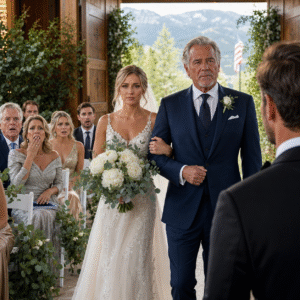
3 days before my wedding, Dad called: “I’m not walking you down the aisle. Your sister says it would upset her.” Mom agreed: “Just walk alone. It’s not a big deal.” On my wedding day, I didn’t walk alone. When the doors opened and guests saw who was holding my arm, my father, sitting in the back, went pale.
The steel jaws of the pruning shears snapped shut.
I stood inside my greenhouse with the severed stem of an imported orchid in my hand, tracing the bruised white petals with my thumb. My sister Isabella had sent it the week before. It was expensive, beautiful, and already dying because it had no roots.
“It is just about being sensitive right now, Penny,” my father said.
His voice came through the speakerphone resting on my potting bench, small and hollow against the glass walls. Outside, the Bozeman wind rattled the panes, sweeping over the Montana fields with a dry, unforgiving chill.
“Izzy is hitting a rough patch with Preston,” he continued. “Seeing you so happy, getting everything you want, it is rubbing salt in the wound. I cannot walk you down the aisle and leave her sitting in the pew feeling overshadowed.”
Three days. Seventy-two hours before I was supposed to stand at the altar, Hector Ramirez was dropping out.
Not because of an emergency. Not because of illness. Not because of a delayed flight or some crisis nobody could control.
He was abandoning me because my happiness was inconvenient to his favorite daughter.
My mother’s voice drifted through the phone next, muffled and faint, like she was moving around their kitchen island arranging flowers while my father dismantled one of the most important days of my life.
“Your dad is right, sweetie. Just walk alone. It is a very modern thing to do anyway. It is not a big deal.”
Most people believe family will automatically stand beside you when it matters. They are wrong. Sometimes the people who share your blood are simply waiting for the right moment to let you fall.
I set the dead orchid on the dirt-covered table.
I did not yell. I did not ask them how they could justify ruining my wedding to protect a grown woman’s ego. The tears I might have shed ten years earlier had dried long ago, replaced by a cold, clinical clarity.
My mind flashed back to a middle school gymnasium. I was twelve years old, standing beside a poster board about the root systems of native Montana flora, a blue first-place ribbon hanging from the corner. Beside me were two empty metal folding chairs.
My parents had skipped the state science finals because Isabella had a preliminary tryout for the junior varsity cheer squad.
The pattern was not new. Only the stakes had changed.
“Okay,” I said. My voice was level. “I understand.”
My father released a loud breath of relief.
“Oh, thank goodness. You are always the practical one, Penny.”
“We will sit in the back,” he added. “Make a quiet exit. We have to help Izzy set up her anniversary party later that evening anyway.”
“See you Sunday,” I replied.
Then I ended the call.
I picked up my phone and opened a secure cloud folder I had maintained for the past six months. The folder was simply titled Receipts. I uploaded the automatic audio recording of the call, watching the green progress bar fill until the file locked into place.
I was twenty-nine, the founder of a botanical formulation company my family dismissed as a little weed-picking hobby. I had built it from a greenhouse outside Bozeman with my own hands, my own formulas, and my own refusal to quit.
They saw dirt under my nails.
They never looked long enough to see what I was growing.
I opened a text thread to Elias Thorne, the man I was marrying.
To my parents, Elias was nothing more than a wilderness guide who drove a dusty Ford Bronco, wore faded flannel, and lacked the flashy leasing power of Isabella’s husband. They had no idea who Elias actually was, and they never cared enough to look past the dirt on his boots.
I typed quickly.
“Dad just dropped out. He is not walking me. Izzy feels overshadowed.”
I set the phone face down on the wooden bench and turned back to my potting soil. I expected a call. Maybe a long message of comfort. Maybe an offer to come over.
Thirty seconds later, the screen lit up with one incoming text.
Elias did not offer pity. He did not offer outrage.
“Do not worry,” the message read. “I know exactly who to call.”
To understand why my father felt comfortable tossing my wedding aside with a single phone call, you have to understand the currency that ruled our family.
That currency had a name.
Preston Hayes.
My brother-in-law was a commercial real estate developer. He wore aggressive pinstripe suits, drove vehicles with European badges, and made sure everyone within a fifty-foot radius knew the price of his vacations.
He also funded the illusion of my parents’ wealth.
He paid the initiation fees for their country club membership. He covered the lease on my mother’s luxury sedan. He treated them to expensive dinners and let them believe they had risen into a social class they had only borrowed.
In exchange, Hector and Vivian Ramirez handed over their dignity and their loyalty.
Preston bought the room, so Preston called the shots.
Two weeks before my father canceled on me, we sat around a mahogany table at a high-end steakhouse in downtown Bozeman. The lighting was low, the bill was going to be steep, and the power dynamic was suffocating.
Elias and I sat near the edge of the booth, nursing our waters. Preston sat at the head of the table, swirling an expensive glass of Cabernet and holding court.
“So, Elias,” Preston said, projecting his voice so neighboring tables could hear. “Still dragging tourists up the ridges? When are you going to settle down and get a real job? A guy your age should be thinking about equity, not how many hiking trails he can memorize.”
My father let out a short, obedient laugh, eager to align himself with the man paying for his ribeye.
I felt my jaw tighten. I opened my mouth to defend the man I loved, but Elias placed a warm, calloused hand over my knee beneath the table.
He did not look embarrassed. He did not look angry.
He looked at Preston the way a scientist observes an interesting but harmless insect.
“I like the trails,” Elias said, his voice calm and steady. “They get me exactly where I need to go.”
Preston scoffed.
“Well, ambition is not for everyone. You need killer instinct in the real world. Take my new commercial project on the west side. We are building a luxury mixed-use development. Retail on the bottom, high-end condos on top. It is a game changer for the county.”
My mother leaned forward, eyes wide with practiced admiration.
“That sounds incredible, Preston. You are doing so much for the community.”
“I try, Vivian. I try,” Preston said, leaning back and resting his arm across Isabella’s chair. “The only headache is the commercial easement. Everything is green-lit. The zoning is prepped. The capital is secured. But the access road requires an easement through an adjacent parcel, and the owner is a stubborn dinosaur.”
“A dinosaur?” my father asked, eager to participate.
“Some old rancher sitting on hundreds of acres of prime real estate,” Preston complained, waving his hand. “He refuses to grant the easement, refuses to take a meeting. He does not understand modern capital. He is a fossil holding up progress because he wants to keep his dirt quiet. I told my legal team to find a loophole and squeeze him out. You cannot stop progress.”
Elias took a slow sip of water.
“Some men value quiet dirt over loud concrete,” he offered mildly.
Preston rolled his eyes.
“Spoken like a true wilderness guide. Real money requires concrete, Elias.”
Isabella, sensing that the conversation had hovered on her husband too long, tapped her manicured nails against her wine glass. She needed the spotlight returned to its rightful place.
“Speaking of progress and exciting news,” Isabella announced, her voice rising an octave, “Preston and I decided we are throwing a spontaneous anniversary gala. We want to celebrate our life together and host some of the new investors flying into town.”
My mother clapped her hands together.
“Oh, Izzy, a gala? How glamorous. When are you thinking of hosting it?”
Isabella looked directly at me across the table.
Her smile was sharp, calculated, and bright.
“June 14th,” she said. “We know it is short notice, but the investors are only in town that weekend, and we just had to make the timing work.”
The table went dead silent.
June 14th was my wedding day. I had mailed the save-the-date cards eight months earlier.
My parents did not gasp. They did not point out the obvious conflict. Instead, my father cleared his throat and looked down at his plate while my mother began running logistics.
“Well,” my mother said, her voice tight but accommodating, “we will just have to figure out a tight schedule. We can manage both, right, Hector?”
“Of course,” my father agreed too quickly. “We will make it work. It is a big weekend for the family.”
I sat frozen.
The cruelty was not a byproduct of their busy lives. It was the point. Isabella had chosen that exact date to force a choice, testing the strength of Preston’s financial leash.
She wanted to prove, in front of everyone, that she could summon our parents away from my defining milestone for a fabricated party.
When dinner finally ended, we stepped out onto the cold Bozeman sidewalk. The night air bit at our coats. We walked toward the parking lot, where Preston’s gleaming silver Porsche Macan sat under a streetlight, looking entirely out of place against the rugged Montana backdrop.
Next to it sat Elias’s dusty ten-year-old Ford Bronco.
Preston unlocked the Porsche with a loud double chirp.
“Drive safe, you two,” he called, his tone dripping with condescension. “Hope the old truck starts in this cold.”
Elias walked past the driver’s side of the Porsche. He paused, running one finger lightly along the pristine fender. Then he looked up at Preston.
“Nice ride, Preston,” Elias said quietly. “Enterprise commercial leasing out of Seattle, right? Tier Four corporate package. They do great maintenance on these fleet vehicles.”
Preston froze.
The smug smile vanished from his face, replaced by a flash of panic. His hand stalled on the door handle.
“It is a business expense,” Preston snapped, his voice defensive and thin. “Smart capital allocation.”
“Very smart,” Elias agreed, offering a polite nod. “Have a good night.”
We climbed into the Bronco. Elias started the engine, and it roared to life without a single sputter.
As we pulled out of the lot, I watched Preston in the rearview mirror. He was still standing beside the Porsche, staring after us, visibly unsettled by the dirt-poor guide who had casually identified the commercial paper holding his luxury illusion together.
I leaned my head against the cold passenger window, watching the streetlights blur past.
My sister was a bouquet of cut flowers. She required constant maintenance, expensive vases, fresh water, and an audience to look alive. She needed galas and leased cars and applause.
I spent my life working with soil. I understood that true growth happened in the dark beneath the surface, where nobody was watching.
I was building roots. Deep, unshakable roots that could survive a hard Montana winter.
They were trying to erase me, assuming I would wither without their sunlight. They had no idea what kind of storm they were standing in.
Forty-eight hours before I was scheduled to put on a white dress, the air inside my greenhouse was thick with the sharp, grounding scent of crushed sage and damp loam.
I stood at my stainless steel workbench, carefully measuring a rare alpine botanical extract into small glass vials. This was my sanctuary. Soil acidity could be adjusted. Growth could be nurtured. Variables could be controlled.
The variables outside the glass walls were spinning rapidly out of my hands.
My phone vibrated against the metal counter. The caller ID showed Sarah Jenkins.
Sarah was the events director for the Bozeman Botanical Gardens, the venue where I was supposed to marry Elias in two days. She was also a friend, and she stocked my bespoke salves in the garden gift shop.
I wiped my hands on my canvas apron and answered.
“Penny, I need you to listen to me very carefully,” Sarah said.
Her voice was stripped of its usual cheerful rhythm.
“Your brother-in-law, Preston, is currently sitting in my outer office. He just placed a thick manila envelope full of cash on my desk and asked for the buyout price to secure the entire garden property for Saturday night.”
My hand froze over a glass vial.
He was not just trying to overshadow my wedding by hosting an anniversary gala on the same night. He was trying to buy the exact ground out from under my feet.
“What did you tell him?” I asked, my voice dropping low.
“I told him our contracts do not have buyout clauses for private events,” Sarah replied. “He laughed and said, ‘Everyone has a number.’ He offered ten thousand dollars cash to cancel your reservation and transfer the permit to his catering team. I told him to leave my office before I called security. Penny, he is in the lobby right now making phone calls. You need to handle this.”
“Do not sign anything, Sarah. I will be right there.”
I hung up and stripped off my apron. My gloves hit the counter with a heavy thud.
Preston thought his leased wealth allowed him to bypass basic decency. He thought he could write a check and erase my existence.
I grabbed my keys and marched out of the greenhouse. The Montana sun was high and unforgiving.
Just as I reached the gravel driveway, a sleek black Lincoln Navigator pulled through the front gates. It parked perfectly parallel to my front porch, the engine humming with a quiet, expensive purr.
The driver’s door opened. Maya Thorne stepped out onto the gravel.
Maya was Elias’s older sister. She lived in Chicago, where she worked as a senior corporate attorney for a firm that handled multi-tier acquisitions. She wore a tailored charcoal suit, a silk blouse, and a gaze that missed nothing.
Maya fought her way up the corporate ladder by dismantling arrogant men in boardrooms before they finished their morning coffee.
“Get in,” Maya said.
The command was smooth, but it left no room for debate.
I stopped halfway to my car. “How did you know?”
“Elias called me,” Maya replied, opening the passenger door of the Navigator. “He handles the mountains. I handle the liabilities. Your brother-in-law is a liability. Get in the car, Penelope. We are going to lunch. You need to eat, and we need to establish a perimeter.”
I slid into the leather passenger seat. The vehicle smelled like bergamot and fresh paper.
Maya drove toward downtown Bozeman with the same precision she likely used to draft legal briefs.
We arrived at a high-end bistro on Main Street, the kind of place with exposed brick, low ambient lighting, and waiters who memorized sparkling water preferences. Maya requested a corner booth facing the door. She ordered a salad and black coffee. I ordered a sandwich I knew my stomach would reject.
“Your family views your boundaries as a challenge,” Maya said before the drinks arrived. “They are not merely neglecting you. They are running a coordinated offensive because your independence is a direct threat to their hierarchy. Preston uses money to control your parents. You do not require his money, which means he cannot control you. He hates that.”
