I Buried My Famous Husband Six Months Ago. Yesterday I Saw Him Alive At A Grocery Store.
Yesterday, I saw him alive.
Not in a dream.
Not in some cruel trick of memory.
Not in one of those old movie reels where the dead return in soft focus and the music tells you what to feel.
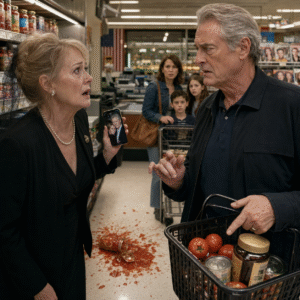
I saw him under fluorescent grocery-store lights, standing three shelves away from me, holding a basket of tomatoes, soup cans, and store-brand coffee like he had not been buried six months earlier beneath a marble headstone with his name on it.
Thomas Whitmore.
My husband of forty-one years.
The man Hollywood had mourned with black suits, tribute montages, and speeches about legacy.
The man whose face had been projected twenty feet tall at the Grand Meridian Theater while actors half his age cried into microphones and called him a legend.
The man I had buried.
The man whose side of the bed I still could not bring myself to touch.
That morning, I went to the grocery store because grief does not excuse an empty refrigerator.
It was a small market in Studio City, the kind Thomas always loved because the produce was good and the employees pretended not to recognize actors unless the actors clearly wanted to be recognized. He used to say the best thing about getting older in Hollywood was becoming invisible in all the useful ways.
I remember standing in the canned goods aisle, staring at rows of beans and soup, thinking how strange it was that the world could keep restocking shelves while my life had stopped.
Six months of silence.
Six months of waking before dawn and reaching across the mattress before remembering there was no one there.
Six months of old interviews playing on YouTube because sometimes I needed to hear his voice and sometimes hearing it nearly killed me.
I reached for a jar of tomato sauce.
That was when I heard it.
A soft cough.
Then a muttered complaint about prices.
“Eight dollars for sauce. For sauce.”
The jar slipped slightly in my hand.
No.
My body knew before my mind would allow it.
That voice had lived in my kitchen for four decades.
That low rough edge. That little irritated rhythm. That half-muttered performance he did when he thought no one was listening.
I turned slowly.
And there he was.
Silver hair that still refused to lie flat.
Broad shoulders, a little more hunched now.
The same scar above his right eyebrow from the stunt accident he always said looked more heroic than it felt.
The same mouth.
The same hands.
Thomas.
My Thomas.
I dropped the jar.
It shattered on the floor, red sauce splattering across the white tile like something alive. People gasped. A teenager in a green apron said, “Ma’am, are you okay?”
I did not answer.
My feet were already moving.
“Thomas,” I cried.
The name tore out of me.
He turned.
For one terrible, beautiful second, I expected everything to break open in the right direction.
Recognition.
Shock.
Tears.
His arms around me.
Some impossible explanation that would hurt but still bring him back.
Instead, he looked at me like I was a stranger.
Not cruelly.
Worse.
Gently.
“I’m sorry,” he said slowly. “I think you have me mistaken for someone else.”
The words hit harder than the sight of him.
Mistaken.
As if forty-one years could be mistaken.
As if I had not memorized every line of his face in the dark.
“No,” I whispered, stepping closer. “No, Thomas. It’s me. Eleanor.”
His eyes flickered.
Just once.
Then he stepped back.
That step hurt more than anything.
Thomas had never stepped away from me. Not even in our worst fights. Not even when reviews were bad, money was tight, studios were cruel, or our son was breaking our hearts in ways we did not yet have language for.
“My name is Daniel,” he said. “Daniel Brooks. I don’t know you.”
His voice was the same.
Deep.
A little tired.
The voice that had whispered lines to me before premieres because he still got nervous even after fifty years in front of cameras.
I reached for my phone with shaking hands and pulled up a photo from last summer.
His last birthday.
Or what I had believed was his last birthday.
Us on the back porch, his arm around my shoulders, his cake melting because he insisted we eat outside even though it was too hot.
“Look,” I said, holding the phone up between us. “Look at this. You burned the steaks that day and blamed the grill. You said a man can win three industry awards and still be defeated by propane.”
He glanced at the screen.
Something moved across his face.
A pause too long.
A tightening in his jaw.
Then he shook his head.
“I’ve never seen that photo before,” he said. “You must be going through something very difficult.”
He put a hand on my shoulder.
That touch nearly broke me.
It was his hand.
The same warmth.
The same weight.
The same thumb pressing softly near my collarbone the way he always did when he wanted to calm me down.
“Please,” he said gently. “You should sit down. Get some water.”
I stared at his left hand.
“Show me your fingers,” I said.
His expression changed.
Only slightly.
“What?”
“Your hand. Show me your fingers.”
He frowned, but lifted his hand.
There it was.
The crooked pinky.
The one he broke at fifteen helping his father repair a theater roof in Pasadena. The one I used to tease him about when we held hands during screenings.
My stomach dropped.
“I have to go now,” he said quickly.
Too quickly.
“I truly hope you feel better.”
And then he turned his cart and walked away.
Just like that.
I stood there while an employee cleaned the mess at my feet. People avoided my eyes. Someone whispered, “Poor woman.”
They were wrong.
I was not poor.
I was terrified.
Because as I watched him disappear toward the checkout, one thought screamed louder than grief ever had.
If my husband was alive, then who was buried in his grave?
I should have gone home.
I should have locked the door, taken a pill, called my son, and allowed everyone to tell me grief had finally broken something inside me.
That would have been easier.
Cleaner.
Kinder.
But I did not go home.
I watched him from the end of the aisle as he paid for his groceries.
Cash.
I noticed that.
Thomas had always used a card, partly because he liked records, partly because he liked complaining about records. This man paid with folded bills, pressing the edges flat with his thumb.
The same way Thomas used to flatten script pages before a table read.
My chest tightened.
When he pushed the cart toward the exit, my feet moved before I made a decision.
I followed.
Outside, afternoon light hit my face.
He loaded groceries into an old white sedan, paint dulled by age, a dent along the rear door. Not the car Thomas owned. Not the car he loved and polished every Sunday with a rag tucked into his back pocket like he was still a struggling actor trying to keep one good thing nice.
But the way he placed the bags inside was unmistakable.
Heavy items first.
Bread on top.
Eggs last.
I memorized the license plate without realizing I was doing it.
Then he drove away.
I stood there for a moment, hands clenched at my sides.
Then I walked to my car.
The black Mercedes Thomas had bought me two years before the accident because he said he wanted me to have something safe, something reliable, something that made him worry less when I drove alone at night.
I followed him.
Three or four car lengths back.
Close enough not to lose him.
Far enough not to be noticed.
My heart pounded so loudly I was afraid the cars around me could hear it.
We passed Ventura Boulevard, turned through quiet streets, then into a neighborhood I rarely visited. Smaller houses. Older lawns. Chain-link fences mixed with white picket ones. Jacaranda trees dropping purple flowers onto cracked sidewalks.
He slowed in front of a simple pale green house with a low fence and wind chimes near the porch.
The kind of house no magazine would ever photograph.
The kind of house where real people kept real lives.
He got out with the groceries.
Then the front door opened.
A woman appeared.
Mid-fifties.
Dark hair pulled back.
No makeup.
Sweater sleeves pushed to her elbows.
She smiled when she saw him.
Not a polite smile.
A familiar one.
She leaned in and kissed his cheek.
My vision blurred.
She took one of the bags from him, speaking softly. I could not hear the words, but I recognized the ease.
Shared routine.
Shared mornings.
Shared lies.
Then two children burst through the doorway.
A boy and a girl, maybe eight and ten.
“Grandpa!” the girl shouted. “Did you bring the ice cream?”
He laughed.
That laugh.
Warm.
Lopsided.
The laugh that had filled our kitchen for forty-one years.
The laugh the memorial montage had ended with while an entire theater stood applauding a dead man.
He crouched, letting the children climb onto him, balancing groceries with practiced skill.
The woman watched, her hand resting lightly on his back.
Then they all went inside.
The door closed.
I sat frozen in my car halfway down the street, gripping the steering wheel until my fingers hurt.
Only then did I realize I was crying.
Not sobbing.
Not shaking.
Just steady tears sliding down my face.
Six months of mourning.
A closed casket.
A Hollywood memorial.
His old co-stars holding my hands.
Lucas standing beside me at the grave, telling me Dad would want me to be strong.
And here Thomas was.
Alive.
Laughing.
Holding children who called him Grandpa.
I took out my phone and began taking pictures.
The house.
The car.
The address number.
The front porch.
My hands shook so badly that half the photos blurred, but some were clear enough.
Clear enough to ruin everything.
When the light began to fade, I drove home.
I do not remember the drive.
I remember only sitting in my garage afterward, engine off, phone in my hand, zooming in on his face again and again.
Every line matched.
Every shadow.
When I finally went inside, the house felt staged.
Not lived in.
Staged.
As if the rooms had been built for the role of widowhood.
Thomas’s awards on the shelves.
The framed posters from his films.
The black-and-white photo of him laughing behind a camera.
The condolence letters stacked in a drawer.
The program from his memorial screening.
A life of grief curated around a lie.
I did not sleep that night.
I sat at the kitchen table with one lamp on, old photo albums spread open around me like evidence at a crime scene.
Wedding day.
First house.
Lucas as a baby on Thomas’s chest.
A beach trip in Santa Barbara where Thomas’s shirt rode up and showed the small mole near his collarbone.
I looked at the photos from the pale green house.
Then at the albums.
Scar above the eyebrow.
Crooked pinky.
Uneven ears.
The mole.
These were not things grief invented.
These were facts time had carved into a body.
At 3:40 in the morning, I stopped pretending I was waiting until morning.
I called Lucas.
He answered on the fourth ring, voice thick with sleep.
“Mom? Do you know what time it is?”
“I need you to come over right now.”
A pause.
“What happened?”
“I saw your father yesterday.”
Silence.
Then a breath.
“Mom…”
“Alive,” I said. “I saw him alive.”
Another pause.
Longer.
“Mom, if this is about Dad again, we talked about this. Grief can do strange things.”
“I followed him home, Lucas. I saw where he lives. I saw his family.”
His breathing changed.
That was the first thing I noticed.
Not his words.
His breathing.
“Stay there,” he said finally. “Don’t go anywhere. I’m coming.”
The call ended.
Forty minutes later, Lucas walked into the house without knocking, the way he had since he was sixteen.
He found me at the kitchen table surrounded by photos.
My son was forty now, though that morning he looked older. He had Thomas’s height, my eyes, and the polished sadness of a man who had spent too much time learning to look calm in public.
Since the accident, he had been managing Whitmore Productions, the small company that held Thomas’s residuals, licensing rights, old film participation, and development assets. He had accepted the role at the memorial with trembling dignity.
“My father built stories,” Lucas had told the crowd that night. “Now it’s my honor to protect his legacy.”
People cried.
I cried.
Now he stood in my kitchen looking at the photos on my table like one of them might explode.
“Mom,” he said softly. “What is going on?”
I handed him my phone.
I did not speak.
I watched his face as he scrolled.
First confusion.
Then denial.
Then something else.
Fear.
He swallowed.
“He looks like Dad,” he said carefully.
“Look at his hand.”
“Mom—”
“Look.”
He zoomed in.
The crooked pinky.
His face changed.
Still, he tried.
“People can resemble each other.”
“Not like this.”
“We buried Dad.”
“A closed casket.”
“The accident was bad.”
“Did you see his body, Lucas?”
His jaw tightened.
“No.”
“Neither did I.”
The room went very still.
“I want to go back there,” I said.
“No.”
“Yes.”
“This is not healthy.”
“Are you coming with me or am I going alone?”
He looked at me then, really looked, and maybe he understood that whatever he had feared was already happening.
“Fine,” he said. “We’ll go. So you can see it isn’t him. So you can let this go.”
We left before dawn.
The city was quiet in that early Los Angeles way that feels like a set before crew call. Empty intersections. Palm shadows. A few joggers. Delivery trucks. The first gray light beginning to press against the hills.
When we turned onto the quiet street with the pale green house, my heart began to hammer again.
“That one,” I said.
Lucas parked half a block away.
We waited.
A few minutes later, the front door opened.
Thomas stepped out.
No hat.
No disguise.
Just an old sweater, jeans, and that same slow careful way he moved in the morning before his knees warmed up.
Lucas leaned forward.
The color drained from his face so completely I thought he might faint.
Thomas walked to the car.
He drove past us.
Lucas did not move.
When I looked at my son, tears were running down his cheeks.
“Mom,” he whispered.
And in that moment, before he said another word, I knew.
Whatever truth he had been carrying had finally broken him.
Lucas put his forehead against the steering wheel.
His shoulders shook.
I had seen my son cry before — when his first marriage ended, when his dog died, at his father’s memorial — but never like this.
This was not grief.
This was collapse.
“I’m so sorry,” he said.
Sorry meant guilt.
Sorry meant knowledge.
Sorry meant I had not lost my mind.
“Tell me,” I said.
My voice sounded almost calm.
That frightened me.
Lucas lifted his head.
His eyes were red and full of shame.
“Dad didn’t die in that accident.”
The words sat between us.
Heavy.
Final.
I did not scream.
I did not gasp.
Some part of me had crossed into a place where shock no longer worked.
I nodded once.
“Go on.”
He wiped his face with both hands.
“He had another family. Mom… for a long time. More than twenty years.”
I stared through the windshield at the empty street.
“That woman?”
“Claudia. She used to work in makeup on one of his series back in the nineties. It started while he was shooting in Vancouver. Then it never stopped. He lived with her part of the time. Trips, reshoots, location scouting, festivals, development meetings — a lot of it was her.”
I thought of all the times I had defended him.
Thomas is working.
Thomas is exhausted.
Thomas gives everything to his art.
Art.
What a beautiful curtain for selfishness.
“How long did you know?” I asked.
Lucas looked away.
“Three years.”
The answer entered me like cold water.
“I found out by accident,” he said. “I was helping him clean up old production files. There were duplicate utility bills, insurance payments, tuition checks, medical bills. Two households. Two lives.”
“And you said nothing.”
“He begged me not to tell you. He said it would destroy you.”
“He was right about that part.”
Lucas flinched.
“He said if you found out, you’d divorce him. You’d take half of everything. The house. The company. The residuals. The library rights. He said it would all get dragged into court and he’d spend his last years fighting instead of living.”
“His last years,” I repeated.
“Six months ago, he came to me with a plan.”
The street seemed to narrow.
“He wanted out. Completely. He said he wanted to be with Claudia for good. But he didn’t want the divorce, the press, the money, the humiliation. A famous man leaving his wife after forty years for a second family? He said the media would eat him alive.”
“So he decided dying was cleaner.”
Lucas closed his eyes.
“Yes.”
“How?”
“Mom—”
“How?”
His voice dropped.
“There was a man. Terminally ill. No close family except a niece. He had been living around the old studio warehouse. Dad found him through someone who did security work. He paid the niece. Paid the man before he died. Documents were switched. The accident was staged after he was already barely alive. The body was badly damaged. The casket stayed closed.”
I remembered.
The police call.
Lucas standing in my bedroom, saying the detective recommended I not view the body.
Lucas arranging everything.
Lucas choosing the casket.
Lucas holding my arm at the cemetery while I buried a stranger.
“You let me bury another man.”
His face crumpled.
“Yes.”
“You let me mourn him.”
“Yes.”
“You watched me stand in front of all those people at the memorial while they played clips of your father smiling on screen.”
“Yes.”
“And you took the microphone.”
He covered his mouth.
“I didn’t know how to stop it.”
“You knew before it started.”
He sobbed once.
“I thought I could take care of you.”
The words were so obscene in that moment I almost laughed.
“Take care of me?”
“If he died, the estate structure changed. Most of the public-facing assets passed through me. He had already moved money under the Daniel name. The rest came to Whitmore Productions. I thought I could manage everything, give you distributions, make sure you were comfortable.”
“Distributions.”
I turned to look at him.
“My husband faked his death, my son helped him, and I was going to be given distributions?”
He broke completely.
“I know. I know how it sounds.”
“No, Lucas. I don’t think you do.”
There was a long silence.
Then I asked the question I already knew would hurt.
“Who is buried in his grave?”
Lucas swallowed.
“I don’t know his real name. Dad said it was better if I didn’t.”
I looked at him for a long time.
The boy I had raised.
The man I no longer understood.
“Take me home,” I said.
“Mom, please. We need to talk.”
“Take me home.”
He drove me back in silence.
When we arrived, he followed me to the front door.
“Mom, please.”
I turned.
“You let me bury a stranger and called it mercy.”
He flinched as if I had slapped him.
“Do not come inside.”
Then I closed the door.
For three days, I did nothing.
That is what people do not understand about betrayal.
They think the first response is screaming.
Mine was stillness.
Lucas called. I did not answer.
He came by twice. I watched from upstairs while he stood in the driveway, looking smaller than he had ever looked to me, then left.
Claudia’s house remained in my phone.
The photos remained.
Thomas’s face remained.
I did not call him.
Not yet.
Anger rushes.
Strategy waits.
On the fourth morning, I woke before dawn and knew exactly what I was going to do.
I showered.
I dressed carefully.
Navy slacks. White blouse. Low heels. Pearl earrings.
Not widow clothes.
Not mourning clothes.
My clothes.
When I looked in the mirror, I saw someone older, yes.
But sharper.
Awake.
I drove downtown to a private investigation office in a building I had passed a hundred times and never noticed.
The man behind the desk was in his sixties, thinning hair, sharp eyes, no wasted politeness.
“I need to find someone,” I said, sitting before he invited me.
He leaned back.
“Missing or hiding?”
“Hiding,” I said. “And legally dead.”
That got his attention.
I told him everything.
Not the heartbreak.
Not the forty-one years.
Facts.
The closed casket.
The grocery store.
The false name.
The pale green house.
The second family.
Lucas.
The memorial.
The Whitmore Productions assets.
I showed him the photos.
He listened without interrupting.
When I finished, he nodded slowly.
“If what you’re saying is true, this isn’t only infidelity. This is identity fraud, estate fraud, financial exploitation, and probably conspiracy.”
“I know.”
“It will take time.”
“I have time.”
“It will cost money.”
“I have money.”
He named a number.
I wrote the check.
“I don’t want suspicion,” I said. “I want proof.”
He smiled faintly.
“I can do proof.”
Over the next week, I watched from the edges of my own life.
I returned to the pale green house at different hours, wearing hats and sunglasses, sitting in the car like a stranger.
I learned his schedule.
He left around eight.
Returned around six.
Church on Sundays.
Grocery store Wednesdays.
Grandchildren after school.
A good man, the neighbors would have said.
I learned the name he used.
Daniel Brooks.
Retired transportation consultant.
Widower.
No close family.
I watched Claudia touch his arm the way I used to.
I watched him fix a porch light with his crooked pinky bent around the screwdriver.
I watched him smile with the ease of a man who believed his past was buried.
It was not.
The investigator called me seven days later.
“I have enough for a full report,” he said. “You should come in.”
The folder he handed me was thick.
Heavy.
Real.
A fake birth record.
Bank accounts opened under Daniel Brooks, funded by transfers made weeks before Thomas’s supposed death.
Utility bills tying him to Claudia’s house for years.
Old production expense reimbursements that were not production expenses at all.
Payments to Claudia through consulting vendors.
A life hidden under the language of work.
Then the last section.
Phone records.
Lucas and Thomas.
Before the accident.
After the funeral.
During the months I thought I was alone.
Hundreds of calls.
Some long.
Some short.
All damning.
Lucas had not just known.
He had stayed involved.
I closed the folder slowly.
“Thank you,” I said.
As I walked out, something settled inside me.
This was no longer about rage.
It was about dignity.
About truth.
About refusing to be erased quietly.
They thought I would mourn forever.
They thought silence meant weakness.
They were wrong.
The storm had not passed.
It had only just begun.
I did not confront Lucas immediately.
Every instinct in me wanted to throw the folder on the table and demand answers.
But I had lived beside a performer long enough to understand staging.
Timing matters.
Audience matters.
Proof matters most.
I made an appointment with an attorney the next morning.
Not a divorce attorney.
Not an estate attorney.
A criminal defense-turned-victim advocate who understood fraud, financial crimes, identity theft, and what powerful men do when they think reputation is armor.
Her name was Marla Quinn.
She had silver hair cut sharply at the jaw and a voice that made nonsense feel embarrassed to exist.
After reviewing the report, she looked up.
“This is a criminal conspiracy.”
I nodded.
“Your husband committed identity fraud, estate fraud, and financial theft. Your son aided and benefited. You are entitled to restitution, asset recovery, and criminal referral.”
“What do you need?”
“A confession would help,” she said. “Especially from Lucas. We need proof of transfers, forged authorizations, and knowledge. If we have that, the case becomes much harder to bury.”
I knew where some of the documents would be.
Lucas kept an office at Whitmore Productions’ archive warehouse in North Hollywood.
Years ago, after Thomas forgot his keys twice in one week, Lucas gave me a spare.
“For emergencies,” he had said.
I almost laughed thinking about that now.
But first, I needed him to talk.
I called Lucas that afternoon.
“Mom,” he answered immediately. “Are you okay? I’ve been worried sick.”
“I’m tired,” I said.
I let my voice soften.
“I don’t want to fight anymore. I need to understand everything so I can move forward.”
Relief moved through his breath.
“Of course. Anything.”
“Lunch tomorrow,” I said. “Somewhere quiet.”
He agreed.
That night, I placed a small recorder in my purse.
I practiced keeping my hands still.
At lunch, I listened.
I let him think I was broken enough to be manageable.
I asked when the plan started.
How the money moved.
Who signed what.
Where the proceeds from the licensing deals went.
Why he agreed.
What Thomas promised him.
Each answer came easier than the last.
He thought confession, if framed as explanation, would become forgiveness.
He did not see the recorder.
He did not see that every word was sealing the door.
While we ate, Marla and the investigator were already at work. With the evidence I provided, they secured emergency access to financial records and preservation orders for Whitmore Productions’ accounts.
The transactions told the rest.
Forged signatures.
Unauthorized transfers.
Licensing proceeds redirected.
Funds wired into accounts Lucas controlled.
By the time lunch ended, the trap had closed.
That afternoon, Marla filed the complaint.
Identity fraud.
Forgery.
Financial exploitation.
Estate fraud.
Conspiracy.
Two days later, she called.
“The district attorney accepted the case. Warrants are being prepared.”
I sat alone in the living room when the call ended.
No television.
No music.
Just the ticking clock on the wall.
I thought of the woman I had been six months earlier, crying into the empty side of the bed, begging a dead man to come back.
That woman would not have survived this moment.
But I was no longer her.
I did not feel joy.
I did not feel triumph.
I felt resolved.
The truth was no longer mine alone.
Soon it would belong to the law.
The first arrest came at dawn.
Lucas.
“No resistance,” Marla said over the phone. “He asked if you knew.”
“What did you say?”
“I said you were the reason we knew.”
I closed my eyes.
The weight of my son in handcuffs did not feel like victory.
It felt like gravity.
By noon, the family began calling.
Cousins.
Old friends.
People who had stood beside me at the memorial and told me grief would get easier.
I ignored them.
At two, Marla called again.
“The Daniel Brooks identity is being formally invalidated. Accounts under that name are frozen. He has nowhere to hide.”
That was when I knew I needed to see him.
Not to argue.
Not to explain.
To end it.
I drove to the pale green house and parked directly out front.
No hiding.
No distance.
No sunglasses.
I walked up the path and rang the bell.
Claudia opened the door.
Up close, she looked tired, kind, and completely unprepared for what my life was about to do to hers.
“Can I help you?” she asked.
“I’m here to see Daniel,” I said. “It’s urgent.”
She hesitated.
“He’s in the backyard.”
She stepped aside.
I walked through a house that smelled like coffee, crayons, and someone else’s marriage.
There were children’s drawings on the refrigerator.
A photo of Claudia and Thomas at the beach.
Another of him holding a toddler.
A life.
Not a mistake.
A life.
He was in the backyard near the fence, tools in his hands, sleeves rolled up.
For one second, he did not see me.
Then he turned.
Recognition hit him fully this time.
“Eleanor,” he whispered.
Not Daniel.
Not confusion.
Eleanor.
I held out the envelope.
“These are legal documents,” I said calmly. “You need to read them.”
His hands trembled as he took the papers.
His eyes moved across the first page.
Then the second.
The color left his face.
“What did you do?”
“I told the truth.”
He looked past me toward the house.
“Does she know?”
I raised my voice just enough.
“She does now.”
Claudia appeared behind him.
“What?”
He said nothing.
I turned to her.
“I am his wife,” I said. “His legal wife. We were married for over forty years. The man you know as Daniel Brooks does not exist.”
Silence.
Claudia stared at him.
“Thomas?”
He closed his eyes.
Her hand went to the doorframe.
“You said you were widowed.”
“I—”
“You said you had no one.”
“I had someone,” I said. “Me.”
He dropped to his knees on the concrete.
“Eleanor, please. I can explain.”
“No,” I said. “You explained enough when you let me bury a stranger.”
Sirens sounded faintly in the distance.
He looked toward the street.
“They’re coming.”
“Yes.”
I turned to leave.
“Eleanor,” he called. “For the years we shared. For what we were.”
I stopped but did not turn around.
“What we were was real to me,” I said. “That is why you will never understand what you destroyed.”
The police arrived as I reached the sidewalk.
I did not watch them lead him away.
But the story did not end at that house.
Because that evening, Hollywood had planned to honor a dead man.
The Grand Meridian Theater was hosting a memorial tribute for Thomas Whitmore’s lifetime legacy. It had been scheduled for months. A restored print of his most famous film. Clips from his career. Lucas was supposed to accept a foundation award in his name.
By then, Lucas was already in custody.
Thomas was being processed under a name that did not exist.
Marla asked if I wanted to cancel.
I said no.
For six months, the lie had been public.
So the truth would not be whispered.
I arrived at the theater in black.
Not widow black.
War black.
The lobby glowed with old Hollywood glamour: framed posters, champagne glasses, reporters, actors, producers, directors, publicists, all gathered to mourn a man who had not been dead when they cried for him.
The host began with soft words.
Legacy.
Art.
Devotion.
Then Marla walked to the edge of the stage and handed the organizer a court-stamped document.
The room shifted.
Whispers moved faster than music.
I stepped onto the stage before the tribute reel could begin.
A giant photograph of Thomas smiled behind me.
The one everyone loved.
The one where he looked generous, brilliant, impossible not to forgive.
I stood beneath it and looked out at the room.
“I buried my husband six months ago,” I said.
The theater went silent.
“Today, the law confirmed what I saw in a grocery store yesterday.”
A murmur rose.
I held up the folder.
“Thomas Whitmore did not die in the accident you were told about. He lived under another name while I mourned him. And the legacy being honored tonight was built on a lie that involved identity fraud, stolen assets, and the son who stood beside me at his funeral.”
No one moved.
Somebody gasped.
Somewhere near the third row, a woman began crying.
I looked up at Thomas’s giant smiling face.
Then back at the crowd.
“This tribute is over.”
And for the first time in forty-one years, I walked off a stage without looking for my husband in the wings.
Thomas died three weeks later.
Not dramatically.
Not in a courtroom.
Not under lights.
A heart attack in the holding facility while awaiting formal charges.
The call came early in the morning, procedural and calm.
“He passed at 5:20 a.m. You are listed as next of kin.”
For a long moment, I said nothing.
I did not feel relief.
I did not feel sorrow.
What I felt was distance.
“Cremate him,” I said. “Scatter the ashes at sea. No service.”
“Are you certain?”
“Yes,” I said. “He already took one funeral from me. He won’t take another.”
The legal process moved forward without him.
The Daniel Brooks identity was erased.
Accounts were restored.
Assets hidden, transferred, or stolen under false authority were recovered and redistributed by the court.
What was stolen came back to where it belonged.
Lucas accepted a plea deal.
Forgery.
Financial fraud.
Conspiracy.
Not a lifetime in prison.
But long enough to understand that love does not cancel consequences.
We spoke once after sentencing.
He looked smaller behind the glass.
“I thought I was protecting you,” he said.
“No,” I said. “You were protecting him. Then yourself.”
He lowered his head.
“I’m sorry.”
“I believe you.”
His eyes lifted, hopeful.
“But I do not forgive you yet,” I said. “And I may never forgive the part of you that watched me mourn and stayed silent.”
He nodded.
For the first time, he did not argue.
Months passed.
The house felt different.
Not empty.
Mine.
I removed some of Thomas’s posters.
Not all.
I did not want to pretend forty-one years had never happened. I had loved him. That was the terrible part. What we had been was real to me, even if he had divided himself into lies.
I redecorated slowly.
New curtains.
New paint.
Books where awards had been.
Fresh flowers in the hallway.
I traveled with friends.
I returned to the piano.
I laughed without guilt.
I slept through the night.
Grief had not destroyed me.
Silence had.
Truth saved me.
One afternoon, I visited the cemetery where a stranger lay beneath my husband’s name.
The stone still said Thomas Whitmore.
Beloved Husband.
Father.
Artist.
I stood there for a while.
Not to mourn.
To close a door.
That grave did not hold my husband.
It held my innocence.
I left without looking back.
Today, my life is quieter.
Smaller in some ways.
Stronger in all the ways that matter.
I no longer confuse loyalty with self-erasure.
I no longer believe love requires silence.
I learned that dignity is not granted by marriage, motherhood, or public sympathy.
It is claimed the moment you refuse to be lied to any longer.
And I learned that even after betrayal, even after years of deception, even after you find out the person you buried was not the person you lost, it is never too late to choose yourself.
That choice changes everything.
THE END
