I Found My Grandson And His Baby Living Under A Bridge. He Froze When I Said His Name… He Had Been Told I Was Dead. Then I Took Them Home On My Private Jet And Revealed The Secret His Father Buried For Thirty Years.
I found them under a highway bridge in the pouring rain.
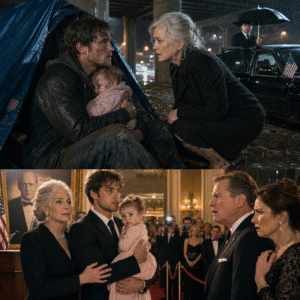
Two shapes pressed together beneath a cheap blue tarp.
A young man.
A feverish baby.
Cars thundered overhead on Interstate 71, their tires hissing across the wet asphalt, the sound rolling down through the concrete like a low, endless growl. Rainwater ran through the mud around the tent, carrying cigarette ends, paper cups, dead leaves, and everything else the city had decided not to keep.
The tarp was tied to a support pillar with frayed cord. It snapped and sagged in the wind, a useless little roof against a sky that seemed determined to fall.
I should not have been there.
Not at my age.
Not in that neighborhood.
Not in Italian shoes now sinking into Ohio mud.
Not with my silver hair pinned beneath a silk scarf, my hands accustomed to marble desks, fountain pens, private screenings, studio contracts, and leather folders embossed with the Sterling Pictures seal.
Women like me were supposed to enter through side doors.
We were supposed to sit beneath chandeliers and speak quietly while younger people waited for us to approve budgets, greenlight films, and decide whether a star’s scandal could be buried before morning.
We were not supposed to kneel in mud under a bridge.
But grief has never cared what kind of shoes a woman is wearing.
And blood, when it finally calls, does not ask whether the weather is convenient.
The baby whimpered.
It was a thin sound. Not a full cry. Not the angry, healthy protest of a child demanding comfort. This was smaller. Weaker. The kind of sound a body makes when it has almost run out of strength.
The young man tightened his arms around her and curved his body lower, using his back as a wall, as if he could shield her from the rain, from the traffic, from me, from the whole cruel world by making himself smaller.
Then he looked up.
And I saw my husband’s eyes.
Not perfectly. Not exactly.
But close enough that thirty years disappeared in a single breath.
The same deep brown.
The same stubborn crease between the brows.
The same look Spencer used to have when someone underestimated what he was willing to protect.
My hand tightened around the umbrella.
“James Sterling?” I asked.
His head snapped up.
Suspicion came first.
Then fear.
Then the immediate hardening of a father who had nothing left except the child in his arms and would fight the world with his bare hands if he had to.
“Who are you?” he demanded.
His voice was rough, defensive, nearly swallowed by the storm.
I stepped closer, but not too close. I had spent a lifetime learning how power enters a room. I knew what it looked like when it frightened people. So I lowered myself slowly into a crouch, ignoring the protest in my knees and the cold water soaking through the hem of my coat.
“My name is Alice Sterling,” I said.
His face did not change.
The baby whimpered again.
“I know your father told you I was dead,” I continued. “But I’m not.”
His eyes narrowed.
“My grandparents are dead.”
“No,” I said. “Your father lied.”
The words were soft.
They still cut through the rain.
“I’m your grandmother.”
For a moment, only the traffic answered.
Then James laughed.
Not because it was funny.
Because the world had become so absurd that laughter was the only sound left.
“My grandmother,” he said bitterly. “Right.”
“I know you don’t believe me.”
“I don’t even know you.”
“No,” I said. “You don’t.”
“And now you just show up under a bridge?”
“Yes.”
“Why?”
I looked down at the baby.
Her cheeks were too red. Her tiny eyelashes stuck together from fever and rain. Her lips were slightly parted, and every breath came in shallow little pulls.
“Because she needs a doctor.”
His arms tightened.
“We don’t need anything from you.”
“You do.”
The words came out too sharp. Too much like the woman I had become in boardrooms. Controlled. Direct. Accustomed to people obeying before they understood.
I forced myself to breathe.
“Not for you,” I said more gently. “For her.”
His jaw clenched.
“What’s her name?”
He hesitated.
Even that felt like surrender.
Then he looked down at her and said it quietly.
“Sophie.”
Sophie.
My great-granddaughter.
A name I had never heard until that moment, yet somehow it landed inside me as if it had been waiting years to be spoken.
“I can get her warm,” I said. “I can get her dry. There’s a car right there. I’m staying at the Granville Hotel. A pediatrician can meet us in less than an hour.”
James looked past me toward the black Lincoln idling on the shoulder. My driver, Thomas, stood beside it with an umbrella in one hand and concern in the rigid line of his shoulders.
James looked back at me.
“And what do you want?”
“Nothing.”
“People like you don’t want nothing.”
He was right to say it.
People like me rarely did anything without paperwork somewhere behind it.
“I want one hour,” I said. “Let me get Sophie to a doctor. Let me get her warm. After that, if you want to leave, Thomas will take you anywhere you say.”
He studied me.
Rain ran down his face. His clothes clung to his shoulders. His fingers trembled around the baby, not only from cold, but from exhaustion. The pride in him was still standing.
But the father was stronger.
“One hour,” he said.
I nodded.
“One hour.”
He gathered a worn backpack from beside the tarp. The zipper was held together by a piece of string. He pushed himself up too quickly and swayed, catching himself against the concrete pillar.
I moved forward by instinct.
He flinched.
So I stopped.
“I’m all right,” he said, though he clearly was not.
“No,” I said softly. “But you’re standing.”
He looked at me then.
Not with trust.
Not yet.
But with the first small crack in suspicion.
We walked to the car.
I angled the umbrella over Sophie and let the rain destroy my hair, my coat, my shoes, and every remaining illusion that dignity had anything to do with being dry.
Thomas opened the back door.
James stopped.
He stared at the leather seats, the polished wood trim, the folded wool blanket, the bottled water tucked into the side pocket, the soft glow of the reading light.
For a second, he looked less like a grown man and more like a boy standing at the entrance of a world he had been told all his life did not belong to him.
Then Sophie coughed.
He got in.
I slid in beside him.
“Granville Hotel,” I told Thomas. “And call Dr. Winters. Tell her it’s urgent.”
Thomas met my eyes in the mirror.
“Yes, Mrs. Sterling.”
The car pulled away from the bridge.
Through the rain-streaked window, the blue tarp grew smaller, then vanished behind concrete.
And I knew, with a clarity that frightened me, that the life I had preserved in ice for thirty years had just cracked open.
Three days earlier, I had been sitting in my Bel Air house pretending I was not afraid.
The house sat high above Los Angeles behind gates, palms, cameras, and hedges trimmed with military discipline. From the west terrace, the city spread below me in glittering fragments: towers, freeways, studio lots, swimming pools, old mansions hidden behind newer walls, a thousand lights pretending that ambition was the same as life.
People called it the Sterling House.
In magazines, they called it one of the last true homes of old Hollywood.
They were wrong.
A home is not marble, glass, and a view over Los Angeles.
A home is noise in the hallway.
A door opening without permission.
Someone’s shoes where they do not belong.
The Sterling House had none of that.
It had silence.
It had awards behind glass.
It had portraits of dead actors who had once needed me when I could finance a film, rescue a script, or make a scandal disappear before breakfast.
It had Spencer’s Oscar on a shelf in the study, polished once a week by staff who never knew that I could not look at it without seeing his hand tremble on the morning he died.
On my desk sat a black folder.
Decker Investigations.
I had avoided opening it for three mornings.
I had signed production approvals beside it. I had reviewed streaming-rights offers beside it. I had corrected a young executive’s careless memo about remaking one of Spencer’s classic films beside it.
Anything to avoid touching it.
On the fourth morning, I grew tired of my own cowardice.
I opened the folder.
Six pages.
Thirty thousand dollars for six pages and one photograph.
Information has become terribly efficient. It destroys you without taking up space.
The first line read:
James Spencer Sterling. Age twenty-eight.
Current residence: unhoused.
Last known location: Columbus, Ohio.
My coffee went cold.
I had known James existed.
Not in a grandmotherly way. Not with birthday cards or school photographs or phone calls. I knew of him the way one knows of a legal problem buried in old files. A child born after betrayal. A name in an investigator’s report. Proof that Gregory had continued his life somewhere far away while mine had stopped.
Gregory.
My son.
The word still carried an ache, but no warmth.
Thirty years earlier, Gregory Sterling walked out of our lives with almost everything not nailed to the floor.
He took money, yes.
But money was the least of it.
He took bearer bonds Spencer had set aside for future grandchildren. He drained emergency accounts. He transferred intellectual property into shell companies no one noticed until too late. He sold pieces of Spencer’s early film catalog through private channels. He emptied the studio vault of contracts, letters, production reels, and a pocket watch Spencer’s father had carried when he worked as a projectionist in Savannah.
Then he disappeared with Brenda, the woman who had spent three years whispering in his ear that the Sterling empire was old, suffocating, and owed him more.
I had thought greed was loud.
Gregory taught me it could move quietly.
The morning Spencer found out, the house was too still.
I remember that.
The roses on the hall table.
The smell of lemon oil from the housekeeper’s polish.
The blue scarf I had left over a chair.
Ordinary things standing there innocently while catastrophe waited in the study.
I found Spencer in his leather chair.
The wall safe was open.
Empty.
His desk drawers hung out at crooked angles. The framed photograph of Gregory at ten years old lay facedown on the floor. Spencer did not turn when I entered.
“He took it all,” he said.
His voice was not angry.
That frightened me more.
I called the bank. The accountant. Gregory’s office. Gregory’s phone.
No answer.
When I turned back, Spencer’s color had changed.
Gray.
One hand pressed to his chest.
The other reaching for me.
The doctor called it a massive coronary.
Natural causes.
Nothing anyone could have done.
I knew better.
Spencer Sterling died in the room where he built his dreams, betrayed by the son who had mistaken inheritance for permission.
After the funeral, Hollywood performed grief the way Hollywood performs everything.
Elegantly.
Directors came in black suits. Actresses cried carefully. Studio heads told stories about Spencer’s courage, his eye, his generosity, his belief that movies should give ordinary people a place to see their own dignity reflected back to them.
They said I was strong.
They said I would carry his legacy.
They did not know that strength can sometimes be nothing more than shock wearing good tailoring.
I carried it.
I carried Sterling Pictures because someone had to.
I became colder. Cleaner. More precise.
I stopped acting. Stopped attending premieres unless business demanded it. Stopped letting people call me Alice unless they had earned the right. I let the gossip columns call me the Ice Queen of Bel Air. I let younger executives whisper that grief had turned me into marble.
They were not entirely wrong.
Ice preserves things.
Rage.
Grief.
Names.
Regret.
It also prevents anything warm from growing.
For years, I had investigators look for Gregory. At first out of fury. Then out of duty. Then eventually not at all.
The last useful report placed him in Seattle with Brenda and a baby on the way. He was working under a modified résumé, using Spencer’s connections while claiming he had escaped a controlling family. There was a townhouse. A new car. A photograph of Gregory laughing at a barbecue.
I shut the investigation down after Spencer’s funeral.
I told myself chasing Gregory would not bring Spencer back.
That was true.
But it was not the whole truth.
The whole truth was uglier.
I was afraid to know the child.
Afraid to see Spencer in him.
Afraid to love someone Gregory could use to hurt me again.
So I sealed that part of my life away.
And for thirty years, it stayed sealed.
Until three weeks before I found James under that bridge, I woke at two in the morning with my heart racing.
Not from a dream.
Not exactly.
More like someone had called my name from another room.
The house was dark. Los Angeles glittered below the terrace, indifferent and hungry. I made tea in the kitchen and sat alone in my robe, staring at the city that had applauded me, feared me, used me, and left me with rooms too large for one woman.
By dawn, I had called Decker’s son.
“Find Gregory Sterling,” I told him. “And if he has children, find them first.”
The report came two weeks later.
James Sterling.
Born in Seattle.
Moved to Ohio at six.
Average student.
No criminal record.
Married at twenty-two to Olivia Wittmann.
Daughter born sixteen months earlier: Sophie Marie Sterling.
Worked as a set carpenter and lighting assistant for regional commercial shoots, then in a prop warehouse after the production company shut down.
Terminated during downsizing.
Wife left.
Apartment lost.
Car repossessed.
Shelter application waitlisted.
Called his parents asking for temporary housing.
Request denied.
I stared at those two words.
Request denied.
Two words can carry an entire bloodline’s rot.
Gregory had denied his own son shelter the same way he had denied his father an explanation, denied me a goodbye, denied Spencer the right to know his grandson existed.
Some poisons travel quietly.
The last page held the photograph.
A young man beneath a bridge.
Dark hair.
Thin shoulders.
A baby pressed to his chest.
A small hand reaching toward his face.
I set the photograph down carefully.
Then I pressed the intercom.
“Margaret.”
“Yes, Mrs. Sterling?”
“Prepare the jet. I’m going to Columbus.”
A pause.
“When?”
“Tomorrow morning.”
“How long will you be gone?”
I looked again at the photograph.
“At least a week.”
“Should I notify the board?”
“No.”
“Mrs. Sterling—”
“No one comes with me.”
Another pause.
Then, softer:
“Yes, Mrs. Sterling.”
The jet took off before sunrise.
Six hours from Van Nuys to Columbus.
Six hours to wonder whether I was too late.
Outside the window, clouds stretched beneath us like a white carpet. The cabin attendant placed a breakfast tray near my hand. I did not touch it. Food felt absurd. So did the leather seat, the polished table, the silent luxury of a machine designed to carry rich people over consequences.
When we landed, rain had swallowed Ohio.
Thomas waited at the private terminal with an umbrella.
“Mrs. Sterling,” he said, opening the door.
“Thomas.”
“Where to?”
I handed him the address.
He glanced down once.
His expression remained professional.
“About thirty minutes.”
The car moved through Columbus under a low gray sky.
At first, the city looked like every other city I had seen through tinted glass: chain restaurants, billboards, pharmacies, credit unions, storage units, gas stations bright against the rain.
Then we turned east, and the scenery changed.
Empty lots.
Boarded windows.
Payday loan signs.
Liquor stores behind bars.
A woman pushing a stroller too quickly beneath a broken umbrella.
A man under a bus shelter with no bus coming.
I had filmed scenes in neighborhoods like this. I had financed stories about people living close to the edge. I had sat in editing rooms while directors argued over whether poverty should look more “real” or more “cinematic.”
There is nothing cinematic about wet socks.
Nothing poetic about a sick baby under concrete.
The car slowed near the overpass.
And then I saw the blue tarp.
That was where the story began.
The Granville Hotel suite smelled like soap, fresh linen, and money.
The contrast from the bridge was almost indecent.
James stood just inside the doorway with Sophie pressed against him, scanning the room as if expecting hidden cameras, locks that would turn from the outside, or men waiting to tell him he had made a mistake.
“You can sit wherever you like,” I said.
He did not sit.
Sophie whimpered.
Dr. Winters arrived within forty minutes.
She was calm, sharp-eyed, and unbothered by expensive hotel suites or soaked young fathers. She treated James not like a homeless man and not like a charity case, but like a parent in crisis.
That mattered.
“How long has she been feverish?” Dr. Winters asked.
“Three days,” James said. “Worse since yesterday.”
“Coughing?”
“At night.”
“Drinking?”
“A little.”
Sophie cried weakly during the exam, then collapsed against James as if even protest had cost too much.
Dr. Winters listened to her chest.
“Respiratory infection,” she said finally. “She needs antibiotics immediately. If she doesn’t improve by morning, we’ll admit her. But I think we caught it in time.”
James closed his eyes.
Just for a second.
But the relief that moved through him was so raw I had to look away.
After the doctor left, room service arrived.
Soup.
Chicken.
Bread.
Fruit.
Rice.
Tea.
Enough food to feed six people.
James looked at it like a trap.
“You should eat,” I said.
“I’m fine.”
“You’re not.”
His mouth tightened.
“I said I’m fine.”
I nodded toward Sophie.
“Then eat for her. A father who collapses cannot hold a baby.”
He hated that.
But he ate.
Fast at first. Almost desperately. Then slower when his body remembered dignity. I held Sophie while he finished, and the weight of her small body against my arm nearly undid me.
It had been decades since I held a baby.
Gregory had been the last one who belonged to me.
That thought entered and left like a knife.
When James finally set down the spoon, he looked across the room.
“Why are you really doing this?”
“It’s complicated.”
“Try.”
I looked down at Sophie’s face.
“Because your grandfather deserved to know you existed. Because your father stole more than money. Because I was a coward for longer than I want to admit. Because I found out you were sleeping under a bridge with a sick baby, and there are moments in life when hesitation becomes another kind of sin.”
He stared at me.
“You had me investigated.”
“Yes.”
“So you just decided to swoop in?”
“I decided to show up.”
“With doctors and suites and private jets?”
“Yes.”
“That’s not normal.”
“No,” I said. “It’s not. But neither is leaving your son and granddaughter under a bridge.”
His face hardened.
“My father told me you were dead.”
“I know.”
“He said his parents were cruel. Said he got away from you. Said the whole Sterling family was poison.”
“Gregory often described his consequences as other people’s cruelty.”
James looked at me sharply.
“What did he do?”
“Not tonight.”
His jaw tightened.
“I have a right to know.”
“You do,” I said. “And I will tell you. But tonight Sophie needs medicine, and you need sleep. The truth has waited thirty years. It can wait until morning.”
He wanted to argue.
Then Sophie stirred and made a faint sound.
His anger folded immediately into concern.
That told me more about him than any report had.
He was not Gregory.
Not yet.
Maybe not at all.
Before dawn, Sophie’s fever broke.
By morning, Dr. Winters cleared her to travel, with strict instructions.
James stood at the private terminal staring at the jet.
“That’s yours?” he asked.
“Sterling Pictures owns it.”
“That means yours.”
“That means the board tolerates my use of it.”
For the first time, something almost like amusement touched his face.
Then the steps lowered, and the moment vanished.
During the flight, he watched Sophie the entire time. He checked the medication schedule twice. He adjusted her blanket. He asked the cabin attendant to warm water with the exact seriousness of a man negotiating peace.
Halfway to Los Angeles, he finally spoke.
“If you’re my grandmother, why didn’t you ever come for me?”
There it was.
The question I deserved.
I looked at my hands.
They were old hands now. Ringed, manicured, steady from practice. Hands that had signed contracts, cut deals, written condolence notes, opened envelopes, closed doors.
Hands that had not reached for him.
“Because I stopped looking,” I said.
He stared.
I did not soften it.
“I looked at first. After Gregory disappeared. But after Spencer died, I convinced myself chasing your father would only keep the wound open. I knew there was a baby somewhere. I told myself you were probably safe. That your father had at least managed that much.”
James laughed without humor.
“He managed himself.”
“Yes,” I said. “I know that now.”
“You gave up.”
“Yes.”
The word sat between us.
No excuse could improve it.
“I was broken,” I said. “That is not a defense. Only the truth.”
He looked out the window.
For a long time, neither of us spoke.
Then he said, “My dad was always good at making himself the victim.”
“So was his mother, when she wished to be,” I said quietly.
He glanced at me.
I let the confession stand.
We landed in Los Angeles under a sky too bright to be kind.
The car took us through gates, up curved roads lined with palms, past houses hidden behind bougainvillea and cameras.
James watched everything through the window with a face I could not read.
When the Sterling House appeared at the end of the drive, white stone and glass catching the sun, he shifted Sophie higher on his shoulder.
“You live here alone?”
“Yes.”
He looked at the house.
“Why?”
No one had asked me that in years.
“Because I did not know where else to put my life.”
Inside, Margaret had prepared the east wing.
A quiet suite.
A nursery.
A crib.
A rocking chair.
Clothes in drawers.
Formula.
Diapers.
A pediatrician scheduled.
A nanny, Maria, arriving by evening.
No chandeliers. No antiques. Nothing fragile enough to make James afraid to breathe.
“There’s a lock on your door,” I told him. “No one will enter without permission.”
He looked at me.
That, more than the room itself, seemed to matter.
For the first three days, James stayed mostly in the east wing.
I did not force gratitude.
Gratitude demanded too early is only another kind of debt.
Maria became the first person he trusted.
She was in her fifties, practical, warm without being intrusive, and entirely unimpressed by wealth. She asked permission before touching Sophie. She spoke to James, not around him. She taught him how to manage the medication schedule without making him feel foolish.
Sophie recovered quickly.
Fever gone.
Breathing steady.
Cheeks round again.
Within a week, the house heard her laugh.
I was standing in the hallway when it happened.
A small, bright laugh from the nursery.
Nothing dramatic.
No music swelled.
No camera moved in.
But that laugh traveled through the silent east wing and broke something open.
For thirty years, my house had preserved loss.
Now a child had made noise in it.
One evening, I found James standing outside Spencer’s study.
The door was closed.
His hand hovered near the knob.
“You can go in,” I said.
He turned quickly.
“I wasn’t trying to pry.”
“It isn’t prying. He would have wanted you there.”
Spencer’s study had survived like a shrine.
His desk.
His leather chair.
His brass lamp.
Shelves of scripts, contracts, photographs, old cameras.
A framed lobby card from the first film he ever produced.
The pocket watch, recovered years later from a private collector who did not know what grief he was selling back to me.
James stepped inside.
I did not follow.
Some rooms must be entered alone.
An hour later, he came out with red eyes.
“My father said Spencer was cruel.”
I nodded.
“Your father lied.”
“He said Spencer never gave him anything.”
“Spencer gave him too much.”
James absorbed that.
“What happened?”
So I told him.
Not everything.
Enough.
I told him about the missing money. The stolen rights. The private catalog sales. The vault. The heart attack. The funeral. The investigator. The baby I never held because I was afraid.
James did not speak for a long time.
Then he said, “I’m sorry.”
I almost said, You don’t need to be.
But apologies are not always admissions of guilt. Sometimes they are offerings of witness.
So I said, “So am I.”
Months passed.
James did not heal in a straight line.
No one does.
Some days he was calm. Some days sharp. Some days he paced the terrace after Sophie slept, unable to trust the quiet. Some nights he checked the locks three times. Some mornings he apologized for taking up space in a house with thirty empty rooms.
I did not tell him to stop.
I simply stayed.
Sophie learned to walk in the sunroom, gripping furniture and shrieking with triumph. The first time she stumbled into my knees and grabbed my trousers with both hands, I froze.
She looked up at me, drool shining on her chin, and laughed.
James stood in the doorway.
“She likes you,” he said.
“I like her,” I replied.
My voice was steadier than my hands.
By spring, James had begun exploring the old studio lot.
Sterling Pictures still owned ten acres in Burbank: two soundstages, an editing building, offices, an archive, a costume warehouse, and a small theater where Spencer used to screen rough cuts for people he trusted enough to tell him the truth.
James started with the archives.
He said he wanted to understand where he came from.
I told him the archivist would be happy to help.
What I did not tell him was that I watched the security logs and saw he spent hours there.
Photographs of Spencer with actors long dead.
Production notes in his handwriting.
Budgets from films made on impossible faith.
Letters from crew members thanking him for paying them on time when another producer would have disappeared.
James read everything.
One afternoon, I found him in the small screening room watching one of Spencer’s earliest films. A simple picture about a factory worker who returns from war and builds a house for his family with his own hands.
The film was not famous.
Not like the others.
But Spencer loved it.
James paused the projector when I entered.
“He understood working people,” James said.
“He was one.”
“Most people in this town pretend to.”
“Spencer never had patience for pretending.”
James looked at the frozen image on the screen.
“I don’t know anything about movies.”
“You know about survival,” I said. “That is rarer.”
He frowned.
“That doesn’t make me useful in a studio.”
“No,” I said. “But listening does.”
So he began at the bottom.
Not as an heir.
Not as my grandson.
As an assistant in the production office under a woman named Lena Morales who had worked for Sterling Pictures for twenty-two years and considered nepotism a personal insult.
I chose her deliberately.
James filed call sheets.
Carried coffee.
Sat in meetings without speaking.
Read scripts no one wanted to touch.
Organized prop returns.
Checked lunch orders.
Drove contracts across town.
Learned union rules.
Learned how a set breathes.
Learned that one delayed truck can cost more than most families make in a year.
Learned that actors are not always the center of a production, though they are often the last to know.
He did not complain.
That was what people noticed first.
He listened.
That was what people respected later.
Six months in, Lena sent me a note.
Sterling listens before he fixes things. Rare disease. Could be useful.
From Lena, that was poetry.
By the second year, James moved into development.
He did not read scripts the way polished executives did. He did not ask first about marketability, franchise potential, or whether a lead could attract foreign presales.
He asked:
“Who is this for?”
“Why does the mother never get a scene alone?”
“Why is the poor character only here to teach the rich one gratitude?”
“What happens after the final kiss?”
The younger assistants loved him.
The older producers were cautious.
One executive called him sentimental in a meeting.
James looked at him and said, “Sentiment is when you fake feeling to avoid truth. I’m talking about stakes.”
The room went quiet.
I smiled into my coffee.
By his third year, he produced a small film no one wanted.
A story about a single father living in his car with a child after losing a job.
Not glamorous.
Not easy.
Not something the marketing department knew how to sell.
James fought for it.
Not loudly.
Persistently.
He found the director. Protected the budget. Insisted on casting unknown actors with faces that looked lived in. Refused the studio note asking to make the ending “more aspirational” by giving the father a sudden wealthy benefactor.
“That’s not hope,” he said. “That’s fantasy. Hope is smaller and harder than that.”
The film premiered at a modest festival.
Then another.
Then it found an audience.
Critics called it humane.
Viewers called it honest.
I called it Spencer’s ghost finally finding a new language.
On the night the film screened at the Sterling Theater, James stood in the back with Sophie asleep against his shoulder. She was four by then, too big to be carried for long, but he carried her anyway.
The audience stayed silent after the credits.
Then they stood.
James did not move.
He looked frightened by applause.
I touched his arm.
“They’re not taking anything from you,” I said. “They’re giving something back.”
He swallowed.
“I don’t know how to hold it.”
“You learn.”
A year later, I made the announcement.
Not in a closed boardroom.
Not quietly.
That had been my original plan. Clean. Controlled. A memo. A vote. A transition.
Then Gregory returned.
He and Brenda appeared first in the studio lobby, three weeks after Variety ran a profile calling James Sterling “the unknown producer reviving the moral heart of Sterling Pictures.”
Of course that was when they came.
Not when he was under a bridge.
Not when Sophie was sick.
Not when he had nothing.
When his name became useful.
I was in my office when Margaret buzzed.
“Mrs. Sterling,” she said, voice tight, “there are two people downstairs insisting on seeing Mr. Sterling.”
I knew before she said it.
“Names?”
A pause.
“Gregory and Brenda Sterling.”
The room changed.
Not physically.
But every object seemed suddenly too sharp.
The framed photographs. Spencer’s award. The glass desk. The view of the studio lot where a crane moved slowly past Stage Three.
“Have security bring them to conference room B,” I said.
“Should I call Mr. Sterling?”
“No.”
“Mrs. Sterling—”
“Not yet.”
The elevator ride down felt longer than thirty years.
Gregory was standing near reception, arguing with a security guard.
He was older. Thinner. Gray at the temples. But still Gregory. Still handsome in that ruined way charming men sometimes remain handsome long after character has left them.
Brenda stood beside him with her mouth tight, her hair dyed too dark, her eyes moving across the lobby like she was calculating what could still be claimed.
“I’m his father,” Gregory snapped. “Tell him I’m here.”
I crossed the lobby.
My heels struck the polished floor.
Gregory turned.
His face froze.
“Mother.”
“Gregory.”
Brenda’s hand moved to her throat.
“Alice.”
I looked at them both.
Thirty years of imagined speeches disappeared.
All I felt was clarity.
“You came for the headline,” I said.
Gregory flinched.
“We came for our son.”
“No,” I said. “You denied your son.”
His jaw tightened.
“We made mistakes.”
“You made choices.”
In conference room B, Gregory tried everything.
Remorse.
Nostalgia.
Victimhood.
Outrage.
He said he had been young. He said Spencer controlled him. He said Brenda had been pregnant and afraid. He said business had gone badly. He said he never meant for anyone to suffer. He said he wanted to reconnect with James and Sophie.
Finally, when none of that worked, he said what he had really come to say.
“If James is being brought into the studio, there are legal family interests to consider.”
There it was.
The word behind every visit.
Interests.
I stood.
“Do you know where I found your son?”
Gregory looked away.
“Under a bridge,” I said. “In the rain. Holding a feverish baby. That is where your interests left him.”
Brenda’s face flushed.
“We were struggling.”
“You were comfortable enough to refuse shelter.”
“You don’t know what he was like,” Brenda said. “James was difficult. Proud. He wouldn’t listen.”
“He was your child.”
“He was grown.”
“And Sophie?”
No answer.
I placed a document on the table.
“A restraining order,” I said. “It bars you from contacting James or Sophie and from entering any Sterling property, including the studio lot.”
Gregory stared.
“You can’t do this. He’s my son.”
“He was your son,” I said. “You gave up that right when you told him I was dead and left him with nowhere to go.”
His eyes hardened.
“You always thought you were better than me.”
“No,” I said quietly. “I thought you were better than what you became.”
Security escorted them out.
When the elevator doors closed behind them, I sat alone in the conference room and realized my hands were shaking.
A soft knock came.
James stepped in.
Margaret had called him despite my instructions.
Good.
She had always known when to disobey me.
“He came,” James said.
“Yes.”
“You should have told me.”
“Yes.”
He sat beside me.
For a moment, he looked like the young man under the bridge again. Not because he was weak, but because old wounds can drag even strong men back to the place they first learned pain.
“What did he want?”
“Access.”
James nodded slowly.
“Not me. Access.”
I did not answer.
He already knew.
Then he took my hand.
It startled me.
Not because we were strangers anymore.
Because I had spent so many years not being touched with tenderness that tenderness still felt like an event.
“You protected us,” he said.
“I should have done it sooner.”
“You’re doing it now.”
That was the mercy of him.
Not forgiveness cheaply given.
But truth without cruelty.
The public announcement happened two weeks later at the Sterling Legacy Gala.
The studio had hosted it every year since Spencer’s death: a night of gowns, old film reels, restored classics, carefully lit nostalgia, donors, actors, critics, directors, and journalists who liked to pretend they were above sentiment while drinking free champagne beneath photographs of dead stars.
That year, the gala was different.
Everyone felt it.
They had read the profile. They had heard rumors of Gregory’s return. They had seen James’s film, or at least claimed to. They knew something was shifting inside Sterling Pictures, though they did not yet know how much.
The ballroom glowed gold.
Crystal lights.
Black tuxedos.
Diamonds.
Cameras.
A red carpet at the entrance.
A thirty-foot screen playing restored footage from Spencer’s films.
Sophie wore a navy dress with tiny silver stars and held James’s hand like she was escorting him into battle.
“You okay?” he asked her.
She looked up at him.
“There’s too many shiny people.”
James laughed.
“You’re not wrong.”
I watched them from the edge of the stage.
James in a black suit, shoulders straight but eyes alert.
Sophie beside him, fearless in the way children can be when they know someone will catch them.
Maria seated near the front.
Margaret standing by the stage steps with a folder, as she had stood beside me through nearly every turning point of my second life.
Then I saw Gregory.
Back row.
Of course.
Somehow he had gotten in through a donor’s guest list before security recognized him. Brenda sat beside him in a dark dress, rigid with expectation.
They had come to witness.
To calculate.
Perhaps to interrupt.
I could have had them removed.
Instead, I let them stay.
Some humiliations require an audience.
When the room quieted, I walked to the podium.
Applause rose.
Old applause.
Respectful applause.
The kind people give a woman they fear slightly more than they love.
I looked out across the ballroom.
“For thirty years,” I began, “I have been called the keeper of Spencer Sterling’s legacy.”
The room settled.
“People say it kindly. They say it as praise. They say I protected the company he built, the films he believed in, the values this studio was founded on.”
Behind me, the screen showed Spencer as a young man outside the first Sterling soundstage, sleeves rolled up, hair windblown, smiling like the future had dared him to chase it.
“But a legacy is not meant to be preserved behind glass,” I continued. “Films are not made to sit in vaults. Stories do not live because we lock them away. They live because someone brave enough opens the door again.”
I saw James lower his eyes.
I saw Gregory lean forward.
“Three years ago, I found someone who reminded me why Spencer built this studio in the first place. Not because he loved glamour. He didn’t. Not because he worshiped stars. He didn’t. Spencer believed stories could give dignity back to people the world had ignored.”
The room was completely silent now.
“I found that person in the last place anyone here would look for a studio leader.”
I let the sentence sit.
“Under a bridge.”
A ripple moved through the ballroom.
Not scandal.
Recognition.
Shock.
“The young man I found had been lied to. He had been erased from his own history. He had been told I was dead. He had been denied shelter by people who should have protected him. Yet he was holding his sick daughter with more integrity than many powerful men have shown in rooms like this.”
James’s jaw tightened.
Sophie looked up at him.
“He came to Sterling Pictures at the bottom. He carried coffee. Filed contracts. Read scripts. Sat in meetings where people dismissed him because he did not speak the language of vanity. And then he did what true leaders do.”
I looked directly at him.
“He listened.”
The screen changed.
Photographs of James on set. James in a production meeting. James with crew members. James holding Sophie at the back of a theater after the festival screening. James walking through a small apartment set built for his film, hand on a doorframe as if he understood the importance of thresholds.
“Effective tonight,” I said, “James Sterling is the new Chief Executive Officer of Sterling Pictures.”
The applause did not begin immediately.
The room had to absorb it.
Then it rose.
First from the crew tables.
Then the writers.
Then the directors.
Then the whole ballroom.
James stood frozen.
I extended my hand toward him.
“James?”
Sophie tugged his sleeve.
“Dad. That’s you.”
He laughed once under his breath, disbelieving, then walked toward the stage.
As he passed the back row, Gregory stood.
“James!”
The name cut through the applause.
The room turned.
Security moved.
James stopped.
Gregory’s face had gone pale, but his eyes burned with the old entitlement.
“I’m your father,” he said. “You don’t have to let her do this to us.”
That was the last performance Gregory Sterling ever gave in a room that mattered.
James looked at him.
Not angrily.
Not weakly.
With the calm of a man who had finally learned the difference between blood and family.
“You were my father,” James said. “You stopped being my family when you left my daughter in the cold.”
The room went dead silent.
Cameras caught every word.
Brenda covered her mouth.
Gregory looked around as if expecting sympathy to rise from somewhere.
It did not.
Security escorted them out through the side doors.
No struggle.
No shouting.
Just the quiet removal of people who had mistaken access for belonging.
James stepped onto the stage.
I moved aside.
The applause returned, deeper now.
Less polite.
More human.
He stood at the microphone for a long moment.
“I don’t have a speech,” he said.
A soft laugh moved through the room.
“I was told once that Sterling Pictures belonged to people with the right names, the right clothes, the right history. I know now that was a lie. This studio belongs to the people who make the work honest. The writers who tell the truth. The crews who arrive before sunrise. The editors who save films no one thanks them for. The audience members who come in from hard lives and sit in the dark hoping to feel less alone.”
He looked at me.
“My grandfather believed stories could build a home inside people. I never met him. But I think I understand him.”
His voice tightened.
“And I understand this: a legacy is not what you inherit. It’s what you refuse to betray.”
The room stood.
This time, even I could not remain composed.
Sophie ran onto the stage and wrapped herself around his leg. James lifted her, and the photographers captured what would become the image every magazine used the next morning.
The new head of Sterling Pictures holding his daughter beneath a black-and-white portrait of the grandfather he had never met.
The headline was everywhere by sunrise.
Lost Sterling Heir Takes Over Hollywood Studio After Family Secret Revealed.
I hated the phrase lost heir.
James had not been lost.
He had been abandoned.
There is a difference.
The years after that did not become easy.
Real healing is rarely dramatic.
It is school forms and board votes. Pediatric appointments and budget meetings. Security briefings. Difficult anniversaries. A child losing a shoe before a premiere. A CEO taking calls with crayon on his cuff. An old woman learning not to flinch when a little girl climbs into her lap without asking permission.
James changed Sterling Pictures.
Not overnight.
Companies do not become moral because one man with a painful past sits in a larger office.
But direction matters.
Decisions compound.
Values written into budgets become sets, scripts, contracts, salaries, housing funds, and the kind of stories a studio chooses to tell.
James created a fund for first-time filmmakers from working-class backgrounds.
He restored Spencer’s old rule that crew members were paid before executive bonuses.
He reopened the small theater on the lot for community screenings.
He turned one unused production building into temporary housing for families in crisis, calling it Spencer House.
I protested the name.
He ignored me.
Sophie, naturally, loved it.
At five, she stood in the lobby of Spencer House with a yellow ribbon in her hand and announced to a local reporter, “This is where people can be safe while they figure things out.”
The reporter asked where she learned that.
Sophie pointed at James.
“Dad.”
Then at me.
“And Grandma Alice.”
I had to look away.
A year later, James and Sophie moved into the Sterling House.
Not because they needed to.
Because Sophie informed both of us that the house was “too quiet and probably lonely.”
She chose pale blue for her room. James painted stars on the ceiling. Maria arranged bookshelves. I ordered a white desk and pretended it was practical, not sentimental. Sophie taped drawings along the hallway, including one of me with gray hair shaped like a storm cloud and a smile much too wide for my face.
“That’s you happy,” she said.
“I see.”
“You need more teeth when you smile.”
“I’ll work on that.”
The first night they slept there, I woke at two in the morning.
Old habit.
Old grief.
For a moment, I lay still, listening for sounds that would never come. Spencer’s footsteps. Gregory’s car. A phone call. An explanation.
Then my bedroom door opened an inch.
“Grandma Alice?” Sophie whispered.
I turned on the lamp.
She stood there in pajamas, clutching a stuffed rabbit.
“What is it, darling?”
“The house creaked.”
“Houses do that.”
“Is it scary?”
I considered giving her a cheerful lie.
Then I remembered all the adults who had lied kindly and cruelly, and how little comfort falsehood had ever given anyone.
“Sometimes,” I said. “But usually creaking means a house is settling. Finding its place.”
Sophie thought about that.
“Can I settle here?”
My throat tightened.
“Yes,” I said. “You can settle here.”
She climbed into my bed with the complete confidence of a child who has not yet learned to apologize for needing comfort.
Her hand found mine.
Within minutes, she slept.
I stayed awake longer, staring at the ceiling, holding her hand.
In the morning, James found us there.
He stood in the doorway with coffee in one hand and a look on his face that nearly undid me.
“She had a bad dream?” he whispered.
“The house creaked.”
“Serious.”
“Very.”
He smiled.
Then he looked at me lying perfectly still, afraid to wake her.
“You know,” he said softly, “you don’t have to look so terrified.”
“I’m not terrified.”
“You look like she’s a priceless vase.”
“She is more breakable than a vase.”
“She’s also a blanket thief.”
As if to prove him right, Sophie rolled over and stole half the covers.
James laughed.
So did I.
It felt strange.
Full.
Alive.
The second time Gregory tried to return, he did it through television.
A local entertainment channel gave him five minutes in a segment about “Hollywood families divided by money.” He sat beneath studio lights with Brenda beside him and spoke vaguely about estrangement, wealthy relatives, and being denied access to his son.
He never mentioned the bridge.
He never mentioned Sophie’s fever.
He never mentioned telling James I was dead.
He only said, “My son has been influenced by people who want to control the Sterling legacy.”
James watched the clip once.
Then he called Communications.
“No response,” he said. “We don’t feed it.”
I looked at him across the office.
“That is exactly what I would have said.”
“I know,” he replied. “I learned from the best.”
I pretended not to feel moved.
But later that evening, I stood in Spencer’s study and told his portrait, “He is better at this than I was.”
The painted Spencer, young and smiling, offered no argument.
Under James’s leadership, Sterling Pictures changed.
Not overnight.
But slowly, surely, visibly.
He pushed for smaller films when some executives wanted only franchises. He built partnerships with film schools in cities no one in Los Angeles liked to visit. He required executives to spend time on set with crew, not just actors. He created emergency grants for employees in crisis. He backed stories about people Hollywood usually used as background texture.
Some board members resisted.
James listened, recalculated, negotiated, and held the line.
One older director, Franklin Pierce, finally said during a heated meeting, “Mr. Sterling, with respect, compassion is not a business model.”
James looked at him for a long moment.
“No,” he said. “But trust is. And audiences trust studios that remember people live inside their stories.”
The initiative passed by two votes.
Afterward, Franklin found me near the elevators.
“He’s stubborn,” he said.
“Yes.”
“Like Spencer.”
I looked at him.
Franklin had known Spencer longer than almost anyone still alive.
His eyes shone faintly.
“I mean that as praise,” he said.
“I know.”
There were days when grief still came.
It arrived without invitation, often when life was most ordinary. The smell of sawdust from a set being rebuilt. The sight of James rolling up his sleeves the way Spencer had. Sophie humming that wordless tune while drawing at the kitchen table. A summer storm against the windows. A director placing a key prop into an actor’s hand and asking for one more take.
On those days, I allowed myself to miss my husband without freezing around the ache.
One afternoon, Sophie found me in the garden sitting on the stone bench Spencer had installed the year before he died.
“Are you sad?” she asked.
Children ask questions with a brutality adults spend years training out of themselves.
“Yes,” I said. “A little.”
“Why?”
“I miss someone.”
“Grandpa Spencer?”
I nodded.
She climbed onto the bench beside me.
“I miss him too,” she said.
“You never met him.”
“I know. But Daddy says he was good. So I miss him.”
There are moments when the heart breaks not because it is wounded, but because it is fuller than it knows how to hold.
I put my arm around her.
“He would have adored you.”
She leaned against me.
“Would he let me have fish in the pond?”
“Far too many.”
“Good.”
The pond had fish by then.
Twelve of them, because Sophie had negotiated from three with the strategic ruthlessness of a future studio chief. James claimed not to know where she got that.
I told him it was obviously from Brenda’s side.
He laughed so hard he had to sit down.
By the time I was ninety, I had stepped fully away from daily studio operations.
James ran Sterling Pictures with a steadier hand than I ever had.
Sophie was preparing for college.
Maria had retired, though she still came to Sunday dinner and bossed everyone around as if the house would collapse without her supervision.
Margaret scheduled my doctors with the tactical precision of a military campaign.
My body was smaller then. Frailer. I disliked admitting it, so no one mentioned it unless absolutely necessary. James installed railings discreetly. Sophie pretended she wanted slower walks.
One evening, after a family dinner that included too much pasta and a debate over whether Sophie should attend college in Boston or stay in Los Angeles, I walked out to the veranda alone.
The pond shimmered under moonlight.
Fish moved beneath the surface, descendants of the original twelve Sophie had demanded years earlier.
The air smelled of jasmine.
The house behind me glowed with life.
I heard James step outside.
“You should have brought a sweater,” he said.
“You have become very bossy.”
“I learned from you.”
He draped one over my shoulders anyway.
We stood together.
After a while, he said, “Sophie asked me about the bridge today.”
I looked at him.
“What did you tell her?”
“The truth. Not every detail. Enough.”
I nodded.
“She asked if you were scared when you found us.”
I smiled faintly.
“I was terrified.”
“That’s what I told her.”
I looked toward the pond.
“Not of you,” I said. “Of being too late.”
James was quiet for a long moment.
“You weren’t.”
The words moved gently through the warm night.
“You came,” he said.
I closed my eyes.
For decades, I had measured my life by the day I had failed to stop Gregory, failed to save Spencer, failed to keep my family from collapsing beneath the weight of one man’s selfishness. I had believed love was something I had lost because I had not guarded it well enough.
But life, I learned, is rarely one ending.
Sometimes the story returns to the road beneath the bridge.
Sometimes rain reveals what sunlight hides.
Sometimes a woman who has spent thirty years above the world must step into the mud to find the part of her life still waiting to be rescued.
And sometimes, by rescuing someone else, she discovers she has not been dead all these years.
Only frozen.
Waiting.
The next morning, Sophie found me in Spencer’s study.
I had fallen asleep in the chair, the pocket watch resting in my palm. She was seventeen then, tall, bright-eyed, already carrying herself like a young woman who knew the world could be cruel but did not intend to become cruel in response.
“Grandma Alice,” she said softly.
I opened my eyes.
“You’ll hurt your neck sleeping like that.”
“You sound like your father.”
“Good. He’s usually right.”
“Don’t tell him that.”
She smiled and sat on the edge of the desk.
For a while, neither of us spoke.
Then she looked at the watch.
“Was this his?”
“Spencer’s father’s first. Then Spencer’s.”
“And then Dad’s?”
“One day.”
“And then mine?”
I looked at her.
“If you want it.”
She seemed offended.
“Of course I want it.”
“It is not valuable in the way people usually mean valuable.”
“I know,” she said. “That’s why I want it.”
I studied her.
“What do you think it means?”
She considered this seriously.
“It means somebody before me built something. Somebody after him broke something. Then Dad and you built it again. So if I get it, I have to keep building.”
Tears rose so quickly I could not stop them.
“You understand more than most adults.”
She shrugged.
“I had good teachers.”
The doorway creaked.
James stood there with coffee in one hand and an expression that said he had heard enough to be undone by it.
Sophie turned.
“Dad, Grandma Alice slept in the chair again.”
“Traitor,” I said.
James handed me the coffee.
“Responsible citizen,” he corrected.
Sophie opened the pocket watch carefully.
The old mechanism ticked softly in the room.
Steady.
Persistent.
Alive.
Years before, I believed time only took things away.
Now, listening to that watch tick between my great-granddaughter’s hands, I understood that time can also return what grief cannot hold forever.
Not in the same form.
Never untouched.
But sometimes with enough love around it to begin again.
I thought of the bridge.
The rain.
The feverish baby.
The wary young father.
The black Lincoln waiting on the shoulder.
One hour, he had said.
Then we talk.
One hour became a night.
A night became a flight.
A flight became a home.
A home became a studio reborn, a family restored, a legacy rescued from the hands of a man who had mistaken inheritance for ownership.
I had spent thirty years believing I was the last keeper of Spencer Sterling’s dream.
I was wrong.
Dreams do not survive because one person guards them in a locked room.
They survive when someone opens the door.
Sophie closed the watch and placed it carefully on the desk.
“When I run Sterling Pictures,” she announced, “we’re making movies for people who think nobody sees them.”
James looked at her.
“When?”
She lifted her chin.
“You heard me.”
I laughed.
The sound surprised me with its fullness.
James shook his head.
“She’s yours.”
“She is absolutely yours,” I replied.
Sophie grinned.
“I’m both.”
And she was.
That was the miracle.
Not that pain vanished.
Not that betrayal was undone.
Not that the dead returned or the guilty became innocent.
The miracle was that love, when finally given somewhere honest to live, crossed generations.
It survived theft.
Abandonment.
Pride.
Silence.
Rain.
Hunger.
And the terrible loneliness of people who thought they had no one left.
It found its way beneath a bridge.
It climbed into a warm car.
It slept in a hotel bed under a doctor’s care.
It flew west toward sunlight.
It learned to trust a locked room.
Then an open door.
Then a family table.
And finally, a stage where the truth was spoken loud enough for the whole world to hear.
THE END
