THEY WALKED THROUGH HER PRIVATE GATE AND REALIZED SHE OWNED THEIR FUTURE
Chapter 1: The Black Iron Gate
The black iron gate opened slowly, and for the first time in five years, the Cortés family stopped laughing.
Thirty-two of them sat in polished cars outside my private residence in Valle de Bravo, dressed for Easter dinner as if they were arriving to witness my embarrassment. Silk dresses. Gold bracelets. Tailored jackets. Polished shoes. The kind of careful luxury worn by people who believed status could protect them from truth.
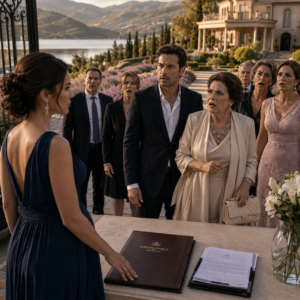
At the front of the line, Rodrigo lowered the window of his black SUV and frowned at the guard standing beside the gatehouse.
“There must be some mistake,” he said.
The guard checked the guest list without blinking.
“No mistake, sir. Mrs. Mariana Varela is expecting you.”
Behind Rodrigo, Doña Teresa leaned forward from the back seat. Even through the tinted glass, I could imagine the sharp pinch of her mouth.
“This is a private residence?” she demanded.
“Yes, ma’am.”
For a moment, no one spoke.
Then the gate continued opening.
Heavy. Smooth. Final.
The drive beyond it curved through lavender gardens and cypress trees toward the house they had never imagined I could own. Lake Valle de Bravo glittered in the distance, blue and silver beneath the Easter sun. On the left were stables, service vehicles, and staff moving with quiet efficiency. On the right, stone paths disappeared into gardens designed with the kind of patience money alone cannot imitate.
Nothing looked rented.
Nothing looked temporary.
Nothing looked borrowed for one afternoon of pretending.
By the time their cars reached the main entrance, the smiles were gone.
Paola, Rodrigo’s sister, stepped out first, one hand clutching her designer bag, her eyes moving over the limestone façade, the carved wooden doors, the tall windows, the terraces wrapped in bougainvillea.
“This has to be a hotel,” she whispered.
Doña Teresa followed, adjusting the pearls at her throat as though they might restore her authority.
“Or a rented venue,” she said.
But her voice had lost its teeth.
A butler opened the door.
“Good afternoon,” he said. “Mrs. Varela is waiting on the terrace.”
Mrs. Varela.
Not Mariana Cortés.
Not Rodrigo’s ex-wife.
Not the poor little girl they had tolerated for five years.
Mariana Varela.
The name landed among them like a door closing.
They entered the house in silence, the same family that had arrived ready to mock my downfall now walking carefully across stone floors beneath high ceilings and sun-washed arches. Art hung on the walls with the quiet confidence of inheritance. Fresh flowers stood in large ceramic vases. The air smelled faintly of citrus, waxed wood, and the lilies arranged near the staircase.
Their polished shoes echoed through the hall.
That echo pleased me more than applause would have.
Because sometimes the first consequence is not a legal document, a board vote, or a bank notice.
Sometimes it is silence entering a room where cruelty expected to be entertained.
Chapter 2: Outside the Family Court
Three weeks earlier, Doña Teresa had laughed outside the family court in Guadalajara and told me I would not survive without her son.
“Without my son, you won’t even be able to pay your electricity bill, Mariana,” she said, in front of everyone.
The courthouse was crowded that morning, filled with divorcing couples, tired lawyers, restless children, and relatives pretending not to enjoy the pain unfolding around them. The fluorescent lights made every face look harsher. The marble floors carried footsteps too clearly. Outside the elevator, Rodrigo stood beside his mother with one hand in his pocket, smiling like a burden had just been lifted from his life.
I held a small suitcase.
I wore a simple cream dress.
And inside my chest, I carried five years of silence so dense it felt almost solid.
Rodrigo’s cousins were there. His sister Paola. Two uncles who had never once called me by my full name. Even the lawyer stood nearby, pretending to review papers while listening to every word.
Doña Teresa’s mouth twisted with satisfaction.
“Let’s see how long you survive without the Cortés family.”
Rodrigo gave a short laugh and adjusted his designer jacket.
“My mother’s right,” he said. “You were never meant for this level.”
This level.
As if cruelty required a membership card.
I looked at the man who had once placed a ring on my finger beneath the chandeliers of a Guadalajara chapel and promised to honor me. He had been handsome that day in the easy way men are when the world has never asked them to earn humility. I had believed his tenderness then. Or perhaps I had believed the version of myself reflected in his attention — chosen, wanted, safe.
Five years later, he was humiliating me in a courthouse hallway as if it were just another divorce formality.
For years, I had ignored the insults.
I ignored how Doña Teresa called me “simple” at Sunday lunches while I served coffee to relatives who never said thank you. I ignored the way Paola examined my dresses and asked, sweetly, whether I had found them “on discount.” I ignored how Rodrigo told people he had rescued me from an ordinary life, as though marriage to him had been charity.
I ignored Doña Teresa searching through my things whenever she visited.
The first time I caught her, she was standing in our bedroom with one of my drawers open, holding a silk scarf my mother had given me.
“I was looking for the bathroom,” she said.
“The bathroom is downstairs.”
She smiled. “Then your house is confusing.”
Our house.
My house, too, though no one in the Cortés family ever allowed that sentence to breathe.
I ignored how Rodrigo never defended me.
That was the part that taught me everything.
Not the insults themselves.
His silence after them.
At first, I told myself he didn’t hear. Then that he was tired. Then that he was caught between me and his mother. Eventually, I understood something far more humiliating.
He heard.
He simply agreed.
Outside the courthouse, as the elevator doors opened, Doña Teresa glanced at my small suitcase and laughed again.
“What did you pack, Mariana? Your dignity?”
Rodrigo smiled.
That smile ended something in me.
Not loudly.
Not dramatically.
It was a small inner door closing.
I turned back.
“You’re right about one thing,” I said calmly.
Rodrigo raised his brows.
“A month is enough to find out who really depends on whom.”
The cousins laughed first.
Then Paola.
Rodrigo tilted his head, amused.
“What now? Motivational speeches?”
“No,” I said. “Just an invitation.”
Doña Teresa’s smile narrowed.
“An invitation?”
“Easter Sunday,” I said. “A simple dinner. So you can see how I live without your money.”
Rodrigo laughed loudly enough for people near the elevator to turn.
Doña Teresa’s eyes lit up with cruel pleasure.
“Oh, sweetheart,” she said. “Where will it be? Some tiny restaurant? Or are you renting a terrace just to pretend?”
“I’ll send the address.”
Paola covered her mouth, smiling.
“How brave.”
I looked at them one by one.
Then I walked away.
Outside, the morning sun hit the courthouse steps. The air smelled of exhaust, hot stone, and street food from a vendor near the corner. A black car was waiting at the curb.


Leave a Reply