The driver stepped out immediately and opened the rear door.
“Mrs. Varela,” he said respectfully, “shall we head to Valle?”
“Yes, Julián,” I said.
I slid into the car with the small suitcase on my lap.
“It’s finished.”
As we pulled away from the courthouse, I looked through the tinted window at Rodrigo and his family still standing near the entrance, still laughing, still certain they had watched me fall.
For the first time in years, the weight in my chest lifted.
Mariana Cortés no longer existed.
Mariana Varela was finally back.
Chapter 3: The Woman They Never Asked About
The Cortés family liked simple stories.
They believed Rodrigo had married beneath him. They believed I came from nothing because my dresses were modest, my jewelry quiet, my manners restrained. They believed I served coffee at Sunday lunches because I was grateful for a place at their table.
They never understood that silence can be discipline.
My mother, Elena Varela, taught me that.
She built Varela Capital from a rented office with one cracked window and a secretary who was also her cousin, driver, and bookkeeper. She started with small business loans, then restructuring, then private equity, then distressed assets. By the time I was twenty-five, she had turned a local financial advisory firm into one of the most discreet rescue structures in western Mexico.
She did not like attention.
“People who need everyone to know they have money,” she used to say, “usually need money more than they have it.”
When she died, she left me the company, her house in Valle, and one warning written in a letter she placed in her desk drawer:
Mariana, never confuse being underestimated with being powerless. It is one of the few advantages the arrogant give freely.
I thought of that letter often during my marriage.
Especially at the Cortés dining table.
The Cortés family loved to speak about land, cattle, development rights, old connections, political favors, and inherited strength. Their home in Guadalajara was full of portraits, silver frames, and heavy furniture meant to suggest history. Doña Teresa presided over Sunday lunches like a queen guarding a throne she had never built herself.
I sat near the end of the table.
Always near the end.
Rodrigo said it was because his family was traditional and seating arrangements mattered. I did not argue. I watched.
People reveal themselves when they believe you have no power to use what you learn.
I learned that Paola spent more than she admitted. That Rodrigo’s uncle Hernán had borrowed money from three different banks and repaid none on time. That the Cortés Group had quietly lost two construction contracts after missing delivery milestones. That their logistics division was drowning in old debt while the family continued arriving at parties in new cars.
I learned that Rodrigo’s confidence was mostly costume.
He spoke beautifully about expansion, legacy, and strategy, but when invoices piled up, he became restless and angry. He blamed accountants. Contractors. Market conditions. Fuel prices. Regulators. Weather.
Never himself.
Two years before the divorce, Varela Capital received a distressed investment proposal through an intermediary. The company name was partially shielded at first, but I recognized the debt pattern instantly.
Cortés Group.
My husband’s family business.
I remember sitting alone in my office that evening, the city lights of Mexico City blinking beyond the glass. The proposal lay open on my desk: urgent credit lines, unpaid suppliers, a bank review looming, payroll risk, reputational exposure.
The Cortés family was not wealthy.
They were leveraged.
There is a difference.
I could have let the bank take them apart.
Perhaps I should have.
Instead, I created a rescue structure under a private investment vehicle that did not carry my name. Emergency credit. Supplier stabilization. Contract protection. Payroll support. Debt renegotiation.
I told myself I was protecting employees.
That was true.
I told myself I was protecting Rodrigo from humiliation.
That was also true.
The mistake was believing he would have done the same for me.
For two years, Cortés Group survived because of anonymous money they never cared to trace. Rodrigo bragged at dinners that his restructuring strategy had worked. Doña Teresa praised her son’s brilliance. Paola posted photos from company events with captions about “family legacy.”
I sat at the end of the table and said nothing.
Once, during dessert, Doña Teresa lifted her wineglass and smiled at Rodrigo.
“My son saved the company through intelligence and discipline.”
Rodrigo looked pleased.
Then he turned toward me.
“Mariana is lucky she married into a family that understands business.”
The table laughed softly.
I remember placing my spoon down beside a slice of flan.
Carefully.
Not because I was afraid it would shake.
Because I was afraid it would not.
Chapter 4: The Ivory Invitations
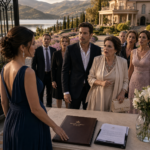
Three weeks after the courthouse, the invitations arrived at the Cortés home in thick ivory envelopes stamped in gold.
Doña Teresa thought it was a joke.
Rodrigo thought it was a performance.
Paola took a photo of the envelope and sent it to the family chat with laughing emojis.
Apparently she found a printer with taste.
The invitation was simple.
Easter Sunday
Four o’clock
Private residence of Mariana Varela
Valle de Bravo
There was no pleading in the language.
No explanation.
No attempt to impress them beyond the weight of the paper and the address they did not recognize.
“We’re all going,” Doña Teresa declared.
Rodrigo objected at first.
“It’s childish. She wants attention.”
“Then we’ll give it to her,” Paola said. “Imagine her face when she realizes we all came.”
A cousin wrote:
Maybe she rented a garden and hired two waiters.
Another replied:
If she serves supermarket mole, I’m leaving.
Doña Teresa sent the final message.
If Mariana wants to embarrass herself, we will be there to watch.
Julián showed me the screenshots because one of the younger cousins, careless and amused, had forwarded them to someone who worked in a company we had saved the year before.
I read the messages once.
Then I set the phone down.
“Do you want to cancel, señora?” Julián asked.
He had worked for my mother before he worked for me. He had driven me to school, to my first internship, to my mother’s funeral, and then to the courthouse the day I reclaimed my name. He had watched the Cortés family reduce me to a wife-shaped shadow for five years.
“No,” I said. “Prepare the house.”
“How many guests?”
“All of them.”
His expression did not change, but I saw the small satisfaction in his eyes.
“Of course.”
The house in Valle had belonged to my mother.
It was not the kind of house that announced itself from the road. That had been her preference. The gate sat back behind stone walls and trees. The driveway curved long enough to force a visitor into awareness. The estate opened gradually: gardens first, then lake, then terraces, then the house itself.
My mother believed architecture should reveal power slowly.
“Let fools speak before they understand the room,” she used to say.
In the days before Easter, the staff prepared with the calm coordination of people who knew the event was not a dinner.
It was a mirror.


Leave a Reply