Chefs planned the menu: lamb in adobo, handmade tortillas, roasted vegetables, fresh fruit, pan de elote, café de olla. The floral team arranged white lilies and blue hydrangeas. The terrace table was set for thirty-two with fine china, crystal glasses, and silverware Doña Teresa would recognize as older and better than anything she owned.
But the food was never meant for them.
At ten that morning, I gave instructions for the meals to be packed and donated after the family departed. There was a shelter outside town and two staff families whose children needed help after recent medical bills. The food would not be wasted on people who came to feed themselves on humiliation.
My assistant, Renata, arrived at noon with the documents.
Transfer papers.
Withdrawal notices.
Employee protection measures.
Board call details.
The Cortés Group would survive, but not under the privileges the family had mistaken for ownership. Payroll would be secured. Essential supplier contracts would be protected. Active employees would keep their salaries. The bank would review the old structure. Family benefits, discretionary draws, luxury vehicle leases, and unnecessary executive allowances would end immediately.
What ended was not the business.
What ended was their illusion.
At three-fifty, I stood in my bedroom as a stylist zipped the back of my deep blue dress.
Not black.
Black was for mourning.
I was finished mourning.
Blue had been my mother’s favorite color for negotiations. She said it made people think of calm water until they realized they were too far from shore.
I looked at myself in the mirror.
For five years, the Cortés family had seen me in cream dresses, simple skirts, polite blouses, the wardrobe of a woman trying not to offend people determined to be offended by her existence.
That woman had survived.
But she would not host Easter.
Mariana Varela would.
At four o’clock, the first car reached the gate.
Chapter 5: The Terrace of Quiet Teeth
They stood on the terrace as if the floor had become uncertain beneath them.
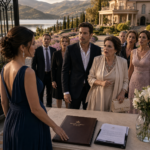
Thirty-two members of the Cortés family gathered around the long table, suddenly unsure whether to sit, speak, or pretend they had not arrived expecting poverty. Behind them, Lake Valle de Bravo shimmered in the afternoon light. A soft breeze moved through the flowers. Music played somewhere inside the house, low enough to feel expensive without asking to be noticed.
Chefs worked nearby.
Staff moved with trained silence.
No one rushed.
No one asked me where anything was.
Because everyone already knew.
That was the first lesson.
This was not a stage.
It was my home.
Doña Teresa stood near the head of the table because habit had carried her there before reality could stop her. Her pearls sat stiffly against her throat. Her eyes moved over the terrace, the staff, the silver, the view, returning each time to the empty chair at the head as if it might confirm she still belonged there.
Rodrigo looked paler than I remembered.
Divorce had not changed his face yet, but uncertainty had. His expensive jacket looked less like confidence now and more like fabric. Paola stood beside him, silent for once, her fingers tight around the strap of her handbag.
Then I walked out.
The conversation, what little of it remained, disappeared completely.
I crossed the terrace without hurry. My deep blue dress moved lightly around my legs. Renata followed two steps behind me with a leather folder. Julián stood near the entrance. The butler moved aside.
Rodrigo was the first to speak.
“Mariana.”
He forced a smile, the same one he had used in restaurants when he wanted waiters to believe he was kinder than he was.
“Who lent you this place?”
A few cousins looked down.
Even they understood the question had come from fear disguised as arrogance.
“No one,” I replied.
Doña Teresa snapped before Rodrigo could recover.
“Stop joking. You could never afford this.”
I looked at her for a long moment.
The woman who had called me poor while living off a company I kept alive. The woman who had measured my worth in jewelry and family name while wearing pearls paid for by emergency credit lines she did not know existed.
Renata stepped forward.
“Ms. Varela,” she said, “the transfer documents are ready. The Cortés Group board also requested a call before Monday’s announcement.”
Rodrigo froze.
“What board?”
Renata placed the folder in my hands.
I set it on the table.
“Your family company.”
Silence fell with such force that even the breeze seemed to pause.
Paola whispered, “What does that mean?”
“It means,” I said, “that for two years, your business survived because of an anonymous investor.”
Rodrigo stared at the folder.
I continued.
“Someone paid emergency debt. Someone protected contracts. Someone covered supplier defaults and short-term credit gaps. Someone stopped the bank from taking everything.”
Doña Teresa’s lips parted.
“No.”
“Yes.”
Rodrigo took one step forward.
His voice sounded unfamiliar now. Smaller.
“…Was it you?”
I looked at him, really looked at him.
The man who had told me outside the courthouse that without him I would not be able to pay my electricity bill.
The man who had smiled while his mother mocked me.
The man who had lived inside a rescue and called himself the savior.
“Yes,” I said. “It was me.”
A chair scraped softly as one of the older uncles sat down too hard.
Paola looked toward the lake.
Doña Teresa gripped the back of the nearest chair.
I opened the folder and turned the first page so Rodrigo could see the structure name, the dates, the emergency funding, the signatures.
“For two years, I kept your company alive while you seated me at the end of the table and treated me like I didn’t belong.”
He swallowed.
“I didn’t know.”
“You never asked.”
His eyes flickered.
That sentence reached a place in him documents could not.
Because it was true.
He had not asked who I was before his last name. He had not asked what Varela meant. He had not asked why certain bankers returned my calls quickly or why my schedule sometimes included trips he assumed were “little errands.” He had not asked because my supposed smallness had been useful to him.
Doña Teresa lifted her chin with visible effort.
“If this is some kind of revenge—”
“No,” I said.
The word cut cleanly through the terrace.
“This is administration.”
A few relatives looked at me then with a new kind of fear.
They understood revenge.
Administration was worse.
Revenge might lose control.
Administration came with signatures.
Chapter 6: The Board on the Screen
The terrace screen lit up, and four lawyers appeared on a video call.
Behind them were glass walls, conference tables, and the kind of stillness that only legal rooms have. One of them was the bank’s restructuring counsel. Another represented Varela Capital. The third handled employee protection. The fourth, an older woman named Lucía Ibarra, had worked with my mother and now answered only to me.
Doña Teresa stared at the screen as if it had opened directly into her chest.
“Tell me this isn’t real,” she whispered.
Lucía spoke first.
“Ms. Varela, the board representatives are ready. We can proceed when you authorize.”


Leave a Reply