When I Tried to Keep My Wedding Peaceful, I Never Imagined My Mother Would Turn a Necklace Into a Trap, Lie About My Father, and Force Me to Choose Between Being Claimed and Being Free.
My Mom Made My Wedding About Her “Shining,” So I Took Back the Spotlight
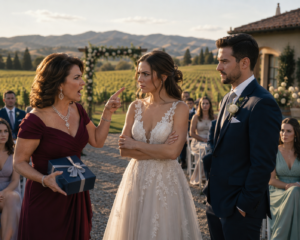
My name is Jamie Sullivan. I’m twenty-nine, I live in Portland, Oregon, and I’m getting married in October.
I should be excited in the normal way—Pinterest boards, tasting cake, arguing about napkin colors. Instead, I’m sitting at my kitchen table, staring at my phone, watching a text bubble form and disappear, and feeling that old familiar knot in my stomach: the one that means my mother is about to make something about me, about her.
If you’ve never had an abusive parent, it’s hard to explain what wedding planning does to your nervous system. It’s like every childhood trigger gets wrapped in tulle and ribbon, then delivered to your door with a smile.
My mother, Marla, is fifty-five. She’s charismatic in public, the kind of woman who can charm a barista into giving her an extra shot for free, then complain about it not being hot enough. She’s also the kind of mother who used to slap me for “rolling my eyes” when I was eight, and once grabbed me by the throat when I was nineteen because I told her she couldn’t read my diary. She stopped the physical stuff the day I moved out at eighteen. Not because she had an awakening—because she realized she couldn’t reach me anymore.
Since then, our relationship has been something I manage, not something I enjoy. I keep it polite. I keep it shallow. I don’t bring her into my private spaces unless I have to. She calls this “boundaries.” I call it survival.
I used to think the worst part of having Marla as a mother was the violence. The slaps. The grabbing. The way she could turn a normal afternoon into a hostage situation with nothing but her tone. But the older I got, the more I understood the violence was just the blunt instrument. The real weapon was her ability to rewrite reality.
If she yelled, it was because I “provoked” her.
If she cried, it was because I was “cold.”
If she humiliated me in front of family, it was because she was “teaching me resilience.”
When I moved out at eighteen, I didn’t have a grand exit. I packed a duffel bag while she was at work, left a note that said I’m safe, and drove straight to my best friend’s apartment with my hands shaking so badly I could barely hold the steering wheel. Marla called me twenty-three times that night. When I didn’t answer, she left a voicemail that sounded sweet enough to fool anyone: “Come home, sweetheart. I’m worried.”
The next voicemail was the truth: “If you don’t come back, don’t bother calling me your mother.”
For years, that was her favorite punishment—withdrawal. She’d go silent until I apologized for whatever she’d done, and if I didn’t, she’d tell people I was “difficult.” That label followed me like smoke at every family gathering. My younger brother Nate learned early to keep his head down. My dad left when I was sixteen, and even though he stayed involved, he couldn’t protect me from Marla’s daily moods. He tried. He just didn’t know how to fight a war where the rules changed every hour.
When I became an adult, I made a quiet trade: I would keep Marla in my life in small doses, and in exchange I would get to stop being hunted. I called her on holidays. I answered texts with neutral words. I avoided topics that sparked her entitlement. In therapy language, it’s “gray rocking.” In my language, it’s making sure the lion stays fed enough not to climb the fence.
That strategy worked until the wedding, because weddings are all fences and spotlights. A wedding turns “small doses” into “roles.” It turns “polite phone calls” into “mother of the bride.” And Marla doesn’t do roles quietly.
I’m marrying Ethan Ross. He’s thirty-one, an elementary school music teacher with a laugh that makes other people laugh, even when they don’t know why. He grew up in a family that argues like adults and apologizes like adults. The first time he saw me tense up because someone raised their voice on a sitcom, he didn’t tease me. He just reached for my hand.
When Ethan proposed, it was quiet. He didn’t do a flash mob or a public stunt. We were on the couch with takeout Thai, his knee bouncing because he was nervous. He asked, I said yes, and for a few minutes the world felt simple.
Then my mother found out.
At first, it was almost convincing. She cried on the phone and told me she’d “always dreamed” of being mother of the bride. She said she wanted to support me, wanted to make this special, wanted to do it right. I heard the same line I heard when I was twelve and she bought me a new coat after screaming at me in the car: I’m trying.
Ethan didn’t tell me what to do. He never does. He asked what I wanted. That’s a deceptively hard question when you’ve been trained to want what keeps the peace.
I didn’t want to cut my mother out completely. Part of me still wanted the normal mother-daughter wedding experience I’d seen in movies: dress shopping, lipstick advice, a hug without strings. The other part of me knew my mother didn’t do normal. She did performance.
So I tried for middle ground.
I set boundaries. I said she could come as a guest. No planning meetings. No vendor calls. No surprise speeches. No “mother of the bride” spotlight moments. She could have a corsage, sit in the front row, take photos, and be polite.
She agreed. For about a month.
The first boundary I set was simple: no surprise planning, no contacting vendors, no playing producer. She could ask, I would answer, and we would decide as a couple. Marla agreed so quickly I almost believed her.
Two weeks later, she mailed a box to my apartment with three bridal magazines, a handwritten note, and a plastic folder labeled WEDDING IDEAS in glitter pen. The note said, I made a timeline for you so you don’t stress. I opened the folder and saw printouts: photographers, florists, caterers—each with a star next to it and a comment in her handwriting. Best lighting. Great for “mother of bride” entrance. Ask for discount if you mention my name.
I called her and said, “Mom, please don’t contact vendors.”
She sounded offended. “I didn’t contact anyone. I just did research.”
“Research that includes instructions to mention your name,” I said.
She sighed like I was the unreasonable one. “Fine. I won’t help. You always reject my help.”
She didn’t yell. She didn’t swear. She just pressed guilt into my ribs until I apologized for asking for basic respect. I didn’t apologize. I repeated the boundary. She went quiet for three weeks, then returned like nothing happened.
The second boundary came when she showed up at a bridal shop downtown without telling me. The receptionist called my phone and said, “Hi, Jamie! Your mom is here for your appointment—she said you’re running late.”
I was at work. I hadn’t booked an appointment.
When I called Marla, she said, cheerful, “Surprise! I thought it would be fun to try dresses. I’m already here. Just leave work early.”
“I can’t,” I said, my stomach tightening.
“You can,” she insisted. “If you want to. You’re choosing not to.”
That line—You’re choosing—was her favorite trap. It made everything feel like my fault.
I told her, clearly, “I’m not doing surprise dress trips. If you want to come dress shopping, you can join the appointment Ethan and I schedule.”
There was a beat of silence, then a laugh that wasn’t warm. “Ethan is going dress shopping?”
“He’s my fiancé,” I said. “He gets to be involved.”
Marla’s voice sharpened. “It’s not his role.”
“It is in my wedding,” I replied.
She stayed angry for a week. Then she sent me a link to a makeup artist with the caption, I just want you to look stunning. People will be looking at me too, you know.
The third boundary was about the ceremony itself. She asked to walk me down the aisle “because it would look right.” My dad had already asked quietly if he could. I wanted my dad. I wanted the man who showed up without demanding applause.
When I told Marla, she said, “So you’re choosing your father over me.”
“I’m choosing what I want,” I said.
She said nothing for a long time, then whispered, “I’m your mother.”
Like it was a contract.
Then she started sending me wedding dresses she “hoped I’d like,” texting links at midnight with captions like, This one says you. She started contacting makeup artists “on my behalf.” She asked, repeatedly, if she could give a speech “just two minutes, sweetheart.” Every time, I repeated the boundary. Every time, she acted wounded, then backed off for a few weeks, then tried again.
It’s a pattern that looks like effort if you’re naïve. It’s not effort. It’s pressure. She pushes until I stop pushing back, then she calls that consent.
The first real clash happened over the venue.
Ethan and I chose a vineyard outside Dundee. It was four hours from my mother’s place in southern Oregon, and we picked a Saturday so nobody had to take time off. We paid extra for that Saturday. We paid extra for everything, because weddings are basically a cash bonfire.
When we told Marla, she complained immediately. “Why so far? Why not somewhere closer to me?” As if we were choosing a venue for her comfort, not our marriage. Then she added, “If it’s not during school holidays, I’ll have to take unpaid leave so I can arrive in style on Friday.”
“In style,” Ethan repeated later, baffled.
My mother wasn’t thinking about the wedding. She was thinking about the entrance.
After the venue fight, she began framing every logistical detail as a personal insult. She complained that four hours was “unreasonable” for her but not for anyone else. She complained that the Saturday date forced her to “take unpaid leave” to arrive on Friday “in style,” as if driving up after work like other guests was beneath her.
I said, “Mom, you can come Saturday morning. The ceremony is in the afternoon. There’s time.”
She scoffed. “Mother of the bride arrives the day before. That’s how it works.”
“Who says?” I asked.
“My mother would have,” she snapped, then paused as if she’d said too much. Her mother—my grandmother—died when I was six. Marla loved using that loss as proof that she deserved special treatment forever. She’d say, “I didn’t have a mother to guide me,” then use that as permission to ignore what I needed. Her grief was always a crown.
Ethan listened to these calls with a quiet fury that made me love him more. After one particularly dramatic complaint about hotels “not being good enough for her,” he said, “Jamie, I don’t want to tell you what to do, but… do you notice she never asks how you’re feeling?”
I stared at him. “She thinks she’s asking,” I said.
Ethan shook his head. “No. She’s telling you what she wants and calling it care.”
That sentence landed harder than Marla’s insults because it was clean. It was true. It made my denial wobble.
I kept trying to find that mythical middle ground. I kept thinking if I could give her a small role, she might stop reaching for the whole stage. I offered her a job that sounded harmless: “You can host the brunch the morning after the wedding if you want,” I said. “Just a casual thing at the hotel.”
Marla brightened instantly. “A recovery brunch,” she said, already spinning it into a headline. “Yes. With a toast. People love a toast.”
“No toast,” I said quickly. “Just brunch.”
She laughed lightly. “We’ll see.”
That was the problem. With Marla, boundaries weren’t agreements. They were suggestions she planned to outlast.
On nights when the planning stress got too loud, I’d sit on my bed scrolling through wedding photos online and feel a weird, aching envy. Not for the dresses or the flowers— for the easy faces of mothers hugging daughters like it wasn’t dangerous. I’d imagine Marla looking at me with simple tenderness, and for a second my chest would soften. Then I’d remember her hands on my throat at nineteen, her nails digging in while she hissed, “You think you’re better than me?” and the softness would snap shut.
That contradiction is the hardest part of having an abusive mother: you grieve and crave and fear the same person.
I was still trying to be reasonable when the necklace thing started.
It began with my younger brother, Nate, calling me on a Sunday. Nate is twenty-four, the only person in our family who has ever looked at my mother and said, You can’t talk to her like that. It didn’t fix her, but it made me feel less alone.
Nate sounded stressed. “Mom wants to talk to you,” he said. “She’s planning something and she’s… you know.”
“What is it?” I asked.
“She wants to have a necklace made for you,” he said quickly, like ripping off a bandage. “For the wedding. She’s saying it’s a surprise but… I thought you’d want to know.”
I felt my shoulders rise. “A necklace.”
“Yeah. She said it’s going to be made from old jewelry from her marriage to Dad. Like… melted down and remade. She’s saying it’s you wearing ‘their history’ or something.”
I stared at my coffee like it might answer. My parents had divorced when I was sixteen. Not a screaming divorce—my dad, Tom, just packed boxes quietly after my mom threw a plate at the wall and called it “passion.” They were distant but polite now. The idea of wearing jewelry made from their marriage on my wedding day felt like bad luck wrapped in sentimentality.
But I also knew how my mother would frame it: ungrateful. Cold. Cruel.
“Do you want it?” Nate asked.
“I don’t know,” I admitted. “Tell her to call me.”
Marla called that night. Her voice was syrupy. “Sweetheart, I have the most beautiful idea,” she said. “A gift from your father and me. Something symbolic. Something healing.”
“Healing,” I repeated, tasting the word. Healing was her favorite word for pretending the past didn’t happen.
She explained the necklace plan: she and Tom would contribute old jewelry from their marriage, have it redesigned into a new pendant, something “fresh” that represented “growth.” She talked like she was hosting a TED Talk.
I said carefully, “I already have the necklace Dad and you gave me for my twenty-first birthday. I planned to wear that.”
She sighed theatrically. “That’s not the point. This is bigger. It’s a family moment.”
Family moment. Translation: a stage.
I didn’t want the necklace, but I could tolerate the concept if—if—my dad actually wanted to be involved. Tom was quiet, practical. He wouldn’t melt down jewelry for symbolism. But maybe he’d do it for me.
“Okay,” I said. “If Dad’s truly part of it, and it’s not… weird, then fine.”
Marla’s voice brightened. “Of course he is. He’s thrilled.”
Something in me flinched at how easily she said that. But I wanted to believe her. I wanted a normal moment.
Two months passed. Wedding planning continued. My mother behaved—mostly—because she was busy “working on the necklace.” She would drop hints in texts: Counting down. You’ll cry. Everyone will talk about it. She said those last three words like they were the goal.
Ethan and I went to Marla’s house for her birthday lunch. She lives with her husband, Rick, a man I tolerate the way you tolerate a neighbor’s barking dog: it exists, you don’t engage, you wait for it to stop. Rick is not fond of me because I don’t play the role my mother wants. I’m not grateful enough. Not pliable enough. Not a prop.
Halfway through lunch, between the salad and the cake, Marla clapped her hands. “Oh! The necklace,” she said, eyes shining. “We need to finalize the plan.”
Ethan’s hand found my knee under the table. Quiet support.
Marla leaned in conspiratorially. “Your father randomly walked out,” she said, like this was a weather update. “So now it will be from me and Rick.”
My fork froze.
“One,” I said slowly, “that doesn’t sound like my dad.”
Marla waved. “He’s weird about feelings. He got cold feet.”
“And two,” I added, “Rick and I aren’t close.”
Rick’s jaw tightened. Marla smiled wider, like she enjoyed the tension.
“This necklace is about you and me,” she said. “Mother of the bride. The most important relationship.”
The most important relationship, she said, as if my husband-to-be was background music.
I felt my heart start to pound. Not panic. Anger. Clean and sharp.
“Dad wasn’t in on it from the start?” I asked, keeping my voice even.
Marla’s eyes widened. “Of course he was. Until he wasn’t.”
I looked at Ethan. He didn’t speak, but his expression said, You know this is a lie.
I excused myself and went outside to the porch, phone already in my hand. I called my dad. He answered on the second ring.
“Hey, kiddo,” Tom said. His voice always sounds like a steady chair.
“Dad,” I said, “quick question. Are you involved in some necklace gift Mom’s making for my wedding?”
There was a pause. “What necklace?”
My stomach went cold, then hot.
“She said you were,” I said. “She said you were melting down old jewelry from your marriage.”
Tom exhaled. “Jamie, no. She mentioned something like that months ago and I told her it was weird. Bad juju, honestly. Why would you want our divorce turned into a wedding accessory? I said I wasn’t doing it.”
“She told me you were,” I said softly.
Tom’s voice sharpened, rare for him. “She lied.”
I closed my eyes. “Yeah,” I whispered. “She did.”
I went back inside with my face calm because my mother feeds on reactions. She was watching me like a cat watches a bird.
“Well?” she asked.
“I talked to Dad,” I said.
Marla’s smile twitched. “And?”
“He said he was never in on it,” I said clearly. “He said you asked and he said no.”
The room went silent in that way families get when someone says the truth out loud.
Rick looked at his plate. Ethan’s hand stayed steady on my back.
Marla’s eyes filled instantly, like she had a faucet installed behind them. “Why would you do that?” she whispered. “Why would you embarrass me?”
“I’m not embarrassed,” I said. “I’m disappointed.”
She started crying harder, louder, like the sound itself could rewrite the facts. “I’m trying to do something special and you’re attacking me,” she said.
“I don’t appreciate being lied to,” I said, and my voice didn’t shake. “And I already have a necklace I plan to wear—the one you and Dad actually gave me when I turned twenty-one. I’m wearing that.”
Marla’s face changed. The tears stayed, but the expression underneath hardened.
“You should wear the new one,” she said, voice suddenly flat. “You’re wrong.”
“I’m not,” I said.
She stood so fast her chair scraped. “Fine,” she snapped, then grabbed her phone and stormed into the kitchen.
Ethan touched my shoulder. “You okay?”
I swallowed. “I will be.”
We left early. On the drive home, my hands shook—not from fear, but from the adrenaline of finally refusing to play along. Ethan drove. He didn’t fill the silence with advice. He just said, “I’m proud of you.”
When we got home, my phone buzzed with a text from Marla.
I’ll tell you what. You keep hurting me, so I won’t come to your wedding. I wish you all the best for the day and your life together.
I stared at the screen for a full minute.
It was the most classic move she had. She wanted me to chase her. She wanted me to beg. She wanted the story to become: poor mother excluded by cold daughter. She wanted control back.
My fingers hovered over the keyboard. A thousand responses crowded my mind: You hurt me for years. You lied. You put yourself first. Please don’t do this. Please do this. Angry. Pleading. Explanatory.
Instead, I did the hardest thing.
I didn’t reply.
For two days, it was quiet. My body stayed braced like she might jump out of a closet. Then she tried again—four missed calls, one text, one WhatsApp, and then she called Ethan—within thirty minutes.
Ethan showed me his call log without drama. “She offered us tickets to an event she can’t use,” he said. “I didn’t answer.”
I texted her one line: No thank you. Please communicate with me, not Ethan.
Then I muted her.
It felt like stepping off a treadmill that had been running under my feet my whole life.
Nate called the next day. “She’s telling people you’re cruel,” he warned.
“Let her,” I said.
Nate exhaled like he’d been waiting to hear me say that. “If she shows up,” he said, “I’ll handle it. You won’t even see her.”
“Are you sure?” I asked.
“Jamie,” he said, and his voice was steady in a way that reminded me of Dad. “You’ve been handling her alone for years. Let someone else carry the door this time.”
After that turning point, wedding planning got lighter. Not perfect—my mind still replayed old scenes. But lighter. I stopped flinching every time my phone buzzed. I made decisions without imagining my mother’s reaction first.
I also started therapy.
I didn’t want to. I resented the idea of paying someone to help me unpack what my mother broke while she walked around untouched by consequences. But my therapist, Dr. Patel, said something in our second session that made my chest ache.
“Therapy isn’t kindness to your mother,” she said. “It’s kindness to your future self.”
I hated how true it was.
We worked on grief—not grief for a mother I lost, but grief for a mother I never had. That grief is strange because there’s no funeral. The person is alive, but the relationship you wanted is dead.
Dr. Patel told me to treat my wedding like a boundary ritual, not a stage. “Your wedding,” she said, “is you choosing a new family system. That’s why your nervous system is louder.”
I told her I felt guilty, like I was being ungrateful. She asked, “Grateful for what?”
The question made me laugh and cry at the same time.
As the wedding got closer, my mother stayed mostly silent. Nate reported occasional texts to him about “how much she sacrificed” and “how daughters should honor mothers.” He ignored them.
Then, three days before the wedding, she sent me one email. Not a text. An email—because emails feel official, like they can’t be ignored.
Subject: Final Thoughts.
The body was four paragraphs of pain theater. She wrote that she would have “killed” for her mother to be involved. That her own wedding was “horrible” because her mother didn’t care. That all she wanted was to support me. That most daughters would be grateful. That she accepted I “clearly don’t want a mother.”
At the end, she wrote: I won’t come. I won’t ruin your day by existing in it.
I read it twice, then forwarded it to Dr. Patel, Ethan, and Nate, and then archived it.
Ethan asked, “Do you want to respond?”
I looked at him. “No,” I said. “This is her choice.”
I didn’t say it out loud then, but “free” didn’t mean painless. It meant the pain was finally mine to handle, not mine to hide.
At the rehearsal the night before, I’d watched guests arrive with wine bottles and easy smiles, and my body had done what it always does when a door opens behind me: it had braced. I kept checking the entrance without realizing I was doing it. Ethan noticed and slipped his fingers into my palm, a silent anchor.
“You’re safe,” he murmured.
I wanted to believe him. I did believe him. But belief and reflex aren’t the same thing.
At one point during dinner, a woman in a cream coat walked in late and my heart actually skipped, because for a second the silhouette looked like my mother. I felt heat rush up my neck, the old childhood fear of being seen and punished. Then the woman turned, laughing, and I realized she was Ethan’s aunt, not Marla. I excused myself to the bathroom and stared at my face in the mirror until my breathing slowed. That’s what trauma does: it makes ordinary moments feel like ambushes.
Nate found me outside afterward, leaning against the railing, trying to cool off in the October air. “You doing okay?” he asked.
“I hate that I’m still scared,” I admitted. “Even when she’s not here.”
Nate nodded like he understood exactly. “That’s the part people don’t get,” he said. “They think the problem is her presence. Half the time the problem is what she trained into you.”
I swallowed hard. “How do you stop it?”
He shrugged. “You practice new reflexes. And you don’t do it alone.”
On the morning after the wedding, my dad helped Ethan load boxes of leftover favors into the car. He moved quietly, the way he always does, but he kept glancing at me like he wanted to say something. When we finally had a moment alone by the vineyard fence, he cleared his throat.
“I know you feel guilty,” he said. “Because you’re you. But guilt isn’t always a moral compass. Sometimes it’s just a bruise someone taught you to press.”
I stared at him. My dad rarely spoke in metaphors. “Did Mom teach you that one?” I asked.
He smiled sadly. “No. Your grandmother.”
I laughed through the lump in my throat. “Sounds like her.”
Dad squeezed my shoulder once. “You built a good day,” he said. “That matters.”
The day before the wedding, I woke up with my stomach in knots. Not because I wanted my mother there—because I feared what she might do. Abusive parents teach you that peace can be interrupted at any moment.
Nate came by that afternoon with a suit bag and a calm face. “I’ve got a plan,” he said.
He and Ethan had arranged two friends—big guys from Ethan’s teaching circle—to act as quiet security. Not bouncers in black shirts. Just friends with clear instructions: if Marla arrives, she is treated like any guest without an invitation. She is offered a ride away. If she escalates, police are called. No scenes. No negotiations.
I wanted to cry from relief.
The wedding morning was bright and cold in that Oregon autumn way. The vineyard was painted in gold and rust. My bridesmaids helped me get ready in a small cottage on the property. My hands shook while I put on earrings. Dr. Patel’s voice echoed: You’re not managing her today. You’re living your day.
At noon, I walked down the aisle toward Ethan.
I saw my dad in the front row, eyes shining. I saw Nate beside him, jaw set like a guardrail. I saw Ethan’s parents smiling softly. I did not see my mother.
For a moment, my body waited for the other shoe to drop.
It didn’t.
The ceremony was simple. Ethan cried. I laughed through tears. When we said our vows, the world narrowed to the two of us and the promise we were making: that our home would be a place where love wasn’t a test.
At the reception, people danced under string lights. My dad toasted to “building things that last.” Ethan’s mom toasted to “choosing peace.” Nate stood near the entrance for most of the night, scanning with the alertness of someone who knows what chaos looks like.
Around nine, he came over and said quietly, “She isn’t coming.”
I felt my shoulders drop in a way I didn’t realize they’d been held all day.
After the last song, Ethan and I stood outside the venue under the dark sky, the air smelling like damp vines and cake. I expected to feel sadness. Instead, I felt something that surprised me: grief, yes—but also relief so deep it felt like sleep.
Ethan wrapped his arms around me. “How are you feeling?” he asked.
I thought about the question my mother had tried to force on me for months: Are you grateful? Are you honoring? Are you doing it right?
I answered my husband instead.
“I feel free,” I said.
The next morning, while we packed up gifts and leftover flowers, my phone buzzed once. A text from Marla.
Hope you had the day you wanted.
No apology. No accountability. Just a line that kept her in the story.
I didn’t respond.
Later I saved Nate’s number under “Peacekeeper” in my phone. It was a joke but also a reminder I’m allowed to ask for protection not permission anymore today.
Life without a mother doesn’t feel like a cliff. It feels like a quiet room after years of noise. At first, the silence is scary. Then you start hearing your own thoughts again.
I don’t know what our future looks like. My mother may try to “weasel” back in. She may show up at holidays with a smile. She may punish me with silence until she wants attention again. But the structure has changed now.
If she comes back, she comes as a guest. No privileges. No spotlight. No red carpet.
My wedding taught me something that therapy is still helping me practice: boundaries aren’t cruelty. They’re architecture. They’re how you keep a life from collapsing under weight it was never meant to carry.
And on the day I married Ethan, I finally stopped building my future on my mother’s ego.
THE END

Leave a Reply