At my father’s graveside, the gravedigger grabbed my arm and whispered, ‘Sir, your father paid me to bury an empty coffin.’ Before I could even breathe, he pressed a brass key into my palm and said, ‘Don’t go home. No matter who calls, don’t go home. Go to Unit 17 on Route 9 — right now.’ Then my phone buzzed with a text from my mother: Come home alone.
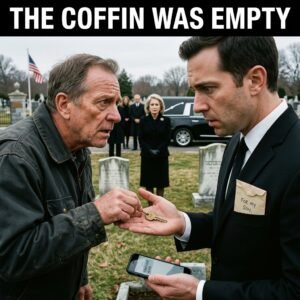
The gravedigger caught my arm before I could leave my father’s grave.
The service had just ended. The last hymn still seemed to hang over the cemetery, thin and trembling in the cold afternoon air. People were moving slowly between the headstones with their heads down, speaking in the soft voices people use when grief has turned ordinary words into something clumsy.
My mother stood near the black funeral sedan with one hand pressed to her mouth. My wife, Celeste, was beside her, holding our daughter’s little black coat against her chest because Emma had gotten too warm and shrugged it off halfway through the service. Our son, Oliver, was asleep against Celeste’s shoulder, too young to understand why everyone around him looked broken.
Behind us, the coffin rested above the open ground.
My father’s coffin.
Raymond Mercer, sixty-six years old, retired accountant, husband, father, grandfather, Little League coach for four seasons back when his knees still let him jog to first base, the man who taught me how to change a tire in a grocery store parking lot during a rainstorm and then bought me hot chocolate because I had not complained.
Three days earlier, they told us he had died of a heart attack in his study.
Three days of phone calls, funeral decisions, neighbors bringing foil-covered casseroles, relatives asking what time they should arrive, my mother sitting at the kitchen table in her robe, staring at my father’s empty chair as if he might still come in and ask whether anybody had seen his reading glasses.
I had barely slept. I had barely eaten. I had stood at the front of the church that morning with my folded eulogy in my hand, looking at my father’s closed casket and trying not to come apart in front of everyone.
Now all I wanted was to get my mother home.
“Mr. Mercer.”
The voice was low, urgent, almost swallowed by the wind.
I turned and saw the gravedigger standing beside me. He was a weathered man in his fifties, with dirt on his boots, work gloves in one hand, and eyes that had seen enough funerals to know when not to bother a grieving family.
“Not now,” I said.
I tried to pull away, but his hand tightened just enough to stop me.
“Please,” he said. “It has to be now.”
Something in his face made me pause.
I glanced toward my mother. She was still by the sedan. My cousin Carol had one hand on her elbow and was saying something about bringing soup by later. Nobody was watching me yet.
“What is it?” I asked.
The gravedigger leaned closer.
“Your father paid me.”
I stared at him.
“Paid you for what?”
His throat moved.
“To bury an empty coffin.”
For a moment, I thought the wind had twisted his words into something insane.
Then I understood exactly what he had said.
I stepped back. “That’s not funny.”
“I know.”
“My father is dead.”
“I know what you were told.”
“I saw him at the viewing.”
The gravedigger’s eyes did not move from mine.
“You saw what he wanted you to see.”
My anger rose so fast it almost felt useful. “You need to leave.”
“I can’t.”
“My mother kissed his forehead.”
“I was told you would say that.”
Before I could answer, he pressed something into my palm.
It was a brass key, old but clean, with the number 17 stamped into the head.
“What is this?”
“Route 9 Storage,” he said. “Unit 17. Go there now.”
I looked at the key, then back at him. “Who are you?”
“Marcus Webb. I’ve worked this cemetery twenty-two years. Your father gave me instructions a long time ago.”
“A long time ago?”
“Twenty years.”
The words landed harder than the cold.
Twenty years.
My phone buzzed in my coat pocket.
I pulled it out automatically, expecting Celeste or my mother or one of the relatives asking where I had gone.
The text was from my mother.
Come home alone.
I stared at it.
Three words.
No honey. No sweetheart. No period. No trembling little heart emoji the way she sometimes used when she was upset and trying to sound brave.
Just: Come home alone.
Marcus saw my face.
“Don’t,” he whispered.
I looked up slowly.
“Whatever you do, do not go home yet.”
My chest tightened. “What is going on?”
He reached inside his coat and pulled out a yellow envelope, worn soft at the edges. My name was written across the front in my father’s handwriting.
Julian.
I knew that handwriting. I had seen it on birthday cards, grocery lists, tax folders, little notes taped to the refrigerator when I was a kid.
Marcus handed it to me like it weighed more than paper.
“Your father said you’d need proof.”
Then he stepped away and disappeared between the headstones.
I stood beside my father’s open grave with a key in one hand, a letter in the other, and a text from my mother glowing on my phone.
The coffin behind me was empty.
And my life split down the middle.
I did not go home.
I went to my car and sat beneath an old sycamore at the edge of the cemetery lot. My hands shook so badly I could hardly open the envelope.
Inside was one sheet of paper.
Julian,
If Marcus has given you this, then I have had to disappear. I know how impossible this sounds. I know you are angry. I know you are grieving because I made you grieve.
I am sorry.
But you must listen carefully.
Go to Unit 17 at the storage facility on Route 9. The key will open the lock. Inside, you will find the truth.
Do not go home first.
If you receive a message from your mother asking you to come home, especially if it sounds wrong, do not answer it. They may have her. They may use her phone to reach you.
Trust Patricia Holloway. She is waiting.
I love you, son. Everything I have done was to protect this family.
Dad.
I read it once.
Then again.
The third time, the words did not become more believable. They became more terrifying.
I looked across the cemetery. My mother’s car was still there. Celeste was buckling Oliver into our SUV. People were hugging, whispering, drifting away.
I should have walked over to them.
I should have told Celeste everything.
Instead, I called her.
“Julian?” she answered. “Where are you?”
“Take the kids and go to your sister’s house.”
“What?”
“Right now. Don’t ask questions. Just go there and call me when you arrive.”
“Julian, you’re scaring me.”
“I know. I’m sorry. Please trust me.”
There was silence on the line, the kind that comes before a marriage either holds or cracks.
Then Celeste said, “Okay.”
I started the car.
Route 9 Storage sat on the edge of town, past a gas station, an old diner with a faded red roof, and a pharmacy sign flashing flu shots and senior discounts. It was the kind of place people drove by without noticing: chain-link fence, rows of metal doors, security cameras tilted under small plastic covers, an American flag beside the office snapping in the damp wind.
A woman was waiting under the awning before I even parked.
She was in plain clothes, late forties maybe, with sharp eyes and a stillness that made her look official before she ever showed me a badge.
“Julian Mercer?” she asked.
“Patricia?”
She opened a leather holder just long enough for me to see the seal.
“Special Agent Patricia Holloway. Federal Bureau of Investigation.”
My mouth went dry.
“Where is my father?”
“Use the key.”
That was all she said.
She led me through the rows of storage units. The pavement was wet from the morning rain. Water gathered in low places, reflecting gray sky and barbed wire. We passed Units 5, 9, 12, 16.
At the back fence, near a line of pine trees, she stopped in front of Unit 17.
I put the key in the padlock.
It turned.
The lock clicked open.
I lifted the metal door.
My father stood inside.
Alive.
For several seconds, I could not move.
He looked older than he had in the casket. Exhausted. Pale. Hollow beneath the eyes. But he was standing there, breathing, one hand braced against a folding table, staring at me with more guilt than relief.
“Julian,” he said.
The sound of his voice almost broke me.
I stepped inside. Patricia lowered the door behind us.
The storage unit was not filled with old lamps and Christmas decorations. It had been turned into a hidden room. A cot stood against one wall. A mini refrigerator hummed in the corner. Several computer monitors showed grainy security feeds. A folding table held maps, phones, case files, and a coffee cup gone cold.
On one wall, photographs and documents had been pinned in careful rows.
My family was on that wall.
Me walking out of my office downtown.
Celeste loading groceries into the trunk of her car.
Emma in her soccer uniform.
Oliver holding his backpack outside kindergarten.
My mother leaving the church after Sunday service.
I turned back to my father.
“What have you done?”
His face tightened.
“What I should have told you years ago.”
I took one step toward him. “I buried you today.”
“I know.”
“My mother buried you.”
“I know.”
“My children cried because Grandpa was gone.”
His eyes filled.
“I know, son.”
I wanted to hit him. I wanted to hug him. I wanted to wake up in my own bed and find out grief had simply made me dream the worst possible thing.
Instead, I stood there shaking.
“Start talking.”
He sat down slowly, as if his body had finally run out of strength.
“In 1995,” he said, “I had a client named Victor Crane.”
At first, the name meant nothing to me.
Then Patricia pulled one of the photographs from the wall and set it on the table.
A man in his late fifties stared back from the picture. Silver hair. Expensive coat. Cold eyes. The kind of face that looked calm because it expected other people to panic first.
“Crane ran an import company on paper,” my father said. “In reality, he laundered money for organized crime from Boston down to Miami. I did not know at first. I was a young accountant trying to build a practice. He brought me clean paperwork, clean suits, clean explanations.”
“But it wasn’t clean.”
“No.”
My father rubbed his thumb over his wedding band.
“I started seeing patterns. False invoices. Shell companies. Payments that circled back through businesses that did not really exist. I told myself I was mistaken. Then I knew I wasn’t.”
“You went to the police?”
“To the FBI.”
Patricia nodded. “Your father became a confidential informant. He wore a wire for almost two years. He helped us build the case that put Crane away.”
I looked at my father as if I had never seen him before.
The man who reminded me to keep receipts. The man who clipped coupons from the Sunday paper. The man who took me to minor league baseball games and always parked two blocks away to save ten dollars.
That man had worn a wire against a criminal.
“In 1998, I testified,” my father said. “Crane was convicted. Thirty years.”
“And you never told me?”
“You were a child.”
“I became an adult.”
“I wanted you to have a life that was not built around fear.”
I laughed once, but there was no humor in it.
“So you built it around lies instead.”
He closed his eyes.
“Yes.”
The honesty made the room worse.
Patricia moved to the wall and tapped a newer photograph.
“Victor Crane was released three months ago.”
The air changed.
“Good behavior,” my father said bitterly. “Reduced time. A man who spent twenty-five years in prison thinking about revenge walked out with money still hidden, contacts still loyal, and nothing left in his heart but hatred.”
I looked again at the photos of my children.
“He’s watching us.”
“He’s planning to use you,” Patricia said. “Your mother. Your wife. Your kids. Anyone who can hurt Raymond.”
My phone buzzed.
Celeste.
I answered so fast I almost dropped it.
“We’re at my sister’s,” she said. “The kids are inside. Julian, tell me what is happening.”
I looked at my father.
His face had gone still.
“Stay there,” I said. “Lock the doors. Do not leave. If anyone calls you from my mother’s phone, do not answer.”
“Your mother’s phone?”
“I’ll explain when I can.”
“Julian—”
“I love you.”
The line went quiet.
Then she said, “I love you too. Come back to us.”
When I hung up, Patricia was already checking one of the monitors.
“We just got cemetery footage.”
My father stood.
The video came up on the screen in grainy black and white.
My mother’s car.
A black SUV stopping beside it.
Two men getting out.
One bending to speak through her window.
My mother stepping out, confused but polite, still in the dark wool coat she had worn to bury her husband.
The second man moved behind her.
He pressed something over her face.
My mother’s knees weakened.
They caught her before she hit the ground and forced her into the SUV.
I grabbed the edge of the table.
The room tilted.
My father made a sound I had never heard from him before.
Not anger.
Not fear.
Something older than both.
“They have Vivian,” he said.
Patricia’s jaw tightened. “They’re using her to force contact.”
My father turned to me.
“Now you understand why I told you not to go home.”
I understood.
And I hated that I did.
For the next two hours, Unit 17 stopped feeling like a storage room and became a command center. Agents arrived quietly through the back gate. Laptops opened. Radios crackled. A county map was spread across the folding table. Names and addresses became routes. Routes became risk. Risk became decisions no family should ever have to hear discussed in calm voices.
They traced the SUV to an old shipping warehouse near the river, a place that had once handled freight before the industry moved out and left behind rusted fences, cracked pavement, and buildings too expensive to tear down.
Crane had chosen it because men like him preferred places nobody visited after dark.
My father wanted to trade himself for my mother.
“No,” I said immediately.
“He wants me.”
“He wants to hurt you.”
“Those are not different things.”
“You don’t get to fake your death, drag me into this, and then go get yourself killed.”
My father looked at me for a long time.
“I am not trying to die, Julian.”
“You made me bury you this morning.”
Pain crossed his face.
“I know.”
“You don’t know what that did to us.”
“You’re right. I don’t.”
That stopped me more than denial would have.
He stepped closer.
“I made choices I cannot undo. I thought I was protecting you. Maybe I was protecting myself too. Maybe it was easier to be the only one afraid than to look at my son and admit the world could reach him because of me.”
His voice broke.
“But your mother is in that warehouse because of something I did before you were old enough to tie your shoes. So yes, I am going in. Not because I want to be a hero. Because I am her husband.”
I looked away.
There are moments when a man sees his father not as a mountain, not as a failure, but as a human being standing under the weight of every decision he has ever made.
That was mine.
Patricia’s plan was simple in the way dangerous plans are simple.
My father would make contact. He would offer himself in exchange for my mother. Crane would want the satisfaction of seeing him, hearing him beg, proving that twenty-five years had not softened revenge. While Crane talked, the FBI would move into position.
I was supposed to stay behind.
I did not.
Nobody liked it. Patricia argued. My father ordered. I refused both of them.
“That is my mother,” I said. “And you are my father. I am done being protected by lies.”
In the end, Patricia looked at my father and said, “If he comes, he follows instructions exactly.”
My father looked at me.
“If I tell you to run, you run.”
I did not answer.
“Julian.”
I swallowed.
“I run.”
The warehouse stood against the evening sky like the shell of a dead factory. The river moved dark behind it, carrying the smell of mud, diesel, and old rain. A buoy bell clanged somewhere in the distance. Beyond the broken fence, the city lights looked far away, like they belonged to another life.
My father walked in through the main loading entrance with his hands visible.
I followed from the side with two agents, staying behind stacked pallets and rusted machinery. My heart beat so hard I could hear it over the faint buzz of the overhead lights.
Inside, the warehouse was enormous and cold.
And in the middle of it stood Victor Crane.
He looked smaller than I expected and more frightening for it. No shouting. No wild rage. Just a still, well-dressed man who had spent half his life saving his hatred like money in a locked account.
My mother was tied to a chair beside him.
Her hair had fallen loose from the careful bun she had worn to the funeral. Her face was pale. Tape covered her mouth. When she saw my father, her eyes widened in shock so sharp it looked like pain.
“Raymond Mercer,” Crane said.
His voice echoed off the metal walls.
“I knew you weren’t dead.”
“Let her go,” my father said. “I’m here.”
Crane smiled.
“You always did think paperwork solved everything. Testimony. Bank records. Federal seals. Nice little signatures on nice little forms.”
He stepped behind my mother’s chair and rested one hand on her shoulder.
“But this is not a courtroom.”
My father stayed still.
“It’s between you and me.”
“No,” Crane said softly. “That is what you never understood. Prison taught me patience. It taught me that a man is not just his own body. He is his wife. His son. His grandchildren. His Sunday dinners. His little routines. You took my life apart with documents. So I thought I would take yours apart with people.”
My mother made a muffled sound.
I moved before I meant to.
One of the agents grabbed my sleeve, but it was too late. A piece of broken glass shifted under my shoe.
Crane’s head turned.
His smile widened.
“There he is.”
My father’s face went pale.
“Julian, no.”
Crane lifted a hand. Two of his men moved into the shadows and dragged me out by the arms.
I fought out of instinct, uselessly. They shoved me to my knees beside my father. The concrete bit through my suit pants.
My mother shook her head, tears spilling down her face.
Crane looked down at me.
“The son becomes a lawyer. Isn’t that sweet? Did he teach you to keep clean records too?”
I said nothing.
My father did.
“He has nothing to do with this.”
“Of course he does,” Crane said. “He is what you got to keep.”
He pulled a gun from inside his coat.
The warehouse seemed to shrink around the dark circle of the barrel.
My father stepped in front of me.
Crane laughed.
“Still protecting him.”
“Let Vivian and Julian walk out,” my father said. “You can have me.”
Crane looked almost disappointed.
“Raymond, after all these years, you still think I want a trade.”
He raised the gun.
“I want memory.”
Then the lights went out.
For half a second, everything became darkness.
Then white beams cut through the warehouse from every direction.
“FBI! Drop your weapons!”
The air exploded with shouting, running feet, bodies hitting concrete, metal clattering against metal. Crane swung the gun toward the nearest light.
A shot cracked.
I dropped flat.
Another shot answered.
Crane fell hard, screaming, the gun skidding across the floor.
My father was already moving toward my mother. I crawled after him, half blind from flashlight beams and fear. He tore at the tape gently, whispering her name over and over.
“Vivian. Vivian, look at me.”
When the tape came free, she gasped.
“You’re alive.”
“I’m alive.”
“You fool,” she sobbed, and then she pulled his face to hers and kissed him like anger and love had become the same language.
I reached them and put my arms around both of my parents.
For a moment, I forgot the warehouse. I forgot Crane being cuffed on the floor. I forgot Patricia shouting orders and agents calling for medics and men being dragged toward the loading doors.
My mother was alive.
My father was alive.
And the secret that had ruled our family from the shadows had finally run out of dark places to hide.
The aftermath was not clean.
Real life rarely gives people a neat final page.
My mother spent one night in the hospital. The doctors said she would recover. The bruises would fade. The fear would take longer.
Victor Crane went back into federal custody facing charges that would keep him from walking free again. Kidnapping. Conspiracy. Attempted murder. Weapons violations. A list long enough to make even Patricia look satisfied when she read it.
My father had to answer questions too. Some from federal officials. Some from my mother. Some from me.
Especially from me.
Three days after the warehouse, he and I sat on the porch of a safe house near the Jersey Shore. The place looked like any rented beach cottage in the off-season: faded blue shutters, sand in the walkway cracks, gulls crying over a gray stretch of water. Somewhere nearby, someone was burning wood in a backyard firepit.
For a long time, neither of us spoke.
Finally, I said, “You should have told me.”
He nodded.
No defense. No correction.
Just that.
“Yes.”
That hurt more than an excuse.
“I had a right to know.”
“Yes.”
“Celeste had a right to know.”
“Yes.”
“My children could have been taken, and we didn’t even know what we were protecting them from.”
His face folded under the words.
“I know.”
I wanted him to argue. Anger needed something to push against.
But my father only sat there, looking older than sixty-six, looking like a man who had survived danger but not judgment.
“I thought silence was safety,” he said. “At first, you were little. Then you were in high school. Then college. Then you were engaged. Then Emma was born. Every year I told myself I would explain it when the time was right. And every year, normal life made me selfish.”
“Selfish?”
“I liked watching you live without fear.”
His voice was quiet.
“I liked seeing you complain about mortgage rates and daycare costs and whether your son would ever stop throwing cereal under the table. I liked that those were your problems. Ordinary problems. I did not want to hand you mine.”
I looked out toward the water.
I thought of Emma asleep with her stuffed rabbit tucked under one arm. Oliver with pancake syrup on his shirt. Celeste at our kitchen table, asking me what I had not told her yet.
Would I lie to protect them?
The answer came too quickly.
Yes.
And that was what made forgiveness hard. Not because I could not understand my father.
Because I could.
“I’m still angry,” I said.
“You should be.”
“I don’t know how long I’ll be angry.”
“I can live with that.”
I looked at him.
He swallowed.
“I only hope I get to live close enough for you to tell me when it passes.”
That was my father. Not asking for a clean pardon. Not dressing it up. Just sitting beside the wreckage and hoping I would not leave him alone with it.
I reached over and took his hand.
It was the same hand that had steadied my bicycle, signed my college checks, held my newborn daughter with terrified tenderness, and written my name across an envelope meant to save my life.
“I love you,” I said. “That didn’t die at the funeral.”
He covered his face with his free hand.
For the first time since I was a child, I watched my father cry.
Two years have passed.
My father and mother sold their old house and moved to a small white cottage near the coast. There are blue shutters, two rocking chairs on the porch, and a backyard where Emma and Oliver chase fireflies in the summer until their grandmother calls them in for lemonade.
My father still looks over his shoulder sometimes.
He thinks nobody notices.
I do.
But he laughs more now. Real laughs. The kind that start in his chest when Oliver tells a joke that makes no sense, or when my mother scolds him for burning the hamburgers and he says, “Vivian, I fooled the entire town once. I can fool a grill.”
Celeste knows everything.
Forgiveness came slowly between us too. It came through late-night talks at the kitchen table, through anger that did not disappear just because the danger had passed, through long silences and honest answers. She forgave me, but not cheaply. I am grateful for that. Cheap forgiveness does not rebuild trust. Honest forgiveness does.
Emma and Oliver know only that Grandpa had to go away for a little while and came back.
Someday, maybe, I will tell them more.
Not yet.
For now, they get pancakes on Sundays and birthday cards in my father’s careful handwriting. They get stories about Little League and fishing trips and how their grandfather once drove through a snowstorm in Ohio because Grandma Vivian had gone into labor early.
They get ordinary.
After everything, ordinary feels like a miracle.
Last Christmas, Marcus Webb sent me a card.
There was no return name, just a postmark from two towns over. Inside, he had written:
Your father is a good man. Take care of him.
I framed it and placed it on my desk.
Sometimes the person who changes your life is not the one standing in the spotlight. Sometimes it is a gravedigger with dirt under his fingernails, holding a key beside an empty coffin because a frightened father trusted him twenty years earlier.
This morning is Sunday.
The house smells like coffee, toast, and maple syrup. Celeste is in the kitchen. Emma is arguing that chocolate chips count as breakfast if they are inside pancakes. Oliver is wearing one sock and claiming the other has vanished forever.
My phone buzzes.
Dad.
Bringing your mother’s pancakes. Door open?
I smile and type back.
Door’s open.
An hour later, three generations crowd around my kitchen table.
My mother pours coffee. Celeste hands out plates. Emma talks too fast about school. Oliver gets syrup on his elbow somehow. My father sits across from me, alive and impossible, buttering a pancake like a man who has earned the right to enjoy small things.
He catches my eye.
“Not bad for a dead man,” he murmurs.
I laugh.
My mother rolls her eyes.
Celeste smiles.
The children ask what is so funny, and none of us answer because some stories are too heavy for a Sunday morning kitchen.
So we eat.
We pass the syrup.
We talk about soccer practice, grocery prices, the neighbor’s new dog, and whether my father is allowed near the grill next weekend after what happened to the hamburgers.
Outside, the world keeps moving.
Inside, my family sits together.
Alive.
And for the first time in a long time, that is enough.

Leave a Reply