When Wren Turned Her Late Father’s Police Uniform Into a Prom Dress, She Never Imagined One Girl’s Cruel Joke Would Stain the Fabric, Expose a Six-Year Secret, and Make an Entire Ballroom See Her Father Differently.
The first time I understood that my daughter had been grieving in places I couldn’t reach, she was standing in the garage with her fingers curled around a dusty garment bag.
It was late March in Cedar Hollow, Ohio, the kind of evening when the last pale light hangs over the driveway and every sound in the house feels farther away than it is. I had gone looking for Wren because dinner was already on the table and she hadn’t answered when I called. I expected to find her in her room pretending to study, or on the back porch with her headphones in, staring at the woods behind our fence the way she did when she wanted to disappear without actually leaving.
Instead I found her under the harsh fluorescent light in the garage, standing in front of the old metal cabinet where I had kept things that belonged to her father.
The garment bag hung from a hook on the cabinet door. It had been there for almost six years. I knew exactly what was inside without needing to unzip it. Daniel’s dress uniform. Navy blue. Brass buttons. Pressed sharp the last time he wore it for the department awards banquet, two months before a drunk driver ran a red light and ended his life on a wet Tuesday night.
Wren didn’t turn around when I stepped in. She was staring at the bag like it was speaking to her in a language only she could hear.
“Dinner’s getting cold,” I said gently.
“I know.”
Her voice had that strained stillness I had learned to notice. I moved closer, careful not to startle her. “You okay?”
She nodded too fast. “Yeah.”
That meant no.
At seventeen, Wren had perfected the kind of self-protection that looked like independence to people who didn’t know better. She never slammed doors, never caused scenes, never asked why other girls had dads teaching them to drive or standing stiffly in tuxedos for homecoming pictures while she had a framed portrait on the mantel and a folded flag in a case. She just adjusted. Quietly. Efficiently. Like grief was a household chore you finished before anyone else woke up.
I leaned against the workbench. “What are you doing out here?”
She exhaled and finally looked at me. Her green eyes were tired in a way no seventeen-year-old’s eyes should be. “Can I ask you something weird?”
“With you, that’s usually how the important questions start.”
The corner of her mouth twitched, but the smile never fully arrived. She turned back to the garment bag. “Prom is in eight weeks.”
I waited.
She shoved her hands into the sleeves of her oversized sweatshirt. “I know we said we weren’t going to spend money on anything stupid.”
“We said we weren’t going to spend money on something you didn’t even want.”
“I don’t want the stupid part,” she said. “The whole giant fake-princess, two-hundred-dollar-hair, limousine nonsense. I don’t care about any of that.”
“But.”
She swallowed. “But I was thinking maybe I could still go.”
The words came out carefully, like she expected them to be rejected if she said them too loudly.
I softened immediately. “Honey, if you want to go to prom, you should go to prom.”
“That’s not the weird part.”
My eyes moved to the garment bag.
“Oh,” I said quietly.
She nodded.
I don’t think any mother is ever prepared for the moment her child asks permission to cut into the fabric of someone she still misses. I felt it in my chest before she even said the words.
“I was thinking,” Wren began, then stopped. Her fingers brushed the zipper but didn’t pull it. “What if I made my dress out of Dad’s uniform?”
For a second the garage seemed to lose all sound.
Not because I was offended. Not because I wanted to protect cloth more than memory. But because the idea was so heartbreakingly her that it stunned me. Not flashy. Not sentimental in the obvious way. Just practical and impossible and full of love.
She rushed on before I could respond. “Not in a disrespectful way. I know how that sounds. I just—I don’t know. I hate the idea of walking into prom in some random dress from a store when he should’ve been there to see it. I hate that he misses everything. I hate that I have to keep pretending big nights don’t matter just because he’s not here for them.”
I blinked hard.
“He gave me that little badge pin when I was ten,” she said, voice shaking now. “Remember? The one he said was for bravery because I got stitches and didn’t cry? I thought maybe I could sew it right here.” She pressed her hand over her heart. “Then it would feel like he was still part of it.”
The fluorescent light hummed above us. Somewhere outside, a truck rolled down the county road. Inside the garage, my daughter stood waiting for me to tell her whether grief was allowed to become art.
I walked to the garment bag and touched the fabric. Dust came away on my fingers.
“Have you thought about how much work that would be?” I asked.
She let out a shaky laugh. “A lot.”
“You’d have to design it. Pattern it. Cut it.”
“I know.”
“You’d be changing it forever.”
Her chin trembled once, but she nodded. “I know that too.”
I looked at her then, really looked at her. At the careful hope on her face. At the fear that I’d say no. At the part of her that was still a little girl asking permission to keep loving her father in a world that kept expecting her to move on politely.
And suddenly the answer was easy.
“If anyone gets to decide what his uniform means now,” I said, “it’s you.”
Her eyes widened. “Really?”
I smiled, though my throat burned. “Really.”
She burst into tears so fast it scared us both.
I pulled her into my arms and held on while she cried against my shoulder, the way she hadn’t let herself cry in months. Maybe longer. Grief is sneaky like that. It waits until it finds a shape it can live inside.
When she finally pulled back, she laughed through her tears and wiped at her face with her sleeves. “Sorry.”
“Don’t apologize for loving your dad.”
“I wasn’t.”
“No,” I said. “I know.”
That weekend, we unzipped the garment bag together on the dining room table.
Daniel’s uniform looked smaller than I remembered, which is one of the cruelest tricks memory plays. The navy wool still held its structure. The patches were immaculate. The brass buttons caught the afternoon light. I ran a hand over the shoulder seam and had a brief, irrational flash of him stepping out of the shower upstairs, shaving cream still on his cheek, calling down to ask if I’d seen his cufflinks.
Wren touched the sleeve with reverence. “He looked so handsome in this.”
“He knew it too.”
That made her laugh.
We spread out tracing paper, fabric chalk, my old sewing box, and three library books on dress construction that Wren had checked out after school. She had inherited Daniel’s patience and my stubbornness, which was a dangerous combination for any project with emotional stakes.
For two hours, we talked design.
She didn’t want to make the dress look like a costume or some dramatic social media statement. She wanted elegance. Clean lines. Something timeless. A fitted bodice, soft off-the-shoulder neckline, full skirt with careful paneling so the original structure of the uniform could live inside it without screaming for attention. She wanted to keep one strip of the dark braid along the waist. She wanted the silver department insignia worked subtly into the back closure. She wanted the badge pin over her heart.
“It should look beautiful first,” she said, sketching. “Then meaningful when people get close enough to understand it.”
I stared at the page. “That’s… actually really good.”
She lifted one shoulder. “I’ve had a lot of time to think about not caring.”
The sentence sat between us longer than either of us wanted.
The first cut was the hardest.
We stood side by side at the table, both holding our breath. Wren had measured three times. She had marked every line in pale tailor’s chalk. Still, when she picked up the shears, her hand shook.
“You want me to do it?” I asked.
She looked at the uniform, then at me, then back again. “No. I think it has to be me.”
So I nodded.
The blades closed through the first section of navy wool with a sound I can still hear if I think too hard. It wasn’t violent. It wasn’t wrong. But it was final. Wren froze afterward, blinking at the fabric in her hand like she expected the room to object.
“It’s okay,” I whispered.
She let out a breath and kept going.
What began as grief became routine. Over the next two months, our house revolved around pieces of navy cloth, half-finished seams, and late-night cups of tea on the dining room table. Wren worked after homework, on Saturdays, in the quiet hours of Sunday afternoons when the church bells drifted over from Main Street and the neighborhood felt suspended in time.
She pricked her fingers. Cursed under her breath. Tore out seams and redid them. Learned how to shape the bodice so it honored the original fabric instead of fighting it. Researched lining materials. Reworked the skirt three separate times because the drape felt wrong. She refused shortcuts with the fierce concentration of someone making more than a dress.
I watched her come alive inside the work.
Not happier, exactly. Grief doesn’t dissolve that cleanly. But steadier. Like she had found a way to carry Daniel that didn’t crush her.
Sometimes she talked while she sewed.
She remembered the way he used to tap the steering wheel at red lights even when no music was playing. The terrible blueberry pancakes he insisted on making every first day of school. The way he’d salute her dramatically if she handed him his keys. The bedtime promise he repeated until she was thirteen and too old to admit she still liked hearing it.
“Brave girl,” he would say, tapping two fingers to her forehead. “You’ve got more strength than you know.”
One Thursday night, as she stitched the waistband, she said it out loud and had to stop because her hands were shaking too badly to keep working.
I took the needle from her and threaded it again while she stood at the sink breathing through tears she wouldn’t quite let fall.
“I don’t want prom to be sad,” she said finally.
“It doesn’t have to be.”
“What if people think it’s weird?”
“People thought your father was weird because he put hot sauce on macaroni and cheese.”
She smiled faintly. “That was weird.”
“And yet we loved him.”
She looked down at the dark fabric pooled across the table. “I just want one night where missing him doesn’t mean pretending.”
I crossed to her and tucked a loose strand of hair behind her ear. “Then let that be the night.”
By the second week of May, the dress was finished.
Wren tried it on in my bedroom because it had the biggest mirror. I helped fasten the hidden back closure, smoothing the fabric over her shoulders with hands that suddenly felt too clumsy for such a sacred task. Then she turned toward the mirror.
I forgot to breathe.
The dress was extraordinary.
Not loud. Not costume-like. Not grim. It was a deep midnight blue that caught the light in soft, rich planes. The off-the-shoulder neckline framed her collarbones with a grace that made her look older and younger at the same time. The fitted bodice gave way to a full, elegant skirt that moved like poured ink. One slim band of braid traced the waist. The badge pin rested over her heart exactly where she’d imagined it, small and shining and unbearably right.
Wren stared at her reflection with wide, uncertain eyes. “Does it look too serious?”
I laughed through the tears already burning my throat. “No, honey. It looks like love.”
That was when she cried, and then I cried, and then we ruined the moment by both laughing because neither of us wanted to get mascara on the bodice.
Prom was held that year at the Ridgeway Event Hall outside Columbus, a renovated brick warehouse with string lights in the courtyard and too much polished concrete inside. Wren’s school had gone all in on the theme—A Night Under the Stars—which mostly translated to silver streamers, rented uplights, and cardboard constellations hanging from the ceiling.
By six-thirty, our house smelled like hairspray and garden roses. Wren’s friend Sadie arrived first in a pale lavender gown, already emotional and carrying shoes she couldn’t walk in. Her date, Mason, showed up ten minutes later in a tuxedo that looked rented down to the fear in his posture. There were photos in the front yard. Corsages. A near disaster involving false eyelashes. The usual rituals that make ordinary American family life feel ceremonial for one evening a year.
Then Wren came downstairs.
The house went silent.
She had styled her hair in a soft low twist that left her face open. Her makeup was light, just enough to make her eyes luminous. But it was the dress that transformed the room, not because it shouted, but because it carried presence. Memory. Intention. Daniel, somehow, without imitation.
Sadie pressed a hand over her mouth. “Wren.”
Mason, poor sweet boy, forgot all known language.
I stood in the foyer with my phone in one hand and my free hand over my heart because it felt physically necessary. For one suspended second, I could almost see Daniel at the foot of the stairs in his dress uniform, grinning like an idiot and pretending not to cry.
Wren touched the badge pin. “Too much?”
I shook my head. “Not even close.”
She came to me then, suddenly not seventeen but every age she had ever been at once. I straightened a fold in the skirt that didn’t need straightening.
“You okay?” I asked.
Her eyes flickered, full of nerves and courage. “Ask me again in an hour.”
I kissed her forehead. “Brave girl.”
Something changed in her face when I said it. Not surprise. Recognition.
“Thanks, Mom,” she whispered.
The ride to the venue was only twenty minutes, but my pulse stayed high the whole way. Wren went with Sadie and Mason in Mason’s father’s SUV, while I followed in my own car because there were parent photos at the entrance and a volunteer check-in line. I told myself I was only there for logistics. In truth, I couldn’t bear not seeing her walk in.
The event hall glowed against the spring dusk, all clean white lights and reflected glass. Students streamed toward the doors in tuxedos and jewel-toned dresses, laughing too loudly, pretending they had done this before. Parents clustered near the entrance with phones raised and corsages wilting under camera flashes.
When Wren stepped out of the SUV, conversation shifted.
It was subtle at first. A glance here. A second look there. Then a ripple.
Not because her dress was flashy. Because it was arresting in a way the usual satin and sequins weren’t. People saw it, then saw the badge pin, then looked again with that curious pause that means they know there is a story but haven’t been told it yet.
A teacher at the check-in table smiled. “That is a beautiful dress.”
“Thank you,” Wren said.
“Where did you get it?”
Wren touched the waist seam. “I made it.”
The teacher’s eyebrows shot up. “You made—well, that’s incredible.”
I saw pride rise in my daughter’s face like a light turning on carefully.
Inside, the event hall was all silver-blue lighting, a mirrored dance floor, and round tables arranged around the edges with centerpieces full of white branches and tiny battery stars. A DJ in a velvet jacket talked too much into a microphone. There was a dessert station, a photo booth, and a punch fountain so aggressively pink it looked radioactive.
I stayed near the back wall with a few other parents and chaperones, trying not to hover. Wren moved through the room with a self-possession I had not seen in years. Students complimented her dress. Some asked if the design was vintage. One girl recognized the police badge and looked startled before murmuring, “That’s actually really beautiful.” Wren accepted every comment with the same quiet grace.
For the first hour, I let myself believe the night would be exactly what she needed.
Then Madison Pike crossed the room.
Every town has a family like the Pikes. Money loud enough to be mistaken for status. A mother on every committee. A daughter raised like the world owed her a spotlight and a witness. Madison was one of those girls who never quite understood why other people didn’t automatically arrange themselves around her mood.
She approached with two friends trailing behind her, both wearing expressions already preparing to be entertained.
Madison stopped in front of Wren and gave the dress a long, theatrical once-over.
“Oh my God,” she said, just loud enough for half the table to hear. “What are you wearing?”
The room didn’t stop, not yet. But the air around them tightened.
Wren turned toward her slowly. “A dress.”
Madison laughed. “Obviously. I mean, why does it look like a military funeral and a thrift store had a baby?”
One of the girls behind her snorted.
I started forward before I even realized I was moving, but I was too far away and there were too many people between us.
Wren’s face changed in the smallest way. Not collapse. Not anger. Just that awful stillness people get when an old pain finds a new opening.
“It was my father’s uniform,” she said.
That should have ended it.
Instead Madison rolled her eyes. “Okay, and? That doesn’t make it less creepy.”
Sadie stood up so fast her chair scraped. “Are you serious right now?”
Madison lifted a shoulder. “What? I’m just saying it’s weird to wear a dead person to prom.”
Everything inside me went cold.
Several students nearby went silent. Even the music seemed suddenly farther away.
Wren didn’t answer. She stood there with one hand lightly over the badge pin, as if instinct had already told her what needed protecting.
Then Madison reached for a cup of punch from the table beside her.
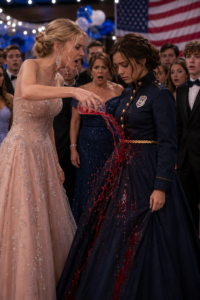
I still don’t know whether she meant to gesture dramatically or whether cruelty is just clumsy by nature. All I know is that her wrist flicked, the cup tipped, and bright pink punch splashed in an arc across the front of Wren’s dress.
There was a sharp collective inhale.
The stain bloomed instantly over the midnight blue skirt.
Sadie shouted, “Oh my God!”
I was there a second later, but Wren had already looked down, not at the ruined fabric, not at Madison, not at the room full of eyes suddenly fixed on her. She looked only at the badge pin.
With trembling fingers, she lifted the edge of the bodice and dabbed at the metal, checking for sticky residue, as if everything else in the world had fallen away except the small silver proof that her father had belonged to her first.
“I’m so sorry,” Madison said, but even then it sounded thin, automatic, shaped by audience before remorse.
Wren didn’t look at her.
I touched my daughter’s arm. “Come on. Let’s get you to the restroom.”
But before she could move, a voice from behind the crowd cut through the room.
“No,” the woman said. “Not until my daughter hears something she should have learned years ago.”
Before she left the restroom, Wren looked at herself in the mirror for a long second. Not checking makeup. Not fixing hair. Just making sure the girl staring back was still hers. Then she squared her shoulders, smoothed the skirt once, and said, “Okay.” It was such a small word, but it sounded like a decision, not surrender. Sadie squeezed her hand. I opened the door.
The crowd parted enough for me to see who had spoken.
A woman in a dark green cocktail dress stood near the refreshment table, her face pale and drawn tight. I recognized her at once. Elise Pike, Madison’s mother.
“Mom?” Madison said, laughing nervously. “It was an accident.”
Elise didn’t even look at her. Her eyes were fixed on Wren. “Before you leave,” she said quietly, “you deserve to hear something.”
Wren’s fingers stayed over the badge pin. “You don’t have to.”
“Yes,” Elise replied. “I do.”
The room had gone still in that eerie, complete way that only happens when a crowd senses the truth is about to rearrange everything.
Elise turned toward her daughter. “Six years ago, there was a crash on Route 17. I was driving you home in a thunderstorm. We hit the guardrail, and your door jammed.”
Madison frowned. “What does that have to do with—”
“Officer Daniel Mercer was the first one there,” Elise said.
Wren went motionless.
Elise’s voice shook now, but she kept going. “You were eleven. You were bleeding and screaming because you thought the car was on fire. I was pinned under the steering wheel. Daniel Mercer broke your window, got you out, wrapped you in his coat, and stayed talking to you until paramedics arrived. Then he came back for me.”
No one moved.
I remembered that night then—Daniel coming home soaked and saying only, “Bad wreck on 17. Kid made it.” He had never told us who the child was.
Elise looked at the badge pinned over Wren’s heart. “Your father did what good men do when nobody’s watching. And tonight my daughter mocked his memory.”
Madison’s face turned white. “Why didn’t you ever tell me?”
Elise gave a broken laugh. “Because I thought gratitude would teach itself. Because I assumed I had raised you better than this.”
The words hit like stones.
Madison looked at Wren, then at the stain, then down at her own hands. For the first time all evening, there was no audience in her expression. Only shame.
“I didn’t know,” she whispered.
Sadie snapped from beside Wren, “You didn’t need a tragic backstory to know not to be cruel.”
Several students nearby murmured agreement.
Elise stepped closer to Wren. “I am so sorry. Not just for tonight. For never telling you that your father saved my child.”
Wren’s eyes filled, but her voice stayed level. “He would’ve done it for anyone.”
“I know,” Elise said. “That’s what makes him who he was.”
Wren looked directly at Madison. “You don’t get to make somebody’s loss into a joke.”
Madison flinched. “I know.”
I touched Wren’s arm. “Come on. Let’s clean up.”
In the ladies’ room, the three of us—Wren, Sadie, and I—huddled under bright fluorescent lights with paper towels, cold water, and club soda. Sadie muttered creative insults about Madison while I blotted the skirt panel as gently as I could.
The punch had left a spreading rose stain across the midnight-blue fabric, but the wool beneath it was darker than satin would have been. Damaged, yes. Ruined, no.
“See?” I said softly after a few minutes. “It’s still beautiful.”
Wren stared down at it. “That’s generous.”
“It’s true.”
Sadie leaned in. “Honestly? It looks kind of dramatic in a cool way.”
Wren gave a watery laugh.
I kept dabbing. “You can leave if you want. No one would blame you.”
She leaned back against the counter and shut her eyes. “If I leave now, it’s because Madison decided what kind of night this gets to be.”
Sadie crossed her arms. “She does not deserve that level of influence.”
Wren opened her eyes and touched the badge pin. “Dad would tell me not to let an idiot reroute the whole map.”
I smiled. “That sounds exactly like him.”
She took a breath. “Okay. I’m staying.”
When we came back into the ballroom, people looked—but differently. Not with gossip this time. With respect.
Madison was gone. So were her two friends. Elise remained near the wall, eyes red, shoulders straight. When Wren glanced her way, Elise placed a hand over her heart. Wren answered with the smallest nod.
Then the DJ lowered the volume and said, “Alright, let’s reset. Slow dance.”
The opening chords of a soft acoustic song drifted through the room. Students groaned automatically, but they moved toward the dance floor anyway.
Mason appeared at Wren’s side in a panic of politeness. “Would you maybe want to dance?”
Sadie muttered, “He is trying so hard to be a gentleman it’s painful.”
For the first time since the punch hit the dress, Wren smiled without effort. “I’d love to.”
He led her onto the dance floor with such nervous care that it nearly undid me.
The stain was still there. But under the silver-blue lights it no longer looked like disaster. It looked like evidence that the night had tested her and failed to reduce her.
Students made room without staring. Wren rested one hand on Mason’s shoulder and one lightly over the badge, and as the music moved around them, the whole room seemed to settle.
I stood near the back wall and thought of Daniel. The way he had loved quietly, without announcing himself. The way he used to tap two fingers against Wren’s forehead before school and say, “Brave girl. More strength than you know.”
Looking at her now, I realized he had never been wrong.
A few students started clapping when the song ended, not loudly, not to make a scene, just enough for Wren to know they understood something. She looked startled, then almost embarrassed, but she smiled anyway. In that brief, shining moment, she was no longer the girl people pitied or the girl someone had tried to humiliate. She was simply the center of her own story again. And that mattered more than anything.
The rest of the evening passed in ordinary prom chaos, which felt like mercy. Sadie danced with three different people and insulted the DJ between songs. Someone lost a shoe. The dessert table was stripped bare. Life resumed its ridiculous rhythm.
Near the end of the night, Wren came over to where I was standing.
“You were right,” she said.
“About what?”
“Not leaving because she made the room smaller.” She glanced toward the dance floor. “It got bigger again.”
I brushed a loose curl from her cheek. “You did that.”
She shook her head and touched the badge. “He did some of it.”
Then she smiled at me. “And you did too.”
When the final song ended, students spilled out into the parking lot flushed, tired, and louder than they had been at the start. Wren carried her heels in one hand and gathered her skirt with the other as we walked to the car.
On the drive home, she said, “I thought if anything went wrong, it would prove I was stupid for caring.”
“And now?” I asked.
She looked down at the badge pin catching faint light from the dashboard. “Now I think caring is the whole point.”
At home, she laid the dress across my bed and studied the stain.
“I can probably get most of it out,” she said.
“You don’t have to.”
“I know.” She ran her fingertips lightly over the mark. “But I think I want to leave a little.”
I understood immediately. Not because pain deserves preserving, but because survival does.
We hung the dress in a clean garment bag and zipped it shut.
At the bedroom door, Wren paused. “Mom?”
“Yeah?”
“Do you think Dad would’ve been proud?”
I thought about the girl who had turned grief into something graceful, who had been humiliated in public and still chosen dignity over spectacle, who had carried her father’s memory not like a weight but like a compass.
I smiled. “I think he would’ve been impossible about it.”
She laughed. “Yeah. Me too.”
Then she touched two fingers to her forehead, copying the old ritual exactly. “Brave girl,” she said, almost to herself.
After she went to bed, I sat alone in the kitchen for a long time. On the table beside my tea sat the empty badge box, velvet indented where the pin had rested for years before Wren stitched it over her heart.
That was when it hit me that the dress had never been only a dress.
It was love made visible.
It was grief reshaped by her own hands.
It was proof that strength is not the absence of hurt, but the decision to walk forward with it and still remain yourself.
Prom had not gone the way we expected. It had become messier, more painful, and far more meaningful than any perfect night could have been. But when I pictured Wren under those silver lights—stained skirt, steady eyes, badge over her heart, choosing to stay—I knew something with absolute certainty.
Daniel would have seen her and understood at once.
His brave girl.
And he would have been right all along.
THE END

Leave a Reply