One chair near the front remained empty.
My chair.
I watched my mother notice it.
She leaned toward my father and whispered something. He glanced at the chair, then at me, then looked away as if the emptiness had nothing to do with us.
Owen stood among the men being honored, his jaw tight. I could see the pride in him. I could also see the fear beneath it, the same fear I had heard in his voice months earlier when he called from a pay phone after a brutal training day.
“Nor,” he had whispered then, “what if I’m not who they think I am?”
“You don’t have to be who they think,” I had told him. “You only have to keep becoming who the job requires.”
He had stayed silent for a long time.
Then said, “Don’t tell Mom I called.”
I never did.
Now, from my half-hidden chair, I clapped when his name appeared in the program. Not loudly enough to draw attention. Not softly enough to deny him. Just honestly.
Then the ceremony stopped.
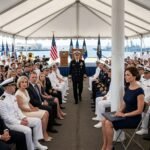
Commander Elias Grant, the senior officer at the podium, lowered his folder and turned to the protocol officer beside him. Their exchange was brief, quiet, and immediately noticeable.
The crowd sensed the pause before it understood it.
Commander Grant stepped back to the microphone.
“Ladies and gentlemen,” he said, voice steady across the tent, “before we proceed, we are missing a special recognition guest whose presence is required by protocol.”
My mother straightened.
My father frowned.
Owen’s eyes moved toward the empty chair near the stage.
The commander looked across the family section.
“Lieutenant Commander Nora Vale?”
The tent went silent.
Not quiet.
Silent.
The kind of silence that reveals every person who has been laughing.
I did not move at first.
For one breath, I was eight years old again, standing in a kitchen with a report card no one read because Owen had scored the winning goal that afternoon. I was sixteen, watching my father introduce me as “our independent one” when he meant disappointing. I was twenty-three, standing outside a base hospital with stitches under my sleeve, deleting a message from my mother that said, Your brother got promoted. Try calling home for once.
Then Commander Grant stepped down from the stage.
He walked through the aisle himself.
People turned. Programs lowered. Phones lifted.
My mother’s face emptied.
My father whispered, “Nora?”
Commander Grant stopped in front of my chair, brought his heels together, and saluted.
“Ma’am.”
The word moved through the tent like a wave hitting stone.
I stood.
Returned the salute.
“Commander.”
Behind him, Senior Chief Alvarez opened a dark-blue folder and showed it to the guard who had almost let my mother define me at the gate.
There it was, printed cleanly under the official protocol addendum:
Lieutenant Commander Nora Vale. Special Recognition Guest. Joint Naval Special Warfare Support. Protocol hold until seated.
The guard went pale.
Commander Grant turned slightly toward my parents.
“It appears Lieutenant Commander Vale was seated incorrectly.”
No one spoke.
He looked back at me.
“Your assigned chair is near the stage, ma’am. If you would prefer, we can also adjust the front family row.”
I understood what he was offering.
He had heard enough. Seen enough. Perhaps not the whole story, but enough.
My mother looked suddenly smaller in her pale suit.




Leave a Reply