When I Found My Fiancée’s Car in Our Parking Lot During the Workday, I Never Imagined My Dog Would Sit Beside Me While I Took the Photos That Ended a $70,000 Wedding.
Paul Harrington didn’t think of himself as a dramatic guy. I was thirty-one, a systems analyst at a financial firm downtown, the kind of job where you spend your best hours staring at dashboards and pretending you’re excited about quarterly “efficiency wins.” It paid well—six figures, solid benefits, boring stability. I liked stability. I liked plans. I liked knowing what came next.
Amanda didn’t.
Amanda was twenty-eight, pharmaceutical sales, always moving, always chasing the next shiny thing. She could sell ice to a snowman. She could also spend money like it was an insult to let it sit still. We met four years earlier at a charity bar event a friend dragged me to. She laughed at my dumb jokes, put her hand on my arm like we’d known each other forever, and by the end of the night I was giving her my number and feeling lucky.
Four years later, we were engaged.
Eight months into the engagement, Amanda had a Pinterest board that looked like a wedding magazine exploded. She wanted a Napa Valley destination wedding with at least one hundred and fifty people. The budget started at thirty grand, then climbed to fifty, then started breathing down seventy like it was inevitable. She called it “our dream.” My sister Alex called it “a financial hostage situation.”
Alex is three years older than me and has the kind of corporate-lawyer stare that can make grown men reconsider their career choices. Our parents died when I was nineteen. Alex basically raised me through college, so when she said, “Amanda has expensive taste and cheap character,” I tried to listen. I just didn’t want to believe her.
My brother Kyle, twenty-seven, had just finished his ER residency. Even he said once, carefully, “She asks you to pay for a lot of things, man.” I brushed it off. Amanda made me feel like questioning her spending meant I was stingy, unromantic, boring. She had a talent for turning any concern into a character flaw of mine.
I had a German Shepherd named Muffin. Best decision I ever made. Amanda tolerated him the way some people tolerate a coworker they can’t fire. She never walked him, never fed him, complained about dog hair, and insisted he slept in my home office because she “couldn’t relax” with him in the bedroom. I did everything for Muffin. He was my constant.
Looking back, the setup was obvious.
I had savings, a maxed 401(k), an emergency fund that could float me for eight months, a few investments doing well. Amanda had maybe two thousand dollars in savings and credit card debt she never talked about. I’d seen statements lying around—at least fifteen grand spread across three cards. Every time I brought up budgets, she’d kiss my cheek and say, “You can’t take it with you, babe.”
Then Brett showed up.
Three months before everything blew up, Amanda started talking about a guy at work. New regional sales director. Thirty years old. “Already making director money,” she said like she was describing a celebrity. Brett said this about the market. Brett’s strategy is brilliant. Brett just got back from Scottsdale. Brett, Brett, Brett. I joked I should buy stock in his name. Amanda laughed too hard.
At first, I told myself it was normal. Sales is networking. People talk about bosses. Then her schedule changed.
She used to be home by six or seven. Suddenly it was nine, ten, eleven. Multiple nights a week. “Team drinks.” “Strategy dinner ran long.” “Client event.” Her phone became a separate universe. She angled it away when I walked by. If I asked who she was texting, she’d say, “Work,” with the kind of tone that dared me to argue.
She also started making little comments that landed like paper cuts.
I’d suggest a quiet Friday night and she’d sigh and say she wished I was more spontaneous. I’d mention maxing my 401(k) and she’d roll her eyes. “You’re acting like an old married couple already.” If I suggested cooking at home, she’d act offended. “We work hard. Don’t we deserve nice things?”
When you’re inside a relationship, you can rationalize almost anything. I told myself she was stressed. Ambitious. Busy. I told myself love meant trusting.
Two months before the end, I started planning a surprise trip. Amanda had mentioned a luxury mountain resort—five-star everything, spa, fireplaces, the whole fantasy. I found the perfect place about three hours north. Three nights. The total was $2,200. It felt like a big splurge, but I pictured her face when I surprised her, and I told myself it was worth it.
I booked it quietly. I even printed the confirmation and tucked it into a folder in my desk drawer. I was going to give it to her with a little handwritten note. I was going to be the spontaneous fiancé she kept hinting she wanted.
I even went a little overboard with the surprise trip. I asked the resort’s concierge if they could arrange a welcome basket and a fireplace-ready room. I checked the weather up there, picked a weekend that looked like fresh snow and clear skies, and lined up a dog sitter for Muffin even though Amanda insisted she “might have a friend” who could do it cheaper. I wanted it handled. I wanted the weekend to feel like I had listened—like I could still speak her love language without going broke doing it. I told myself the money was an investment in us, the same way she called a $600 purse an “investment piece.”
Then it was Wednesday.
I was working from home, back-to-back meetings, brain fried. Muffin needed a walk, so around four I clipped on his leash and went out for air. Amanda had texted that she had client meetings all day and wouldn’t be home until seven or eight.
Half a block from our building, I saw Amanda’s car in the lot.
My first thought was simple: Weird.
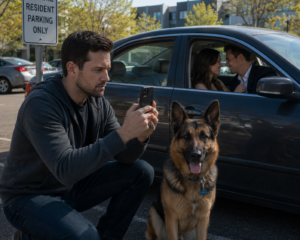
She never came home during the day. I slowed down without meaning to. Muffin sat, tongue out, happy to pause. Through the windshield, I saw a guy in the passenger seat. They were sitting close, angled toward each other. Then Amanda laughed and touched his arm—easy, familiar, intimate.
My stomach dropped like it had missed a step.
I pulled out my phone and took pictures. Three, four shots. Her car. The plate. Her profile. His face. Clear enough that no one could call it “just paranoia.” I didn’t walk up. I didn’t confront. I turned around and walked Muffin the other direction like my body knew I needed time to keep my brain from shattering.
We walked for twenty minutes. Snow from last week’s storm crunched under our shoes. Cars hissed on wet pavement. Muffin sniffed everything like the world was normal. My mind tried to logic it away. Maybe it was a coworker. Maybe he needed a ride. Maybe—
No.
By the time we got back, her car was gone. The apartment looked normal. My hands shook when I poured Muffin’s food. I sat at my desk, staring at my laptop like answers might appear on the screen.
Amanda came home at seven, dropped her bag, kicked off her heels, and said she had a long day. She leaned in to kiss me. I let her. The kiss tasted like lipstick and lies.
“How’d the client meetings go?” I asked, keeping my voice flat.
She spun a story about a picky buyer and didn’t blink. She complained about her day. We ate takeout on the couch. I said maybe ten words. That night, I barely slept. Muffin lay on the floor by my side of the bed, like he was guarding me from something.
The next day, I checked the phone records.
We were on a shared plan under my name. I pulled the detailed usage for the last three months. One number kept popping up. Constant. Twenty, thirty messages back and forth some days—during work, late at night, early morning. I didn’t recognize it.
I ran it through a reverse lookup site. Nothing useful.
I sat on it for two days, watching Amanda like I was seeing her for the first time. The way she stepped into another room for calls. The way she dressed differently on “important meeting” days. The way she smiled at her phone and then cleared her throat when she noticed me.
Friday afternoon, I told her I had to help my buddy move furniture.
She barely looked up. “No problem. I’m meeting Celeste for drinks.”
I didn’t go help anybody. I drove downtown and parked in a garage near her favorite happy hour spot where I could see the entrance. My heart hammered the whole time, like my body knew I was about to confirm something I couldn’t un-know.
Twenty minutes later, Amanda arrived. She stood outside on her phone, wearing a dress I’d never seen and heels too high for a casual meet-up. Five minutes after that, Brett walked up.
I knew it was him the second I saw the shape of his confidence. He didn’t hesitate. They hugged, lingering, her arms sliding around him like she belonged there. Then they went inside together.
I sat in the car gripping the steering wheel so hard my fingers hurt. After ten minutes, I drove home in silence, Muffin’s pictures in my mind like a witness statement.
Amanda got home around ten, tipsy, in a great mood. She told me this whole story about Celeste, how they met some guy, how they all hung out. I nodded like an idiot, because at that point I was no longer part of the relationship; I was collecting evidence.
Saturday morning, I took Muffin to Alex’s apartment.
Alex lived downtown in a nice corner unit with windows overlooking the river. She opened the door in workout clothes, coffee in hand, took one look at my face, and said, “Tell me.”
I told her everything: the car, the phone records, the bar. Alex listened without interrupting. When I finished, she went quiet for a minute, then asked, “What do you want?”
“I want out clean,” I said. “No drama.”
Alex smiled like she’d been waiting for that sentence. “Okay.”
We spent most of Saturday mapping it out. Alex is good at lawyer brain stuff. She asked if I was sure—no doubts, no “maybe we can fix it.” I told her I was done. You don’t come back from months of lying to someone’s face.
We made a plan. Quietly pack essentials. Store them at her place. Find an apartment. Sign a lease. Move everything in one shot while Amanda was at work. Clean break.
Alex also said, “Document the cheating properly. Get proof. Something undeniable.”
It felt gross, like stalking my own fiancée. But Alex was right. Without proof, Amanda could twist the story. Mutual friends would wonder if I overreacted. People love a “both sides” narrative even when one side is trash.
Sunday, Amanda was at brunch with friends. I photographed everything I’d bought: furniture, electronics, kitchen stuff. I dug up receipts. I downloaded bank statements showing rent, utilities, purchases. Three hours later I had a folder on my laptop organized by date and category. It looked like I was preparing for war. In a way, I was.
Monday, Alex texted me addresses for two apartments. Both one-bedroom. Both dog friendly. Both immediate move-in. I told my manager I had a dentist appointment and took a long lunch to tour them. The first place was tiny and dark. The second was on the fourth floor of a newer building fifteen minutes from my office, with a balcony overlooking a small park. I pictured Muffin in that park and signed the lease that afternoon.
Tuesday through Thursday, I packed one box at a time—things Amanda wouldn’t notice missing right away. Clothes from the back of the closet. Personal paperwork. Books. Toiletries. Each night after she went to bed, I carried a box to my car and dropped it at Alex’s. She stacked it all in her second bedroom without comment.
Wednesday, I rented a cargo van for Friday pickup. I asked Kyle and two buddies from work, Steve and Martin, if they could help me move. Kyle hesitated, then agreed, still hoping I’d reconsider. I didn’t.
Thursday night, I needed one last piece: clear proof.
Amanda claimed Thursday nights were “weekly sales strategy meetings.” I called in sick Friday morning. Amanda left for work at her usual time, hair perfect, perfume expensive, eyes bright like she had plans.
At 8:30, Alex, Kyle, Steve, and Martin showed up. We moved like a crew. My furniture. My clothes. My computer setup. Muffin’s bed, bowls, toys. Everything that was mine, gone. I left behind anything that was hers or anything we’d bought together. Not one dish. Not one throw pillow. I wanted zero excuses for her to say I “stole” something.
By noon, the apartment looked like a life interrupted. Empty spaces where my couch had been. Bare walls where pictures had hung. I stood in the doorway for a second, feeling the weird grief of leaving a place that had held my routines.
Alex slapped my shoulder. “You good?”
“Yeah,” I lied.
I left a note on the kitchen counter with the keys on top. I wrote that I knew about Brett. That I wasn’t interested in explanations or apologies. That I moved out today. Everything that was mine was gone. Muffin was with me. I paid my half of the rent through the end of the lease—three more months. After that, she was on her own.
I wrote that the engagement was off.
I wrote that I wanted the ring back—the $8,000 ring she basically picked out herself. She could mail it to Alex’s office or we could do lawyers. Her call. I added that I had documented everything, including her and Brett. Photos and video. I told her not to contact me—no calls, no texts, no showing up at my work.
Then I walked out and locked the door.
That afternoon, in my new place, I opened the desk box where I’d kept the printed trip confirmation. For a second I just stared at it—three nights, mountain views, my careful handwriting on a note I’d never give her. Then I called the resort and canceled. The woman on the phone was polite, sympathetic, and completely indifferent to my life falling apart. “I’m sorry,” she said, “the deposit is nonrefundable.” Seven hundred dollars gone in one sentence. I hung up and laughed once, sharp and empty, because it felt like paying tuition for a class I never wanted to take: how to stop financing someone else’s disrespect. I shredded the paper, walked it to the trash, and watched the strips settle like confetti from a party that never happened.
The first twenty-four hours were quiet.
Saturday was set-up day. Target run for basics. New sheets. Dog food. I took Muffin to the park by my new building and watched him sprint like he’d been released from a cage. Kyle came over with takeout and beer, and we watched a game without talking about Amanda.
Sunday morning my phone started buzzing. Six missed calls. Texts stacking like panic. I didn’t listen to voicemails. I read the first text—Where are you?—and the last—We need to talk like adults. I blocked her number. Blocked her on social media. Blocked her email.
Sunday afternoon, an unknown number called. A guy’s voice, aggressive. Brett.
He asked if I was the jerk who abandoned his fiancée. I asked who it was, just to hear him say it. He did. I laughed and said it was rich coming from the guy sleeping with someone else’s fiancée. Silence. Then I said, “Yeah, Brett. I have video of you kissing her. So maybe don’t call me a coward when you’re the one sneaking around.”
More silence. Then he muttered, “Amanda deserved better.”
“Congrats,” I said. “She’s all yours.” I hung up and blocked that number too.
Monday an email hit my work address with the subject PLEASE READ. I deleted it without opening. Monday afternoon my desk phone rang. Reception said a woman was here asking for me. Urgent.
Amanda.
I told reception I was in a meeting and not available. She insisted. I told them to call security. I didn’t want to see her. Ten minutes later reception told me security was walking her out.
I called HR right after. Broken engagement, ex showing up, potential harassment. They documented it and flagged her name with building security.
Tuesday Alex called: Amanda had contacted her asking for my new address and begging her to convince me to talk. Alex said no. Amanda lost it and screamed that she always hated her. Alex hung up and warned her not to call again.
A week passed. Quiet.
Then a package arrived at Alex’s office. A small box with Amanda’s return address. The ring was inside, loose in tissue paper, not even in the original box. The band had a scratch, like a petty final jab. I took it to a jeweler and sold it. The check was $7,400. I deposited it and felt nothing but relief.
I thought that was the end.
Karma had other plans.
A month later, Steve told me his girlfriend’s friend knew Amanda and said she had serious car problems. I shrugged. Not my circus. Not my monkeys.
A few days after that, an insurance company called me about a claim on Amanda’s car. They said their records showed I was listed as a co-signer on the original loan. I told them she refinanced into her name a year ago and I wasn’t involved. The agent hesitated, asked if I lived at our old address, and said there had been an accident. I felt a cold prick of concern, then reminded myself: not my problem.
I called Alex anyway. Alex told me to forward everything to her.
Two days later, Alex called back laughing so hard she had to breathe between sentences.
“Amanda’s car got totaled,” she said. “Brett was driving. He ran a red light and t-boned another car.”
My jaw dropped. “Is everyone okay?”
“The other driver is fine,” Alex said. “But both cars are totaled. And here’s the fun part—Brett’s license was suspended three months ago for unpaid tickets. He ran from the scene before cops arrived.”
I sat down hard on my couch. “So insurance—”
“Denied,” Alex said. “Because the driver wasn’t legally allowed to operate the car. Amanda’s insurer denied the entire claim. The other driver is suing Amanda personally for damages. Twenty to forty grand depending on what they can prove.”
“Where’s Brett?” I asked.
“Gone,” Alex said. “Quit his job and moved back to his home state. Amanda trusted a guy with a suspended license and now she’s paying for it.”
It felt almost too perfect, like the universe was writing fan fiction. I didn’t celebrate. I just felt the strange calm of knowing I’d stepped off a collapsing bridge before it took me with it.
A week later, Lisa from my office pulled me aside in the break room. Lisa was mid-forties and somehow knew everyone’s business. She asked if she could ask something personal.
“Your ex Amanda,” she said. “My daughter worked at her pharma company. Amanda got fired two days ago.”
I stared. “Fired?”
Lisa nodded. “She missed work, showed up late, had a meltdown in a meeting, got put on probation, then stopped showing up. After that guy she was seeing quit, she fell apart.”
My skin prickled. “She’s been asking about me?”
Lisa’s face tightened. “Yeah. Just… be careful.”
I called Alex immediately. Alex said, “File for a restraining order today.”
I hesitated. “Is that necessary?”
“Paul,” Alex said, voice sharp. “She lost everything. She’s desperate. Desperate people do stupid things.”
That afternoon, I compiled everything: screenshots, HR documentation, the workplace incident, texts from Celeste, the ring return, the unknown-number calls. Alex filed the restraining order request. The hearing was set for ten days out.
Four days before the hearing, Amanda found my address.
I was coming home from work around six with Muffin. I walked into my building lobby and heard my name like a curse.
“Paul.”
Amanda was sitting on a bench near the mailboxes. She stood and looked… wrecked. Hair unwashed. Eyes swollen. Makeup smeared like she’d slept in it.
“Amanda, don’t,” I said automatically.
She snapped, voice rising. “You ghost me, steal my dog, ruin my life, and you’re saying don’t?”
The security guard stood up. I kept my voice calm. “You ruined your own life. You need to leave.”
“We were supposed to get married!” she yelled.
“You were cheating on me for months,” I said, louder now. “Get out.”
She shifted tactics fast, tears forming. “I made one mistake. People make mistakes.”
“Months of lying isn’t one mistake,” I said.
The guard stepped between us. “Ma’am, you need to leave.”
Amanda ignored him. “I want Muffin back.”
“He’s my dog,” I said. “Always was. You never cared about him.”
The guard escorted her out while she screamed that I’d regret this, that she gave me the best years of her life. I went upstairs, locked my door, sat on the couch, and Muffin put his head on my lap like he was anchoring me.
That night at 2:00 a.m., the emails started.
When I woke at six, I had thirty-eight unread emails from different addresses she had created. The first were apologetic. Then angry. Then paranoid. The last were threatening in a way that made my stomach twist. I forwarded everything to Alex.
The blocking helped, but it didn’t end the story. Two weeks after I moved out, a text came from an unknown number: Celeste, one of Amanda’s friends. She wrote that Amanda was “devastated” and “just needed closure.” I replied once: She lied for months. Don’t contact me again. Then I blocked Celeste too, because I was done debating reality with people who benefited from my confusion.
Alex warned me that the next move was predictable: Amanda would try to create a scene where witnesses could be recruited. She was right.
The morning after the email barrage, my HR director called me before I’d finished coffee. “Paul, we need you to come in,” she said. “There’s been an incident.” Building security met me in the lobby and led me into a small conference room with a printed report on the table.
Amanda had shown up at six a.m., before the main doors were staffed, and tried to get in through the loading dock. When the doors didn’t open, she pounded on the glass and screamed my name into an empty hallway. Once security arrived, she insisted she “worked there” and that I was inside “hiding.” When they told her to leave, she started yelling that I had assaulted her, that I had stolen money from her, that she was there to “retrieve her property.” It was pure performance, all aimed at pressure and sympathy.
The HR director slid a still image across the table. Amanda’s face was twisted with rage, hands pressed to the glass, mouth open mid-scream. Another shot showed her pointing at a guard like she owned the building. The security chief tapped the report. “We called the police,” he said. “They escorted her off the property. She is officially trespassed. If she returns, she will be arrested.”
My stomach turned—not because I missed her, but because I could see the escalation pattern Alex had predicted. I thanked HR and walked back to my car with my hands shaking.
Alex filed the emergency motion that afternoon, attaching the emails and the police report. When the temporary order came through, I felt relief and grief at the same time: relief that the law finally drew a line, grief that the person I once planned a life with had turned into someone I needed a court to keep away.
After that meeting, I went home and added the security stills to my evidence folder. It felt absurd to have a “folder” for a relationship, but I’d learned that feelings don’t protect you in court—timestamps do. Muffin paced while I printed copies, then settled beside my chair like he understood we were building a wall. I slept with my phone on loud for the first time in years, waiting for the next escalation all night.
By evening, the court approved a temporary restraining order. It was served to Amanda at her parents’ house. Apparently she’d moved back home after losing the apartment and getting fired. I hoped the legal paper would snap her back to reality.
Two days later my old landlord called. Amanda had been harassing him, claiming I vandalized the apartment and demanding he give her my security deposit. He told me he’d already mailed my deposit refund weeks ago. He forwarded me her messages—unhinged accusations, alternate-reality claims. I sent them to Alex.
The full hearing was Thursday.
Small courthouse downtown. Civil courtroom. Alex presented the timeline like a surgeon. Amanda showed up with a public defender and looked even worse than she had in my lobby.
When it was her turn, she cried and said I ruined her life. The judge asked if she had engaged in a romantic relationship with another man while engaged to me.
“We weren’t married,” she sniffed. “It wasn’t cheating.”
The judge didn’t blink. “Were you engaged and cohabiting?”
“Yes.”
“Did you have an expectation of exclusivity?”
Amanda didn’t answer.
The judge asked if she had shown up at my workplace and residence after being told not to. Amanda said she “just wanted to talk.” The judge signed the order.
Restraining order granted for one year. No contact whatsoever. Any violation means arrest.
Amanda nodded, crying. I felt my shoulders drop for the first time in months.
Afterward, Alex and I drank coffee across from the courthouse. She clinked her cup against mine like it was a toast. “You handled this right,” she said. “You didn’t cave. You didn’t let her rewrite reality.”
I looked down at my hands. “I just wanted peace.”
“Peace is earned,” Alex said.
Nine months later, life looked nothing like it had.
Work promoted me after the high-profile project. I led my own team. Better hours. More money. Less dread. Muffin loved the new park and had a whole crew at the dog run. I started running again, something Amanda called boring. Funny how boring felt like breathing now.
And Isabelle happened.
She was a regular at the dog park—warm smile, steady energy, the kind of person who didn’t make drama a hobby. We started talking over slobbery tennis balls and ended up grabbing coffee. She loved Muffin instantly. She paid her share without making it a statement. She had her own place and her own savings and a calm way of making my chest unclench.
We took it slow. Three months in, it was official. It felt… easy. I hadn’t realized love could feel easy.
I heard through the grapevine Amanda had moved to Nevada. Still dealing with the lawsuit. Still broke. I didn’t care. She wasn’t my problem anymore.
Until I saw her at Target.
It was a random afternoon. Isabelle and I were grabbing dog food and household stuff. Muffin was with us, tail wagging, leash loose. We turned down the home goods aisle and there she was at the end, shopping cart, staring at picture frames like she was trying to buy a new life one rectangle at a time.
Amanda glanced up and froze.
Isabelle felt my body go still and asked quietly, “You okay?”
“Yeah,” I said. And for the first time, it was true.
Amanda walked toward us, chin lifted like she’d practiced confidence in the mirror. She looked thinner, tired, but still had that reflex to perform.
“Hey,” she said.
Silence hung between us for a few seconds. Muffin sat by my leg, calm, as if he remembered exactly who had never wanted him.
“He looks good,” Amanda said, nodding at Muffin.
“He is good,” I replied.
Amanda’s eyes flicked to Isabelle, scanning her with judgment. “So,” she said, trying to smile, “I heard you’re doing well. Promotion. New job.”
“Small world,” I said.
She swallowed, shifting her weight. “Look, I know things ended badly, but I was going through a lot. The thing with Brett, losing my job, the car—”
“Amanda,” I said, voice calm, “it’s over. Move on.”
Her face flushed. “You don’t have to be cruel.”
“I’m not,” I said. “You made choices. Now you’re living with them. That’s not cruelty. That’s reality.”
She didn’t like reality. Her eyes darted to Isabelle again. “Moved on with her,” she said, voice sharp. “Wow. You really downgraded.”
Isabelle laughed, bright and unimpressed. “Girl,” she said, “look in the mirror.”
I almost laughed. I didn’t, because I was done feeding drama.
“All right,” I said, tightening my grip on the leash. “We’re leaving.”
Amanda’s mouth fell open. “What did she just say?”
Isabelle slid her hand into mine like it was the simplest thing in the world. “Ready?” she asked.
“Yeah,” I said.
I looked at Amanda one last time. No anger. No triumph. Just distance. “Good luck,” I said, and I meant it the way you mean it to someone you no longer owe anything. “I hope you figure your stuff out.”
We walked away. Amanda yelled something about love and regret. Her words bounced off the fluorescent lights and died in the aisle behind us.
At the checkout line, Isabelle grinned. “That was fun.”
“You enjoyed that a little too much,” I said.
“Maybe,” she admitted, laughing.
Muffin leaned against my leg, warm and steady. I scratched behind his ears and felt the quiet truth settle in my chest: the trip, the ring, the wedding spreadsheets, the money—none of it mattered compared to peace.
The best surprise I ever gave myself wasn’t a $2,200 resort weekend.
It was leaving.
THE END

Leave a Reply