I folded the place card slowly between my fingers. My mother watched me. “You should just sit where they put you,” she said softly. “It’s Clare’s day.” Clare’s day. That was why I had not turned around immediately. That was why I had driven three hours through October leaves and old memories. That was why the envelope in my purse held a $10,000 check. For my sister. For her new life. For the girl I had loved even when loving her meant watching from far away.
I found the gift table near the entrance to the ballroom. White linen. Crystal bowl for cards. Silver tray. Stacks of embossed envelopes. I reached into the bowl and found mine. Evelyn. Only Evelyn. No last name needed because no one else in that family had dared to use it on me that night. I slipped the envelope back into my purse.
My mother’s eyes widened. “What are you doing?” I looked at the place card in my hand. Then at table one. Then at her. “If I’m just a courtesy,” I said, “so is this.” Her face changed. For the first time that night, she looked genuinely afraid. Not hurt. Afraid. Because money has a way of revealing what people thought they were entitled to.
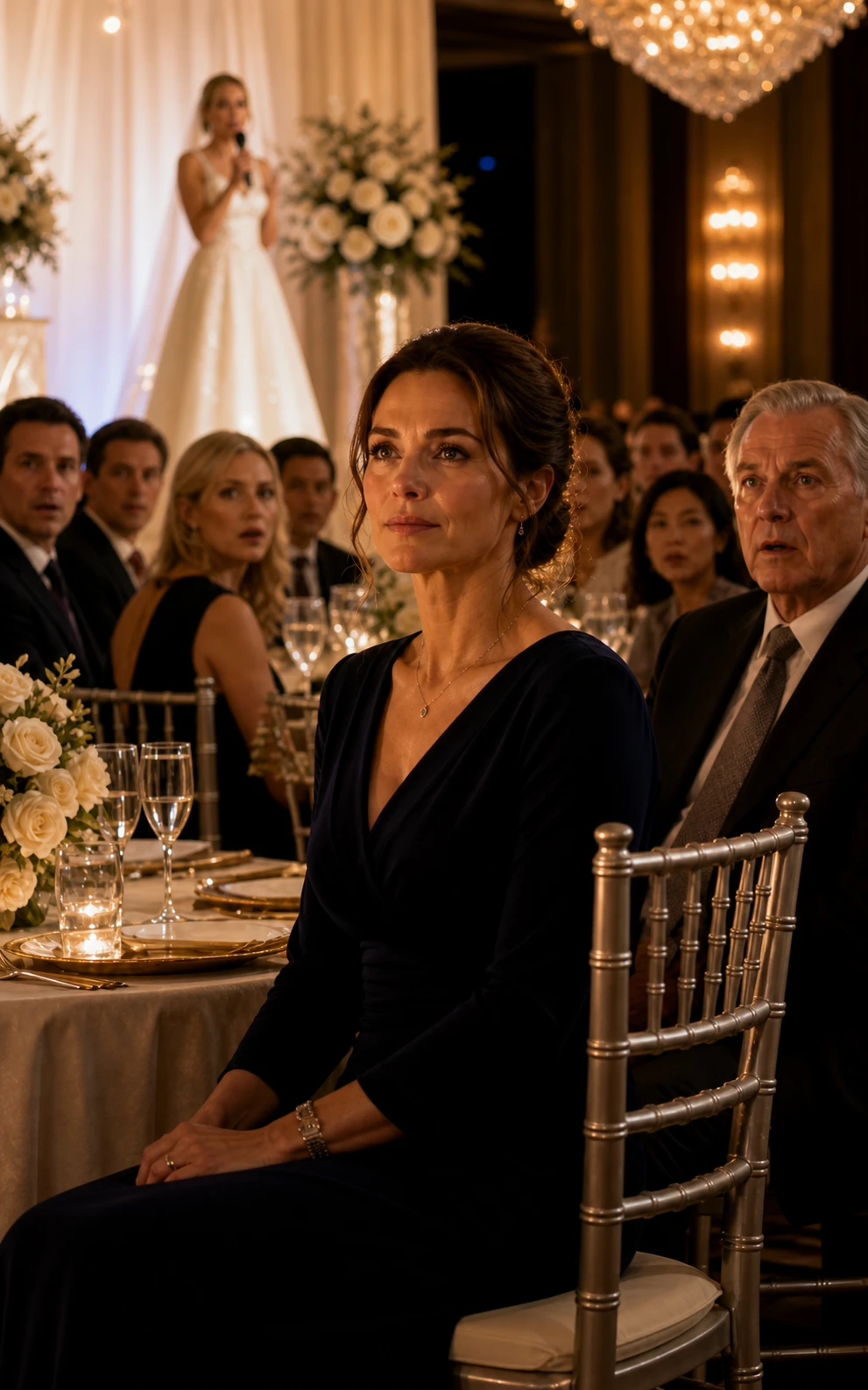
“Evelyn,” she hissed. “Don’t be dramatic.” Dramatic. That word followed me from childhood like a shadow. When I cried after my mother died. Dramatic. When I said Margaret was cruel. Dramatic. When I told my father I did not want the life he had designed for me. Dramatic. When I left. Dramatic. Apparently, if you are quiet enough while being hurt, people call that maturity. But the moment you stop accepting it, they call it drama.
I walked into the ballroom anyway. Table 22. That was where they placed me. Near the kitchen doors. Beside strangers who smiled politely but avoided asking how I knew the bride. The flowers on our table were not real. Not even good fake ones. Across the room, table one glowed beneath white roses and orchids. My father stood there, glass in hand, king of a room built from money, reputation, and carefully managed lies.
Then Clare saw me. She came toward me so fast her cathedral veil trailed behind her like a white wave. “You came,” she whispered. Then she hugged me. Hard. Too hard. Like she had been holding her breath for fifteen years. She smelled like jasmine perfume and hairspray and panic. “I almost didn’t,” I said.
She pulled back, both hands gripping mine. Her eyes were wet. “Dad doesn’t know I invited you.” That explained the place card. That explained table 22. That explained Margaret’s smile. Clare leaned closer. “Please stay. No matter what he says tonight, please stay.” I studied her face. There was something behind her eyes I could not place. Not fear. Not exactly. Resolve. “Clare, what is going on?” She shook her head. “I have something planned.”
Before I could ask another question, someone called her for photos. She squeezed my hands once. “You’re the reason I’m standing here today,” she whispered. “Tonight everyone will know.” Then she was gone. I stood there, unable to move. The reason she was standing here? I did not understand. Not yet.
At cocktail hour, my father found me. He crossed the room with that expensive, effortless authority of a man used to people stepping aside before he asked. He did not hug me. Did not say my name gently. Did not say it had been too long. He looked me up and down and said: “I didn’t realize Clare’s guest list included charity cases.”
There it was. Fifteen years later. Same man. Same blade. Sharper suit. Older face. No softer heart. “Hello, Dad,” I said. “You look well.” His jaw tightened. “You have some nerve showing up here.” “I’m here for Clare.” “You’re here because she’s sentimental.”
Margaret appeared beside him. Of course she did. She always knew when cruelty needed reinforcement. “Oh, Evelyn,” she said, touching her pearls. “How unexpected. I told Gerald someone from the charity list must have gotten mixed up with the invitations.”

Leave a Reply